Tag Archives: wildlife

Verreaux’s Eagle

Aquila verreauxii

The Verreaux’s Eagle (or Black Eagle) is a denizen of rocky hills and mountains, often surrounded by savanna, grasslands or arid scrub, from sea level to 5000m high – the favoured habitat of its most common prey species; the rock hyrax (dassie), which makes up between 60% and 90% of their diet. They will also hunt other mammals (up to the size of springbok and baboons), reptiles (especially tortoises, which they drop from on high so that the carapace shatters) and birds, but they have seldom been seen to eat carrion. Verreaux’s Eagle pairs often hunt together; one bird flushing the prey while the other scoops it up, and then sharing their prey. They do most of their hunting in the early morning and late afternoon, when the hyraxes are sunning themselves on exposed rocks.

With a wingspan of up to 2.3 metres and a weight of between 3 and 7kg, the Verreaux’s Eagle is one of the three biggest eagles to be found in South Africa (the others being the Crowned and Martial Eagles). Females are slightly larger than males.

Verreaux’s Eagles pair for life, and pairs are fiercely defensive of their territories. Their massive stick nests are usually built on cliff ledges (sometimes on equally inaccessible trees or man-made structures). In South Africa they usually start breeding during winter. Two eggs are laid and mostly incubated by the female for 44-48 days, while her mate brings food to her on the nest. The stronger (usually oldest) chick invariably kills, and sometimes eat, its weaker sibling within a few days of hatching. The young eagle starts flying at about three months old and becomes independent of its parents about 7 months after hatching. Immature Black Eagles roam widely before settling down with a mate.

Verreaux’s Eagles are distributed over large areas of East, Central and Southern Africa, wherever suitable mountainous habitat and sufficient populations of dassies are found. With a stable population estimated in the tens of thousands, the IUCN considers the species of least concern. In South Africa, where they occur in all provinces, Verreaux’s Eagles are sometimes hunted due to an undeserved reputation as a threat to small stock, though farmers have of late realised the benefit of these eagles keeping dassie populations under control. In traditional African folklore many people regard them as a messenger from the ancestors.

A pair of Black Eagles have been resident at Johannesburg’s Walter Sisulu Botanical Gardens since the 1970’s, offering probably the most easily accessible viewing of this majestic raptor.

Rock Dassie (Hyrax)

Procavia capensis

As their name suggests, Rock Dassies are closely associated with rocky habitats, be it mountains, hills, cliffs, ditches, canyons, gorges or just plain heaps of boulders – as long as there is rocks with caves and crevices to hide in, a sufficient supply of food, and a place where they can soak up the sun, Rock Dassies can be found from deserts to forests and from sea level to mountain tops, and even in city suburbs. Rock Dassies are entirely independent of drinking water, and feed on a wide variety of plantmaterial; grass, leaves, flowers, fruit, bark, twigs, roots, bulbs, herbs, and even poisonous plants that would kill other animals are all included in their diet.

Adult Rock Dassies are about 20 – 30cm high and weigh anywhere from 2 to 5.5kg, males being a little larger than the females. Notwithstanding their relatively small size, hyraxes are the closest living relative of elephants!

Rock Dassies live in colonies, usually numbering around 30 but up to 100 or more under favourable conditions, consisting of a dominant, territorial male and a harem of females and their young. Females also have a strict hierarchy and will fight viciously to maintain their place in the rank. Dassies are diurnal, and start their day basking on an exposed rock in the early morning sun. They’re rather lazy and spend only about two hours a day feeding, mostly in the morning and afternoon. While feeding they sometimes move a few hundred meters from their rocky abodes. At night and during the heat of the day they rest in caves and crevices among the rocks. Rock Dassies are excellent climbers, both of rocks and trees, are rather quarrelsome and downright aggressive amongst themselves, have very keen senses and have the remarkable ability to look straight into the sun without any apparent ill effect – a handy adaptation to detect their biggest natural enemy; the Verreaux’s Eagle. While the colony is feeding, one individual is always on guard for the eagles and other predators like leopard, caracal, jackal and other raptors. They’re also persecuted as a pest by many farmers, especially those with small stock. Rock Dassies seldom live past the age of 8 years in the wild, though they can get up to 15 years old in captivity.

Females give birth to between 1 and 6 babies at the end of the rainy season, after a gestation of almost 8 months – unusually long for such a small animal. The babies are weaned between 3 and 5 months after birth, and young males are driven from the colony when they’re about a year old.

Rock Dassies occur widely, if discontinuously due to its habitat requirements, over Africa (including parts of the Sahara) and much of the Middle East. Owing to its exceptionally wide distribution and overall large, stable populations, many of which in well protected conservation areas, and despite hunting pressure in some parts of its range, the IUCN lists the Rock Hyrax as being of least concern. in South Africa they can be found in all provinces, wherever their preferred habitat is available.

A related species with a more restricted distribution in South Africa, the Yellow-spotted Rock Hyrax, will be discussed in an upcoming post on de Wets Wild

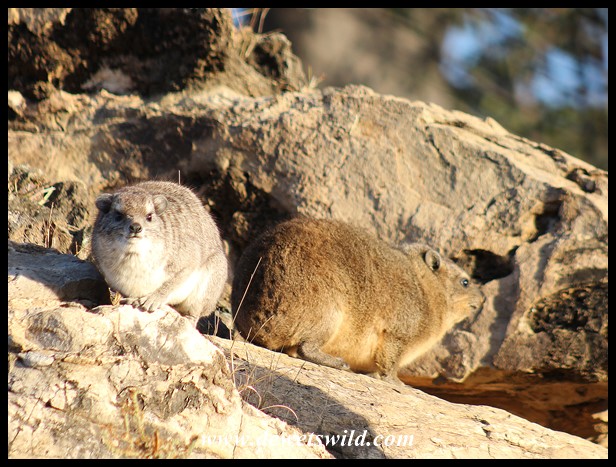
Yellow-spotted Rock Hyrax (left) and Rock Hyrax (right) sharing the sun in Mapungubwe

Three-banded Plover

Charadrius tricollaris

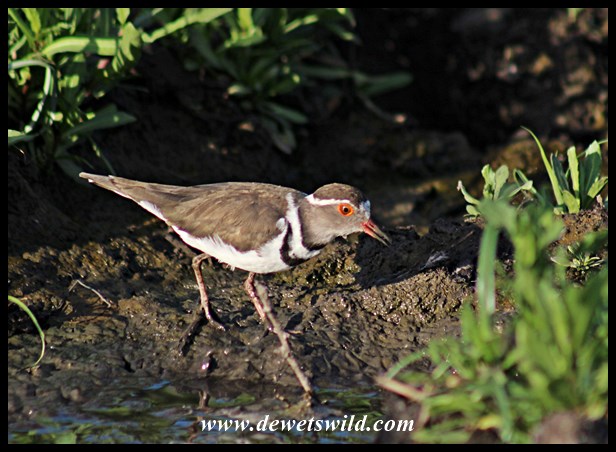
Three-banded Plovers inhabit the open, often muddy, shores of freshwater and brackish habitats, natural or man-made, and feed on a wide variety of worms, insects, molluscs, crustaceans and other invertebrates foraged from the water’s edge. They are usually seen singly or in pairs, with small flocks of up to 20 a rare occurrence. Adult Three-banded Plovers weigh between 28 and 45g, with a wingspan of around 46cm.

Nests are little more than well camouflaged scrapes in the ground, placed near the water among gravel, pebbles, rocks or other debris, in which one or two eggs are incubated by both parents for around four weeks. Pairs vigorously defend their territories from other Three-banded Plovers and even other kinds of birds. The chicks fledge about three weeks after hatching, but remain with their parents until they’re about 6 weeks old. This species breeds throughout the year.

The Three-banded Plover occurs all over South Africa, and has expanded its range in recent times thanks to the construction of artificial water bodies in otherwise arid areas. In the rest of Africa it occurs widely over the eastern and central parts of the continent and is considered of least concern by the IUCN, who sites a total population of between 70,000 and 140,000 (of which between 25,000 and 50,000 is estimated to occur south of the Zambezi River).

Cape Weaver

Ploceus capensis

The Cape Weaver is common in fynbos, wet highlands, coastal thickets and grasslands with easy access to water and stands of trees. It shows a marked preference for agricultural areas causing some conflict with grain and fruit farmers. It feeds on a wide range of plant material (especially seeds, fruit and nectar) and insects, often in mixed flocks with other weavers, sparrows and canaries. They weigh between 28 and 54 grams.

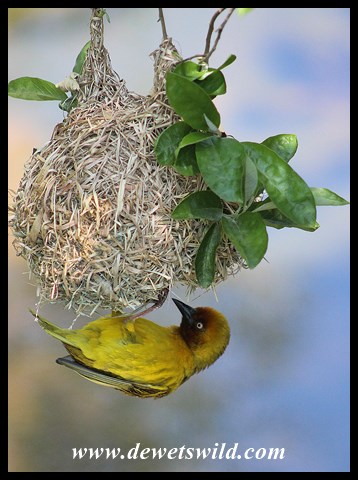
Cape Weavers are gregarious, nesting colonially in reeds, trees or fences (not necessarily near water) during the spring and summer months, often together with other species of weaver and bishop. Males mate with as many as 7 females in a season and has to weave several nests of grass and reeds to accommodate them – females will often tear apart nests that they find inferior. If accepted, the female will line the nest with soft vegetation and feathers and then, after mating, lies a clutch of 2-5 eggs, which she incubates for two weeks. The chicks fledge at about 17 days of age.

The Cape Weaver is a common to abundant species in South Africa, with a limited distribution outside our borders in Swaziland, Lesotho and the extreme south of Namibia along the lower Orange River, and considered of least concern by the IUCN. They are common along the Atlantic coast and adjacent interior of the Northern Cape, throughout most of the Western and Eastern Cape and Kwazulu-Natal, the eastern Free State, Gauteng and the Highveld of Mpumalanga and Limpopo Province.

Leopard Tortoise

Stigmochelys pardalis

Leopard Tortoises are the most widely distributed of Africa’s tortoises, inhabiting habitats ranging from moist savannas to arid scrub, and from sea level to 2900m above. They feed on a wide variety of plants, especially grasses, succulents, forbs, flowering annuals and fallen fruit. They’ll also gnaw on bones or faeces to supplement their calcium intake, and are dependent on a reliable source of fresh water. It is mainland Africa’s largest species of tortoise, adults averaging 40cm in length with a weight around 13kg, though they can exceptionally grow to weigh 40kg under favourable conditions. Females are bigger than males.

Leopard tortoises are diurnal in habit and most active in the warmer months of the year. In very hot or very cold temperatures, they will take cover in dense vegetation, between or under rocks and logs, or in abandoned holes in the ground. They are surprisingly adept at swimming. As is well known in most species of chelonians, the Leopard Tortoise retracts into its carapace at the slightest sign of danger.

Leopard Tortoises only attain sexual maturity at between 12 and 15 years of age and are mostly solitary, except in the mating season. Males will fight over females in the mating season, which in South Africa stretches from September to April, and will attempt to turn each other over. Female leopard tortoises may lay multiple clutches of up to 30 (more usually 6-15) eggs during spring and summer in pits they dig with their hind feet in a sunny, well-drained spot. After laying she fills the hole again and stamps the ground flat with her feet and body. Depending on temperatures the eggs take from 8 to 15 months to hatch, often only after rain has softened the soil above them so that the hatchlings can dig themselves out. Females hatch from warmer nests while males develop at lower temperatures. Hatchlings are only 4-5 cm long and weigh only 20-50g. Eggs and young tortoises fall prey to most of Africa’s reptilian, avian and mammalian predators, and lions and hyenas will take adults occasionally. They are also very vulnerable to veld fires and often infested with ticks. Leopard Tortoises have lived to 75 years in captivity and some sources claim they could reach 100 years in the wild.

The Leopard Tortoise is listed as Least Concern by the IUCN, having a wide distribution in Eastern and Southern Africa. While still numerous in conservation areas, they are dwindling in numbers in areas with high human populations due to habitat modification, illegal collection from the wild for the pet trade (for which several countries have set up captive breeding programs) and to a lesser extent consumption as food. In South Africa they occur at least in parts of every province but can only be considered common in protected areas.

Leopard Tortoises are named for the mottled yellow-and-black carapace of young animals, which dulls and darkens with age.

Black-winged Kite

Elanus caeruleus

Black-winged Kites prefer open habitats, ranging from semi-deserts to the edges of and clearings in forests, but they are most abundant in grasslands, fynbos and cultivated fields. The opening up of large areas for cultivation has aided this species to expand its range and increase its populations. They feed on small mammals (rodents make up about 80% of their diet), birds, reptiles, frogs and insects, hunting from a perch or by hovering above. A Black-winged Kite consumes at least 2 mice per day – about 25% of its body weight of 250g (average). They have a wingspan of roughly 80cm.

Outside of the spring & summer peak breeding season (though some breed year-round), Black-winged Kites often roost communally in groups usually numbering up to 20, though congregations of up to 500 have been recorded. By day they hunt singly or in pairs.

Nests are built of small twigs and lined with finer material, in the tops of trees (or on telephone pylons) that are often used for several consecutive years, though a new nest is built every season. Males defend the territory, but both parents incubate the clutch of 2-6 eggs and bring food back to the hatchlings which emerge after about 5 weeks of incubation. The chicks start flying at about 5 weeks old, but only become fully independent when they are about 4 months old.

The IUCN describes the Black-winged Kite as one of the commonest birds-of-prey throughout its wide distribution range, which covers all of Sub-Saharan Africa, parts of North Africa and the Iberian Peninsula, the Indian subcontinent and Indo-China, and considers it of least concern although it is susceptible to accidental poisoning through pest control measures. It occurs in all of South Africa’s nine provinces, being absent only from the driest parts of the Northern Cape.

Blue Waxbill

Uraeginthus angolensis

Blue Waxbills inhabit savannas, woodlands and gardens with easily accessible water sources. They feed mostly on grass-seeds, and to a lesser extent insects like termites. They are normally seen in pairs or small groups, though larger flocks do occur. At night they prefer roosting in the top of a tall thorn tree. They will also often mix with other kinds of small seed-eaters.

These small birds (8-13g) breed almost throughout the year, with a peak in summer after good rains. Both sexes construct the oval-shaped grass-nest, normally in a thorny tree and near wasp nests. Sometimes they’ll take over disused nests built by other species and adapt it to their requirements. Both parents incubate the clutch of 2-7 eggs, which hatch in less than 2 weeks, and feed the chicks on seeds and insects until they fledge and become independent within 3 – 5 weeks.

The Blue Waxbill occurs commonly from South Africa to Angola in the northwest and Tanzania in the northeast, and is listed as being of least concern by the IUCN. In South Africa it is found from Kwazulu-Natal and the Free State nothwards and is one of the most populous species in these parts, probably numbering in the hundreds of thousands at least. The species is exploited for the pet trade to a limited extent.

Vervet Monkey

Chlorocebus pygerythrus

Along with the Chacma Baboon, the Vervet Monkey must be South Africa’s best known indigenous primate. Male Vervets are considerable stronger built than the females, weighing in at an average of 6kg compared to females at 4kg. Including their tail, Vervet Monkeys are usually just over a meter long.

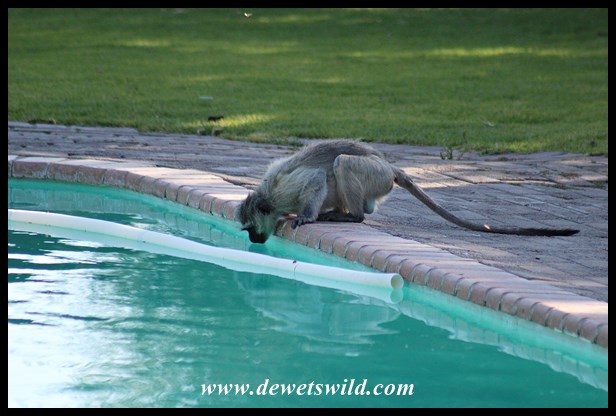
Vervet Monkeys inhabit coastal and mountain forests, woodland, bushveld, riverine thickets, and adjacent grasslands. They’ve adapted to suburban living in many of our towns and cities, and they’ll even forage in plantations and on beaches, provided there is sufficient natural vegetation nearby. Access to drinking water is a crucial habitat requirement for them. Vervet Monkeys follow an extremely wide diet, feeding on fruits and berries, seeds, pods, flowers, leaves, roots, bulbs, tree gum, grass, herbs, spiders and scorpions, snails, insects, eggs and small birds, other small vertebrates, and even marine organisms. Unfortunately they also quickly learn that humans are an easy source of food, either through deliberate feeding or irresponsible discarding of food waste, and can then become a dangerous nuisance.

A highly gregarious species, Vervet Monkeys live in troops numbering from 8 to 140 members (usually around 25) made up of a dominant male, several other males, females (who have their own pecking order) and their young. Troop members have strong bonds of friendship and alliances with others of similar status in the group. Vervets are diurnal, being most active in the morning and afternoon and resting in the midday heat. At night they sleep huddled in small groups in high trees or on inaccessible cliffs. They spend about an equal amount of time foraging in the trees and on the ground.

Female Vervet Monkeys give birth to a single baby – twins are very rare – at any time of the year, though most babies arrive in the spring or summer when food is more abundant, after a 7 month pregnancy. All troop members are very protective of the little ones. Females may live their entire lives in the troop they were born in, while males leave their maternal group at the age of about 4 years to join other troops, staying on average about 3 years with a troop before moving along to another again. Leopards, smaller wild cats, large raptors and pythons are the biggest predators of Vervet Monkeys, which can live to between 12 and 24 years old in the wild.

The Vervet Monkey occurs in a wide band from Somalia and Ethiopia in the north to South Africa, where they are found in all provinces and most of our conservation areas, though their occurrence in the arid west and open central parts of the country is restricted to major riverine arteries. They are regarded as a pest in farming communities and in suburbs, but being a widespread and abundant species the IUCN lists the Vervet Monkey as “Least Concern”.

In Northern Botswana and around the Victoria Falls occurs a different subspecies of Vervet Monkey, C. p. ngamiensis, which is characterised by the richer hues of its coat.

Crowned Lapwing

Vanellus coronatus

The Crowned Lapwing inhabits dry, open habitats like pastures, short grassy savannas, open patches in bushveld, shrublands, semi-deserts and cultivated fields, golf courses and sports fields, avoiding areas where the grass is any taller than 60mm. It is especially fond of overgrazed or recently burnt areas. They feed on insects, especially termites, and other invertebrates.

Outside of the breeding season, Crowned Lapwings come together in loosely associated flocks, usually numbering between 10 and 40 though occasionally as many as 150 individuals, and often associate with the closely related Blacksmith Lapwing. Crowned Lapwings pair for life. They prefer to nest in shallow scrapes on the ground, among newly sprouting grass following veld fires and often in the shade of trees. The nest is further camouflaged with little stones, dry dung, dried grass, etc. In areas with high density, nests are spaced between 25 and 50m apart. Spring is the peak breeding season although some pairs may nest throughout the year. Females are mainly responsible for incubating the eggs, of which there are 2 to 4 in a clutch, though the males will take over for short periods in hot weather. The chicks leave the nest within hours of hatching, walking around and searching for food with their parents. They fledge at about 4 weeks old but often stay with their parents until the start of the next breeding season.

Crowned Lapwings can live up to 20 years of age and weigh on average around 185g.

The IUCN considers the Crowned Lapwing of least concern – it has an increasing population (thanks in no small part to human modification of the environment) and wide distribution over East and Southern Africa. It is found in high densities in all South African provinces.

Common Moorhen

Gallinula chloropus meridionalis

Commonly seen singly, in pairs or small family groups, the Common Moorhen inhabits almost any freshwater habitat but prefers water bodies with thickly vegetated borders. They are omnivorous feeders, eating a wide range of algae, moss, other aquatic plants, green shoots, seeds, flowers, berries and fruits, worms, insects, crustaceans, molluscs, small fish and tadpoles and occasionally bird eggs. They have a wingspan up to 62cm and weigh around 250g.

In South Africa the Common Moorhen breeds throughout the year, with pairs isolating themselves from others of their species except for a few helpers from previous broods. The nest is a cup built of plant material, either floating on a platform on the water or raised above it in emergent vegetation, built by the female with material provided by the male. Clutches contain from 4 to 9 eggs, incubated for three weeks by both sexes. Chicks fledge when they’re about 2 months old.

With a stable population estimated at over 8-million birds, distributed widely over Asia, Europe and Africa, the Common Moorhen is listed as being of least concern by the IUCN. In South Africa it is mostly found in the wetter southern, central and eastern parts of the country, being absent from large areas of the arid western parts.