This was the scene we enjoyed our first cup of coffee, rusks and biscuits with this morning, here in Hluhluwe-Imfolozi Park.


This was the scene we enjoyed our first cup of coffee, rusks and biscuits with this morning, here in Hluhluwe-Imfolozi Park.
If there’s any good advise experienced parents can give newly expecting ones, it is that none of the thousands of parenting guide-books on the bookstore shelves will apply to your child 100%. You have to find what works for you, and go with it – your kid will turn out just fine.
The same seems true in the animal kingdom.
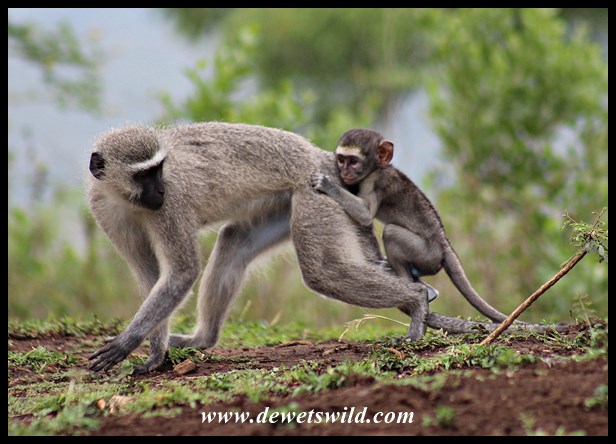
This afternoon while having lunch at Mpila in the Hluhluwe-Imfolozi Park, we noticed this mother Vervet Monkey and her baby coming past in a most unconventional manner. Normally the newly born babies would hang below the moms tummy, within easy reaching distance of her mammary glands. This little one however clung to the fur on his mom’s behind with all his might, and it obviously hurts her to quite some degree, as she regularly took him off and gave him a harsh hiding, to which he then responded with a terrible tantrum, screaming to high heaven until she relents and he gets back onto her buttocks. It was such a funny sight, and if she was human I would have given her a knowing wink of the eye in sympathy.


Just in case you were wondering, this is the more usual way female Vervet Monkeys carry their babies; an example from another mom in the same troop that walked past our accommodation unit.


Today I sneaked a photo of Joubert while he was taking pictures of two playful warthog piglets outside our cottage here in Mpila in the Hluhluwe-Imfolozi Park


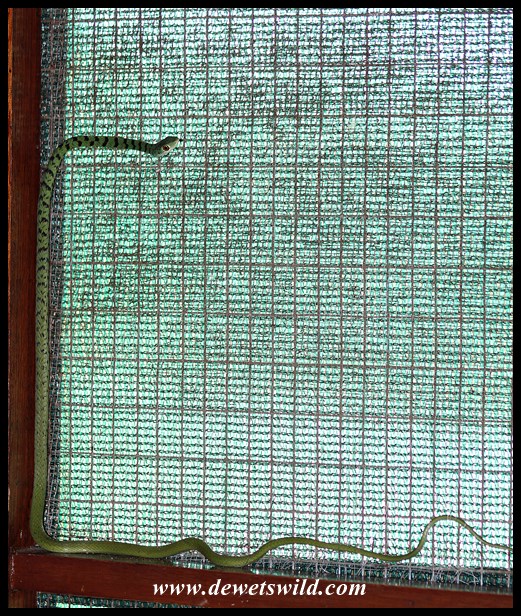
We had only just arrived at Mpila Camp in the Hluhluwe-Imfolozi Park this afternoon, when we were welcomed by this Spotted Bush Snake on the mosquito screen of our kitchen door – What a welcome!

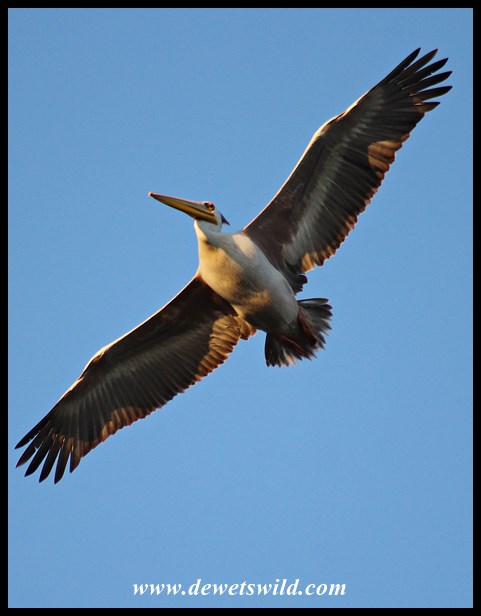
While exploring the mangrove swamps here at Umlalazi Nature Reserve this morning, this Pink-backed Pelican treated us to a low-level flypast.
Today was our last day here at Umlalazi. Tomorrow, we head for the Hluhluwe-Imfolozi Park. If we have a good enough connection well try to post a daily update from there as well.

The shy African Firefinch is a tiny (11cm, 10g) seedeater inhabiting humid thickets in savanna and riverine woodland. They are usually seen in pairs or small groups.
Pairs are monogamous and the male is responsible for the building of the small ball-shaped grass-nest in a densely-leaved bush or dense grass during the summer months. Both parents share the incubation duties for the clutch of 2-5 eggs, which hatch after about two weeks. The nestlings are fed on small insects and fledge when they about 3 weeks old. The chicks become independent around 2 weeks after leaving the nest.
The African Firefinch has a rather patchy distribution across much of sub-Saharan Africa. The IUCN lists it as being of least concern. In South Africa they can be found from the Eastern Cape, through Kwazulu-Natal, Mpumalanga and Limpopo and into Gauteng and the North West Province.


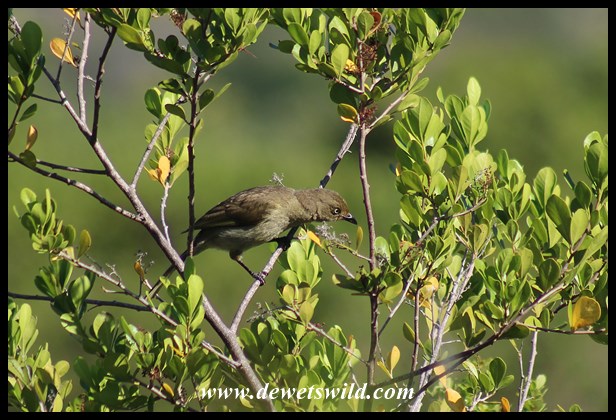
The Sombre Greenbul is a shy species, often more easily heard than seen. They are usually encountered singly or in pairs, feeding on insects and other invertebrates as well as ripe fruit and berries, nectar and flowers. They prefer dense habitats, ranging from forests to thickets in coastal scrub, where they usually move around in the middle and upper levels, and has adapted well to densely planted suburban gardens. Sombre Greenbuls breed in spring and summer, building their cup-shaped nests amongst dense leaves quite high above the ground.
The IUCN lists the Sombre Greenbul as being of least concern. It is distributed along Africa’s Indian Ocean coastline and adjacent hinterland from Somalia to South Africa, where it is to be seen in the Western and Eastern Cape, Kwazulu-Natal and the Lowveld and Escarpment of Mpumalanga and Limpopo provinces.


One of our most familiar swallows, often found in close association with human habitation, is the Greater Striped Swallow. They prefer open, undulating and mountainous habitats, often near open water, where they hawk the flying insects that form their staple diet.
Greater Striped Swallows breed from early spring to deep in autumn and build mud-nests beneath overhanging rocks and toppled trees, but they have adapted well to using the underside of roofs and bridges for the purpose (see photos). Usually clutches consist of 3 eggs, incubated by the female alone for 3 weeks though both parents feed the chicks once hatched. The chicks start flying when they’re a month old but will return to the safety of the nest for a few days afterwards still. Adults measure about 18cm long and weigh around 25g.
Greater Striped Swallows are to be seen seasonally in most of Africa south of the equator, “wintering” in the DRC, Angola and Tanzania and moving southwards to breed in southern Africa from August to March – during summer they occur in virtually every corner of South Africa. The IUCN considers it to be of least concern.


True to its name, the Arrow-marked Babbler is a noisy, social bird, usually encountered in territorial groups of between 3 and 15 individuals and commonly found in thickets in savanna and woodland habitats. Here they forage mostly on the ground, feeding on a variety of fruits, seeds, invertebrates and small reptiles. Pairs of Arrow-marked Babblers are monogamous, and assisted in the processes of nest building, incubation and chick-rearing by the entire group. They may breed at anytime of year, and clutches consist of 2-5 eggs that hatch after about 2 weeks. Adults of the species have a length of about 24cm and weight of around 72g
The Arrow-marked Babbler occurs in Africa south of the equator, and is listed as being of least concern by the IUCN. In South Africa it can be found in the provinces of Kwazulu-Natal, Mpumalanga, Limpopo, North West and Gauteng.


The Umbrella Thorn is one of the most characteristic large trees of our dry savanna regions, and occurs from South Africa through eastern Africa into northern Africa and Arabia. It is a hardy species and can grow to a height of 21m, with a classic umbrella-shaped canopy, though in very arid areas it seldom grows beyond a small scrub. The Afrikaans name, Haak-en-Steek, literally translates as Hook-and-Prick and is an excellent description of the arrangement of the Umbrella Thorn’s spikes. Umbrella Thorns flower in summer, producing dense masses of white flowers.
Umbrella Thorn wood can be used for making furniture, tools and fence posts, the leaves and pods are excellent fodder for game and livestock, and several parts of the plant is used in traditional medicines.


 DeWetsWild