At the end of April, we had the privilege of visiting the Kruger National Park with a wonderful group of friends; altogether 21 adults and children from 5 families and by far the biggest group we’ve ever accompanied to the Park! Our base for the four nights was the camping area at Satara Rest Camp, allowing us to introduce our friends to many of our favourite places in the central section of the Park.

A wonderful group of friends enjoying the scenery at Nwanedzi
Our previous visit to the Satara area was in the winter holidays of 2016, at the height of one of the worst droughts on record in South Africa. What a pleasure seeing the region transformed into a sea of lush green vegetation now at the end of the summer rainfall season, and experiencing a few of the final showers rolling over the Lowveld before winter sets in!

Wonderful to see so much water in the Park – here at Nsemani Dam

Satara scenery

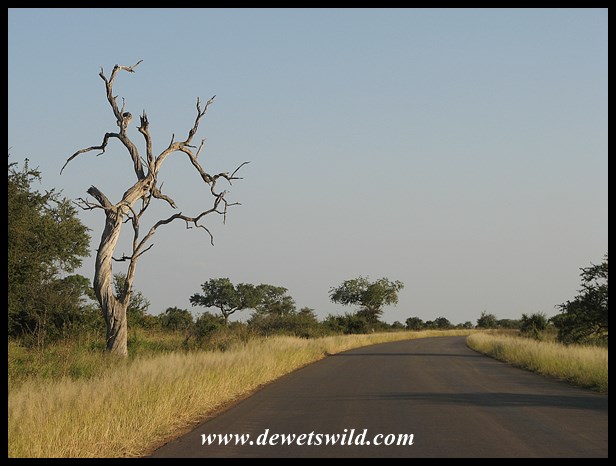
Scenery along the S100

Dusty sunset on the S100

Scenery along the S100

Wonderful to see so much water in the Park – here at Gudzani Dam

Wonderful to see so much water in the Park – here at a stream crossing on the S41

Sunset at Nsemani Dam

Downpour approaching along the Olifants River valley

Downpour approaching along the Olifants River valley

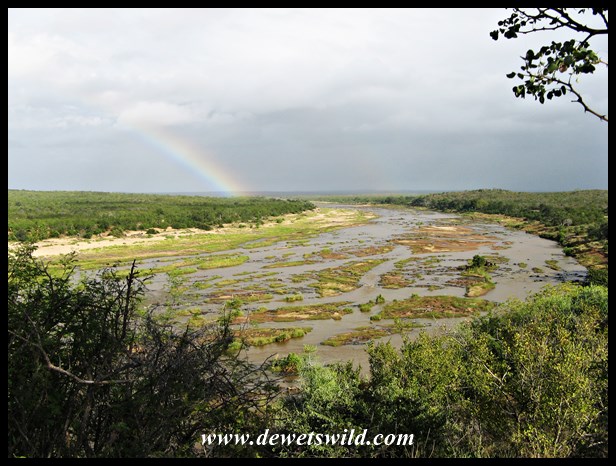
Rainbow over the Olifants

Sunset at Satara
Of course the dense vegetation made game-viewing very tricky, and in stark contrast with our visit last year when there seemed to be predators resident at every one of the few remaining pools of water, we really had to work hard to find the meat-eaters for which Satara is so famous on this visit. We don’t consider ourselves “Big-5” chasers, but when you’re introducing a couple of newbies to Kruger’s wonders you do want her to put her best foot forward, and luckily Satara remained true to her reputation as one of the best game-viewing areas in the Park. Even if the predators kept us in suspense at their appearance, there were still a myriad of other species of game to be found in good numbers and keeping us enthralled on our drives, and even in camp! Of course, we expected to find high concentrations of plains zebra, blue wildebeest and giraffe roaming the central plains, but we were very surprised to find so many elephants around Satara!

Waterbuck among the spiderwebs

Banded mongoose

Hippos at sunset

African Wild Cat visiting our campsite in Satara

Kudu cow

African Buffalo

African Buffalo

Huge herd of impala

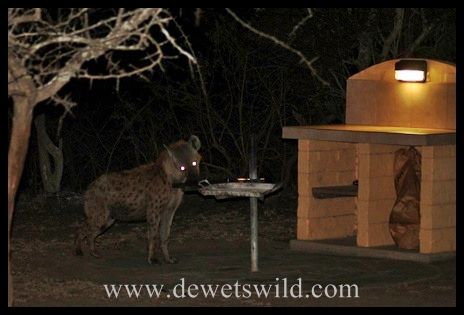
Spotted Hyena on a night drive

Waterbuck calf

Well camouflaged Foam Nest Frog

There seemed to be armoured crickets everywhere you looked! This one was feasting on a trampled comrade in Satara’s parking area…

Pride of lion just north of Tshokwane

Pride of lion just north of Tshokwane

Lion hiding from the rain

Big warthog boar

Blue wildebeest

Giraffe

Plains Zebra

Blue wildebeest

Plains Zebra

Plains Zebra

Giraffe

Giraffe

Plains Zebra

Plains Zebra

Giraffe in rainstorm

Plains Zebras caught in rainstorm

Elephant

Elephant cow with deformed right tusk

Elephant

Wary elephant trio

Big Bull showing off (photo by Joubert)

Elephant in a downpour
For anyone looking for birds, Kruger could never disappoint, however on this visit the Park seemed to be bursting at the seems with feathered inhabitants even more than usually. We’ve shown you the enormous flocks (rather swarms!) of queleas in an earlier post, but notably we’ve also seen bigger flocks of marabou stork and wattled starling on this trip than ever before – no doubt in response to an eruption of food in the form of grass-seeds and the insects that feed on it.

Juvenlie Bateleur

Saddle-billed Stork

Saddle-billed Stork

Saddle-billed Stork

Wattled Starling

Wattled Starling

Marabou

Marabou

Marabou

Marabou

African Mourning Dove

Marabou

Marabou

Burchell’s Starling

Lilac-breasted Roller

Ostrich

Swainson’s Spurfowl

Pied crows

Egyptian Goose

Brown Snake-Eagle

Wattled Starling

African Scops Owl
At the end of our stay we had to contend with every camper’s worst nightmare – having to break up camp in pouring rain! They say that any friendship that survives going on holiday together will remain standing come what may, and happily it seems despite the hardships of dripping wet, muddy bodies and thoroughly soaked camping equipment, our friendship with the Bernards, Krugers, Nels and Therons have come through the tribulations with flying colours.

Camping at Satara, Kruger National Park, April 2017 – click the image for an enlarged view
(If you’d like to find out more about Satara and surrounds, have a look at the dedicated blog post we published about this popular part of the Kruger National Park)
-24.393012
31.779808













 DeWetsWild