Tag Archives: South African Butterflies

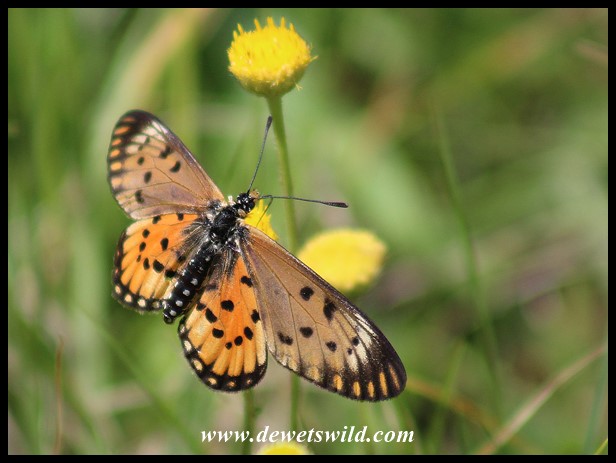
Long-winged Orange Acraea

Acraea (Hyalites) alalonga

The Long-winged Orange Acraea has a limited distribution, being found only on the Drakensberg escarpment and its foothills from Limpopo to northern Kwazulu-Natal. They inhabit montane grasslands. Adults are seen specifically only in two periods of the year; November to January, and again March to May, and have a wingspan of around 6-7cm. The larvae feed on the leaves of plants from the legume family.

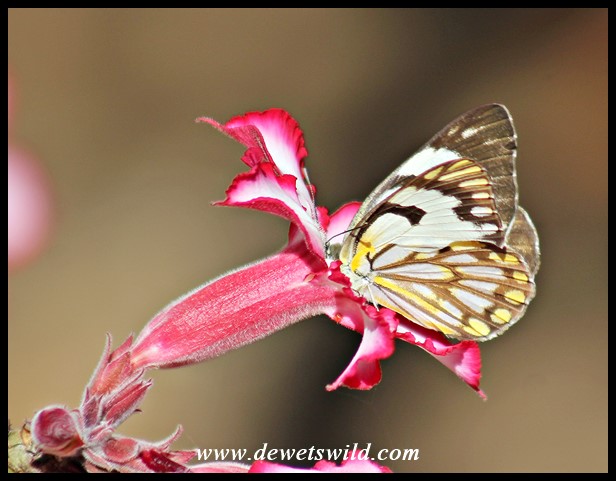
African Veined White Butterfly

Belenois gidica

The African Veined White is a commonly encountered butterfly species occurring in the savanna-bushveld habitats stretching from the Eastern Cape through Kwazulu-Natal to the Lowveld and Limpopo Valley in the north of the country. Adults are on the wing throughout the year and have a wingspan of around 5cm. The widespread wild caper bush (Capparis sepiaria) is an important food plant for the larvae of these butterflies.

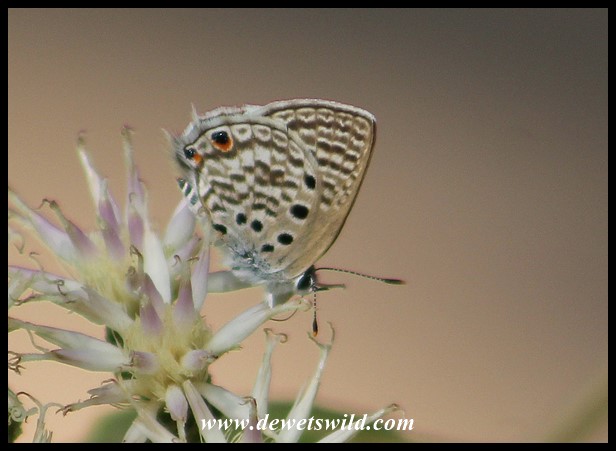
Black-striped Hairtail Butterfly

Anthene amarah

The Black-striped Hairtail is a tiny (wingspan less than 3cm) butterfly with a wide distribution across southern, eastern and northern South Africa and a special fondness for thorn trees – adults relish the flowers while caterpillars subsist on the leaves. Adults can be seen year-round though they’re much more numerous in summer when they can sometimes be seen together in groups numbering several dozen.

Veined Tip Butterfly

Colotis vesta

The Veined Tip is a commonly seen butterfly occurring in savanna habitats and as such is found year-round in Kwazulu-Natal, Mpumalanga, Limpopo, North West, Gauteng and isolated parts of the Northern Cape. Adults have a wingspan of around 4cm and fly relatively low and slow, often landing on flowers.

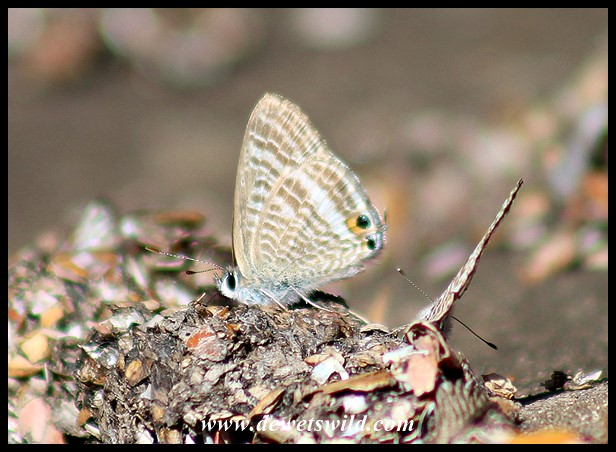
Pea Blue Butterfly

Lampides boeticus

One of the most widespread butterflies in the world, being found in Australia, Asia, Europe and Africa, the Pea Blue, or Long-tailed Blue, occurs all over South Africa. They’re quite catholic in their habitat requirements and very common in gardens. They can be a pest where peas and beans are farmed; the larvae feeding on plants from the legume family.

Adult Pea Blues are seen throughout the year and boast a wingspan of only 2-3cm. The IUCN considers it to be of least concern.

Sandmen Butterflies

Genus Spialia

The Sandmen is a familiar and widespread genus of tiny butterflies, with some species occurring in almost every corner of South Africa in almost every habitat, from forests to semi-deserts, while others have extremely limited ranges and very specific habitat requirements. They all look very similar and are difficult to identify to species level in the field. Adults have a wingspan of only 2-3cm and fly low to the ground, settling often on fresh dung, flowers, leaves, rocks or on the bare ground and regularly returning to the same spot. Their larvae feed on a wide range of indigenous plants.

South Africa is home to 14 species of Spialia Sandmen:
Boland Sandman (S. sataspes)
Bushveld Sandman (S. colotes)
Common Sandman (S. diomus)
Confusing Sandman (S. confusa)
Delagoa Sandman (S. delagoae)
Dwarf Sandman (S. nanus)
Forest Sandman (S. dromus)
Grassveld Sandman (S. agylla)
Mafa Sandman (S. mafa)
Mite Sandman (S. paula)
Mountain Sandman (S. spio)
Star Sandman (S. asterodia)
Wandering Sandman (S. depauperata)
Wolkberg Sandman (S. secessus)

Large Striped Swordtail Butterfly

Graphium antheus

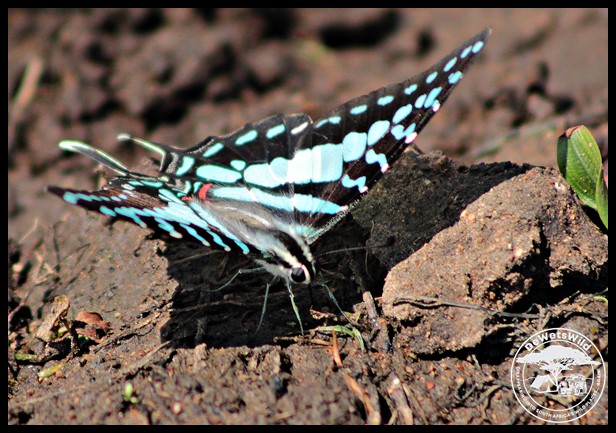
A big and striking butterfly, the Large Striped Swordtail inhabits moist savannas and coastal forests and in South Africa can be seen through most of Limpopo, low-lying parts of Mpumalanga and most of Kwazulu-Natal. Adults of both sexes, on the wing from spring to autumn and boasting a wingspan of around 7cm, can often be seen visiting flowers but the males – as depicted in some of the images below – are especially fond of muddy puddles as well and will often congregate there in large numbers. These butterflies are very strong fliers.


Pearl-spotted Emperor Butterfly

Charaxes jahlusa

The Pearl-spotted Emperor is a common butterfly living in various savanna-type habitats, occurring in this country from the Little Karoo and Albany thicket through much of the Eastern Cape and Kwazulu-Natal and into the northern provinces of North West, Gauteng, Mpumalanga and Limpopo. In the southern parts of their local range adults are seen only in spring and summer, but they’re on the wing year round further north. Beyond our borders this butterfly occurs as far north as Sudan.

Male Pearl-spotted Emperors are territorial and perch on open twigs from which they attack interloping males and try to woo the females for mating. They’re fast flyers and adults of both sexes frequent seeping tree sap and rotting fruit rich in sugars. Caterpillars of the Pearl-spotted Emperor Butterfly feed on the leaves of the Jacket Plum and Zebra Wood. Wingspan in adults measure up to 6cm, making this one of the smaller Emperor Butterfly species.

Eyed Pansy Butterfly

Junonia orithya

The Eyed Pansy is a widespread butterfly occurring from South Africa (Eastern Cape, Kwazulu-Natal, northern Free State, Gauteng, North West, Mpumalanga and Limpopo), through most of Africa, southern and south-east Asia all the way to Australia. They inhabit grassland and thorny savanna habitats. Adults may be seen at anytime of year, usually in open areas where they fly low and fast, often settling on the same bare patches – its Afrikaans name of “Padwagtertjie” stems from its habit of sitting on road surfaces. The males are territorial and defend their patch vigorously. The sexes are similar in appearance and adults have a wingspan of 4-5cm. The larvae is sustained on a diverse selection of plants.

A window into the life cycle of the Garden Acraea

The Garden Acraea is by far the most numerous butterfly in our little garden, and as I type this there’s at least a dozen of them flitting around the plumbago and Cape honeysuckle shrubs in my field of view. This year I’ve paid even more attention than usual to them and been rewarded with a window into their fascinating life cycle.
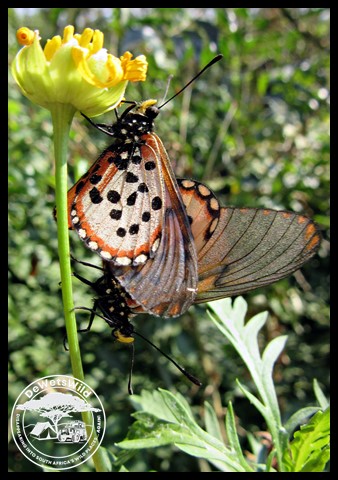
Two Garden Acraeas mating

In April we started noticing large numbers of caterpillars in their final instar moving around the garden, with some of them even finding safe refuges on the patio furniture and security bars in front of the windows where they could start their metamorphosis.

It took several months for them to shed their last caterpillar “skin” to reveal the hard chrysalis inside which they were transforming. Sadly some of the pupae dropped from their safe havens, but I could save a few from marauding ants and put them in a jar on my desk where I could keep a close eye on them.

It didn’t take anywhere near as long – only a few weeks – for the adult butterflies to start emerging.

Soon their wings were unfurled and they could take flight in the same garden where they started their lives.

One of the pupaes I kept in a jar on my desk taking on the wide world outside