Tag Archives: outdoors

Senegal Lapwing

Vanellus lugubris

The Senegal Lapwing, also known as the Lesser Black-winged Plover, is a rather uncommon denizen of open savannas and woodlands with a covering of short grass, being especially fond of recently burned veld, and prone to localised migrations as soon as the grass cover grows too long for them to easily find the termites that make up the majority of their diet.

Senegal Lapwings are partly nocturnal (especially so on moonlit nights), move around in small flocks, and breed in spring and summer with monogamous pairs forming loose colonies when nesting. The nest is little more than a scrape in the ground in which a clutch of 3 or 4 eggs are incubated for a month by both parents. The chicks are precocious, leaving the nest about 4 hours after hatching to follow their parents around and feeding themselves. The chicks learn to fly from around a month old, but may stay with the parents until the next breeding season. Adults weigh around 115g and measure 24cm in length.

Listed as being of least concern by the IUCN, the Senegal Lapwing has a discontinuous distribution over parts of west, central, east and southern Africa. In South Africa it occurs only in the north of Kwazulu-Natal and in the Lowveld of Mpumalanga and Limpopo Province.

Little Bee-eater

Merops pusillus

The Little Bee-eater is, at a weight of about 15g and length of around 16cm, the smallest of Africa’s bee-eaters and probably also in the world. Despite their small size they’re excellent at catching the bees, wasps and hornets that make up the bulk of their diet. Seldomly encountered far from water, Little Bee-eaters inhabit open woodlands and savannas where it catches its prey on the wing. Before swallowing their potentially dangerous prey they disarm the stingers by swiping it against a branch or other hard surface.

Contrary to most other bee-eaters, Little Bee-eaters are solitary breeders, making nest in long tunnels (up to 1.3m!) they dig themselves in earthen walls and riverbanks, usually in spring and early summer before the peak of the rainy season endangers their nesting sites. The pair is monogamous and take it in turns to incubate the clutch of 2-6 eggs over a period of around 19 days. The chicks leave the nest between 3 and 4 weeks after hatching and stay with the parents for several weeks more afterwards. Little Bee-eaters are normally seen in pairs or family groups of up to ten that roost tightly together at night.

Little Bee-eaters occur in all South Africa’s provinces with the exception of the Northern, Eastern and Western CapeNorth of our borders, the Little Bee-eater occurs over most of sub-Saharan Africa. The IUCN considers it to be of least concern despite noting that efforts to control insect outbreaks are contributing to a decline in their population, which, at an estimated 60-million+, is likely the most numerous of all Africa’s bee-eaters.

Green-winged Pytilia

Pytilia melba

The Green-winged Pytilia is a beautiful little finch occurring in all South Africa’s provinces with the exception of the Eastern and Western Cape. It has a wide, if patchy, distribution over much of sub-Saharan Africa and is listed as being of least concern by the IUCN, with its range reflecting the species’ preference for dry and thorny savannas with ready access to a reliable water source. They forage on open ground for the grass seeds that make up the bulk of their diet, occasionally also pecking at termites.

Green-winged Pytilias are monogamous and territorial, and breed throughout the year, though there’s a distinct peak in the summer and early autumn. Their untidy grass-nests are built in the shape of a ball (with a side entrance) in thorny shrubs and trees. Both parents take it in turns to incubate the clutch of up to 6 eggs over a two week period. The chicks grow quickly and leave the nest before they’re 3 weeks old.

Common Diadem

Hypolimnas misippus

The Common Diadem is a large butterfly with a wingspan of 6 to 8cm. The males are distinctive with a velvety black and blue sheen and striking white blotches to the top of their wings, while the females are excellent mimics of the notoriously foul-tasting African Monarch, which supposedly aids in evading predators. With the exclusion of the arid western parts of the country the Common Diadem is widely distributed in South Africa, being found in habitats ranging from grassland and savanna to forest edges, parks and gardens. It is one of the most widespread species of butterfly and, apart from Africa, is also found in parts of Asia, Australia and the Caribbean (the females in different parts of the world mimic different kinds of butterflies). Adults can be seen throughout the year though they’re much more common in the late summer months.

Diederik Cuckoo

Chrysococcyx caprius

The Cuckoos are a family of birds notorious for their excellent hiding skills, and most of them are seldomly seen in the open (and even more difficult to photograph!) despite their often well-known calls attracting the attention of bird-watchers like ourselves. One notable exception to this frustrating trait is the Diederik Cuckoo, which is not averse to showing off its beautifully metallic green and copper plumage together with its giveaway “dee-dee-dee-dee-diederik” call (Diederik being a traditional masculine Afrikaans name).

The “Diederikkie” occurs over virtually the entire African continent south of the Sahara and in parts of the Arabian Peninsula, and it is only in the driest north-westernmost reaches of our country where you’re unlikely to hear them calling in our summer. A handful even stay here right through winter, though the majority departs northwards to central Africa at the start of autumn and then return with the onset of spring. The IUCN classifies the Diederik Cuckoo as being of least concern.

Diederik Cuckoos are usually seen singly or in pairs, and are not very picky about their habitat, though they do seem to prefer the more wooded areas even in otherwise open biomes like grasslands and the Karoo. They are also commonly encountered in suburban parks and gardens and feed almost exclusively on invertebrates, being especially fond of caterpillars, and thus great friends to the gardener.

The Diederik Cuckoo is a brood parasite, with females laying a single egg at a time (as many as 24 in a summer breeding season) in the nests of a wide variety of other birds (two dozen species recorded, with wagtails, weavers and sparrows being especially targeted) after getting rid of any eggs the host birds may already have laid. Shortly after hatching the Diederik chick will then dispatch any other eggs or chicks in the nest so that it can hog all the adoptive parents’ attention. The chick fledges about 3 weeks after hatching and stays with its foster parents for around 3 weeks more afterwards. Fully grown, Diederik Cuckoos measure 19cm in length and weigh around 30g.

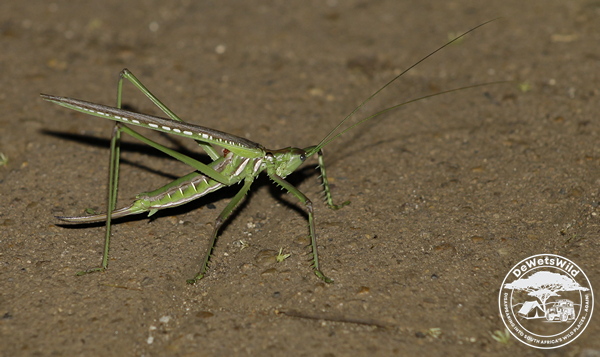
Wahlberg’s Bush Cricket

Clonia wahlbergii

I wish I was brave enough to put one of these insects on my hand and show you just how gigantic they are. But I am not… And my fear isn’t entirely irrational as these katydids, whose bodies measure up to 7cm without including any appendages in the calculation, are reported to have a very nasty bite. Something which I hope never to have to put to the test.

Clonia walhbergii is a nocturnal predator, ferociously feeding on large insects and other invertebrates unlucky enough to cross its path. In South Africa this species is found from the Eastern Cape, through the coastal and bushveld areas of Kwazulu-Natal, the Lowveld of Mpumalanga and Limpopo Province, along the Limpopo Valley right through to the Kalahari regions of North West and the Northern Cape, occurring in habitats that varies from forest margins to arid savanna. It seems not much is known about their reproductive cycle except that eggs are laid in the ground.

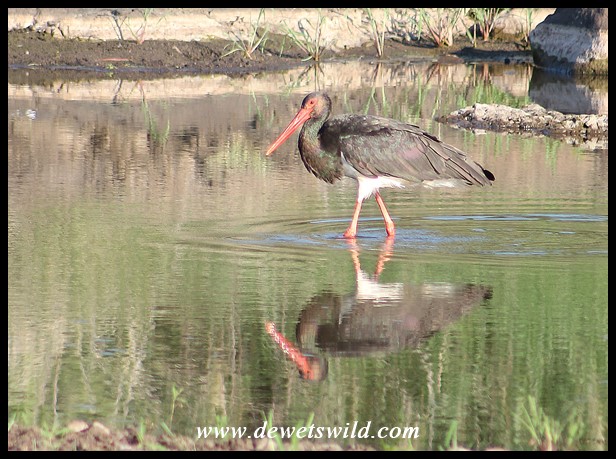
Black Stork

Ciconia nigra

The Black Stork is a very widely distributed species, occurring in Africa, Europe and Asia, and globally assessed as being of least concern by the IUCN despite their populations coming under pressure from loss of habitat and hunting. Although occurring all over the country they are not particularly common in South Africa either and it is estimated that the total population occurring south of the Zambezi and Kunene Rivers is in the region of about a thousand breeding pairs of which only 200 or so occur in our country, qualifying for a local conservation classification of “near threatened”. Although most populations of Black Stork are migratory that is not the case with Southern Africa’s birds which remain in the subregion throughout the year and only move around locally. In our experience the Kruger National Park is the most reliable area to find Black Storks in South Africa.

Black Storks are closely associated with wetlands, swamps, rivers, lagoons, estuaries and inundated grasslands and, as can probably be deduced from their preferred habitat, subsists mainly on an aquatic diet ranging from fish and amphibians to insects and other invertebrates sourced by wading in shallow water. They are usually found alone or in pairs, though congregations numbering into the hundreds have been seen on occasion.

Black Storks are monogamous, and pairs may even have a life-long bond. Their nests are rough platforms of sticks and reeds built on ledges and cliffs, often used for several years. The local breeding season spans the autumn and winter months, typically periods during which most of this country experiences drier weather making it easier to catch prey in dwindling pools of water. Clutches contain as many as five eggs, with incubation by both parents lasting over a month. The chicks fledge at between 2 and 3 months after hatching, becoming independent of their parents soon after. Black Storks may live to 20 years old in the wild, with up to 36 years recorded in captivity. Fully grown adults are magnificent birds, standing a metre high with a wingspan of around 1.5m.

Turner’s Thick-toed Gecko

Chondrodactylus turneri

Also known as Turner’s Giant Gecko for its impressive size (adults measure up to 10cm in length excluding their tail), Turner’s Thick-toed Gecko is a solitary, nocturnal species occurring in semi-desert and arid savannas, usually in rocky outcrops but also occasionally in or around houses. In the spring season females lay 2 or 3 clutches of 2 eggs each in holes dug in the sand. The eggs take 2 to 3 months to hatch. Turner’s Thick-toed Gecko is a carnivore, feeding primarily on insects and other invertebrates. In South Africa, this species is found in parts of Mpumalanga, Limpopo, the North West and Northern Cape provinces.

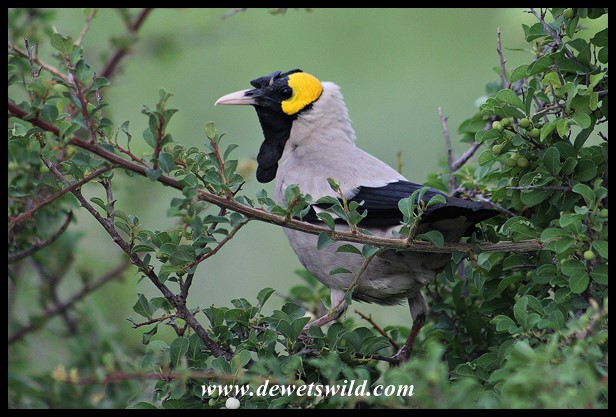
Wattled Starling

Creatophora cinerea

Certainly one of our most social and numerous starlings, the Wattled Starling is also a nomadic bird that moves around in large flocks, following surges in insect numbers and seeding grasses, their principal foodstuffs, that often follow on good rains. They’re well known for following large grazing herbivores, eagerly pecking up insects disturbed by the movement of the large animals through the vegetation. Wattled Starlings are mostly found in open habitats with short grasscover, ranging from semi-deserts to savannas and open woodland.

Wattled Starlings nest colonially, with monogamous pairs building their untidy ball-shaped stick-nests in close vicinity to one another in thorny trees, with their breeding season spanning most of spring and summer. The parents take turns to incubate the clutch of 2-5 eggs over a period of only 11 days and co-operate to feed the chicks, which leave the nest about two weeks after hatching without being able to fly yet. As a result the nesting colonies are often heavily predated on by birds of prey and other meat-eaters for these easy pickings. Fully grown adults weigh in at about 70g and measure around 21cm in length. The pronounced wattles and brightly coloured facial features of the males are seen only during the breeding season, with older males having the most impressive appearance.

Wattled Starlings are commonly recorded in all South Africa’s provinces, with its wider distribution stretching throughout southern, central and eastern Africa to Ethiopia and Somalia. The IUCN considers the Wattled Starling to be of least concern.

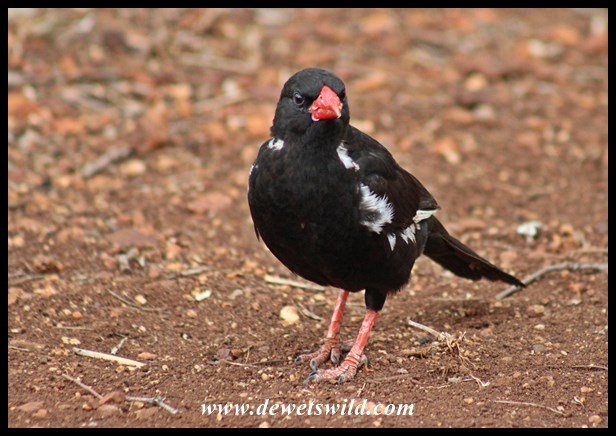
Red-billed Buffalo Weaver

Bubalornis niger

Weighing around 78g and measuring 23cm in length, the Red-billed Buffalo Weaver is one of the largest members of the weaver-family (Ploceidae) occurring in South Africa. They occur in dry savannas and open woodlands, showing a preference for areas dominated by thorny trees and heavily grazed areas, often near human habitation. It does most of its foraging on the ground with insects and other invertebrates, seeds and fruit making up the bulk of its diet.

Reb-billed Buffalo Weavers are social birds living in colonies of varying size. In these colonies the adult males have a dominance hierarchy, with the most dominant male having the biggest harem of females. Their nests are huge constructions of thorny twigs with several nest chambers, and often times several of these “lodges” are placed together in the same large tree, utility pole or windpump. Red-billed Buffalo Weavers breed from early spring to late autumn. The females take full responsibility for incubating the clutch of 2-4 eggs over a two-week period, and also care for the chicks until they leave the nest about 3 weeks after hatching.

Being a species that is actually benefited by agriculture and overgrazing, the Red-billed Buffalo Weaver is considered of least concern by the IUCN. They occur in two separate populations in Africa – one in east Africa and the other in southern Africa. In the RSA, Red-billed Buffalo Weavers occur from the Lowveld of Mpumalanga and Limpopo through Gauteng and the North West to the thorny savannas of the Northern Cape.