

Another bird that we encountered much more frequently during our December 2021 visit to the Kruger National Park than on any previous visit is the African Cuckoo. Perhaps their exceptional numbers this time around is thanks to an explosion of caterpillars following good early rains.


Cuculus gularis
The African Cuckoo inhabits savanna and woodland habitats and feeds almost exclusively on caterpillars; only rarely does it include anything else, like other insects, eggs or small birds, in its diet. They are usually solitary.
As with the other members of the family the African Cuckoo is a brood parasite, relying specifically on the fork-tailed drongo to raise its brood. After mating the male African Cuckoo will distract the fork-tailed drongo parents from their nest while the female Cuckoo gets rid of any drongo eggs already in the nest and replaces them with one of her own. The Cuckoo egg hatches about 17 days later and the newly hatched chick immediately sets about pushing any other chicks or eggs from the nest. It is then cared for by its adoptive drongo-parents, growing rapidly until it fledges about three weeks after hatching. Even after the chick leaves the nest it is still cared for by the drongos for several weeks. Fully grown they measure about 32cm in length and weigh around 105g, so by the time they leave their foster parents the chicks are much bigger than them.
African Cuckoos spend the spring and summer months from August to April in southern Africa, migrating here from equatorial Africa to breed. In South Africa during that period they can be found in all the northerly provinces, being absent only from the Eastern and Western Capes and most of the Northern Cape and Free State. They’re found across most of Sub-Saharan Africa for at least a part of the year. According to the IUCN the African Cuckoo is of least concern.
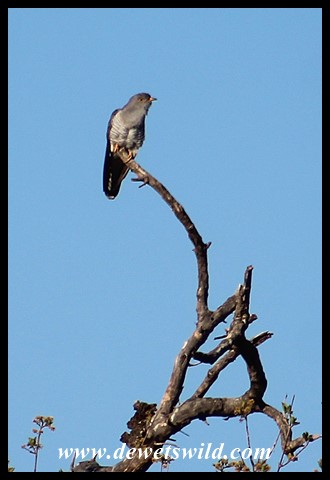
African Cuckoo










 DeWetsWild