Tag Archives: outdoors

Woodland Kingfisher

Halcyon senegalensis

The Woodland Kingfisher is a bird of tall, open woodlands and savannas (as well as suburban gardens and parks), and despite a preference for wooded river courses does not follow an aquatic diet at all. Instead, they feed primarily on insects, especially grasshoppers, though they have been recorded taking small reptiles and chicks from Red-billed Quelea nests. Adults weigh between 55 and 80g and measure up to 24cm from the tip of the beak to the tip of the tail.

Woodland Kingfishers migrate to South Africa (North West Province, Limpopo, Mpumalanga, Gauteng and northern Kwazulu-Natal) to breed here in summer, arriving from September and departing again by end of April. They are mostly seen singly or in pairs. Pairs defend their territories aggressively against others of their kind as well as other species of birds and even humans. They nest in holes in trees, often taken over from woodpeckers and barbets. Clutches normally contain 2-4 eggs and are incubated by both parents for around two weeks. Although the chicks leave the nest at about 3 weeks old, the parents continue to care for the young for as long as 5 weeks after they’ve fledged.

The Woodland Kingfisher occurs over much of sub-Saharan Africa, from Senegal in the west to Ethiopia in the east and south to South Africa, at least for parts of the year, while they are resident in Africa’s equatorial regions throughout the year. The IUCN lists it as least concern.

The call of the Woodland Kingfisher is an unmissable part of the summer soundtrack in many of our favourite wild places, which must be why I’ve set it as the ringtone on my phone…

Double-banded Sandgrouse

Pterocles bicinctus

Double-banded Sandgrouse inhabit open, dry woodlands, savannas and arid grasslands, often in association with low, rocky hills, and is especially fond of mopane savanna. These rather plump birds (26cm long, weigh up to 270g) are often seen on or beside gravel roads, freezing in their tracks in the hope that they’ll escape detection. They feed exclusively on seeds, and drink daily, usually just before sunset. They are usually encountered in family groups numbering 2 to 5 and only rarely in bigger groups of up to 10.

Breeding in this species peaks during the dry season, though breeding attempts have been recorded throughout the year. Pairs are monogamous and use a shallow scrape in soil, gravel or sand, lined with dry grass and leaves, as a nest. The nest is usually hidden among tufts of grass or under bushes, but is often quite exposed. Clutches contain 2-3 eggs and are incubated by both parents for little over 3 weeks.

Despite being common and widespread over southern Africa, and considered of least concern by the IUCN, the Double-banded Sandgrouse population is at risk of decreasing due to habitat loss. In South Africa, this species can be found in the Lowveld, western Limpopo, and parts of the North West and Northern Cape Provinces.

Cape Grassbird

Sphenoeacus afer

As its name suggests, the Cape Grassbird lives in areas of rank, tall grass as well as thick low-growing fynbos and stands of ferns, often on hillsides and in river valleys and usually near water. They are normally seen singly or in pairs. Cape Grassbirds follow an insectivorous diet, catching most of their food on the ground. Adults grow to 19cm in length and weigh between 26 and 34g.

Cape Grassbirds breed almost throughout the year, with a peak in spring and early summer. Pairs mate for life. The female builds the bowl-shaped nest of twigs, grass and leaves near the ground in a tussock of grass or a bush. The female incubates the clutch of 2 or 3 eggs for just over 2 weeks. After hatching, both parents feed the chicks, which fledge at around 2 weeks old.

The Cape Grassbird occurs only in South Africa, Lesotho, Swaziland and in a limited area on the border between Mozambique and Zimbabwe. In South Africa they are found in the Western and Eastern Cape, Kwazulu-Natal, Free State, Gauteng and the Highveld of Mpumalanga and Limpopo. The IUCN currently lists it as “Least Concern” but also cautions that the population of the Cape Grassbird is decreasing due to habitat destruction (threatened by agriculture, urbanisation and invasion by alien trees).

Pied Starling

Lamprotornis bicolor

The conspicuous Pied Starling prefers open habitats in hilly terrain (grasslands, arid scrub and agricultural fields and pastures). They are mainly insectivorous in their diet, but will also feed on fruit and seeds. They often associate with wild and domesticated herbivores, feeding on ticks and preying on insects disturbed by the movement of the large animals. Pied Starlings are about 27cm long and weigh around 100g.

Pied Starlings are gregarious, moving around in flocks that can number over a thousand, especially outside the peak summer breeding season. Pied Starlings prefer to nest colonially in tunnels in earth walls and river banks, which they line with soft plant material and discarded garbage. Clutches contain from 2-6 eggs (most usually 4) that are incubated by the female for two weeks. Both parents, and up to 7 helpers from previous broods, feed the chicks that fledge at between 3 and 4 weeks old.

Thanks to an abundant population, the IUCN considers the Pied Starling to be of least concern. It occurs only in Swaziland, Lesotho and South Africa (all provinces except Limpopo).

We were lucky to see this pair of Pied Starlings sharing tiny red berries at Rietvlei Nature Reserve.

These Pied Starlings using a White Rhino bull as a catwalk for showing off was a rather amusing sighting!


Yellow-billed Kite

Milvus aegyptius

The Yellow-billed Kite spend spring and summer in South Africa, the first birds arriving from central and west Africa in July and the last departing again by April, with the birds being most numerous in December and January. They’ve been recorded from all over South Africa, though they are uncommon in the open and arid central and western parts of the country.

Yellow-billed Kites inhabit a wide range of habitats, from forest edges to grasslands, though they show a preference for woodlands and rural areas with dense human populations. These kites have a varied and opportunistic diet – they prey on a wide variety of birds, small mammals, reptiles, amphibians, insects (especially termites) and other invertebrates, will steal food from other birds and will also scavenge from carcasses and dumpsites. They’re rather fearless, and will even swoop down to steal from picnic tables and barbeques with humans in attendance! They are seen alone, in pairs or in flocks. Adults weigh up to 760g, with a wingspan up to 1.8m.

A large proportion of birds migrating to our country breed here, though it is unclear whether those that don’t breed here are unpaired or from populations that breed elsewhere. Pairs are monogamous and territorial. Nests are well concealed in the canopies of tall trees, and consist of a platform built of sticks and lined with a variety of soft natural and man-made materials. Clutches contain 1-3 eggs, incubated mostly by the female for 5 weeks. For the first month after hatching the male brings food to the female and chicks at the nest, after which she helps to bring food to the chicks. The chicks make their first flight when they are about 7 or 8 weeks old.

Some authorities consider the Yellow-billed Kite to be a race of the Black Kite (Milvus migrans), which also visits our shores in summer and often occurs alongside the Yellow-billed Kite.

Tree squirrel at the day visitors picnic spot

Southern African Tree Squirrel

Paraxerus cepapi

The Southern African Tree Squirrel (also known as Smith’s Bush Squirrel) occurs in bushveld and woodland, and is especially plentiful in riverine bush and mopane veld. They feed on leaves, flowers, seeds, fruit and berries, bark, pods, gum, moss and occasionally insects, eggs and chicks. They can live independently of drinking water. On average they’re about 35cm long (including their bushy tail) and weigh around 175g.

Although they are usually seen foraging alone, Tree Squirrels live in small groups consisting of 1 or 2 males, females and young. The whole group shares a nest, usually a hole in a tree lined with soft plant material. Tree Squirrels are diurnal, and enjoy baking in the sun near their nest hole in the early morning. Their noisy alarm calls is often a good clue as to the whereabouts of predators. When threatened they run to the nearest tree, moving around the trunk so that it is always between them and the attacker, but they can jump distances of up to 2 metres when the need arises.

Females give birth to 1-3 tiny (10g) babies at anytime of year, though mostly in the rainy season. The young leave the nest from about 3 weeks old. Snakes, eagles, owls, genets, cats and mongooses are the chief predators of Tree Squirrels, which has a life expectancy of about 8 years in the wild.

The Southern African Tree Squirrel is found in southern Angola, Zambia, southern DRC, Malawi, Tanzania, Mozambique, Zimbabwe, Botswana, northern Namibia, Swaziland and northern South Africa (Mpumalanga, Limpopo, Gauteng, North West and extreme northern Kwazulu-Natal), where it is a common species and regarded as being of least concern by the IUCN.

African Scops-Owl

Otus senegalensis

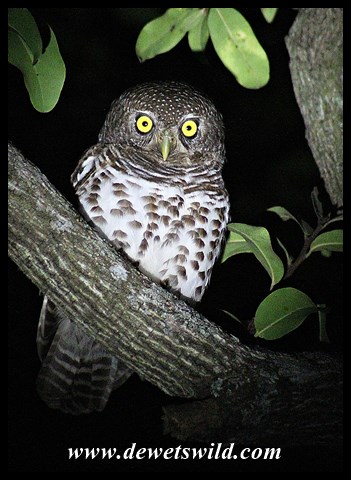
At between 60 and 80g in weight and with a wingspan under 50cm, the African Scops-Owl is one of the smallest owl species on the continent. It inhabits savannas, especially those dominated by thorn trees or mopane, and dry, open woodlands. They feed primarily on insects but will also prey on small mammals, birds, geckos and frogs. By day they are expertly camouflaged, roosting against tree trunks with their cryptic markings blending in perfectly with the textures of the bark. At night, their distinctive “prrrp” call is a familiar sound in many of our favourite wild places.

In southern Africa the Scops-Owl breeds in cavities in trees during late winter and spring. Pairs are monogamous, and the female incubates the clutch of 2-6 eggs for three weeks while the male brings food to her on the nest. After hatching the female stays with the chicks for another two weeks, at which point both parents need to hunt to feed the growing brood. The chicks leave the nest when they’re about a month old.

In South Africa, the African Scops-Owl is found in Kwazulu-Natal, Mpumalanga, Limpopo, Gauteng, North West and the Kalahari regions of the Northern Cape, with a small and seemingly isolated population on the Eastern Cape coast and adjacent interior between East Londen and Port Elizabeth. North of our borders they occur widely over sub-Saharan Africa. The IUCN describes it as common throughout this range and considers the African Scops-Owl of least concern.


An African Scops-Owl that routinely roosts outside the reception office at Satara in the Kruger National Park must be one of the most photographed individuals of its species.

Yellow Mongoose

Cynictis penicillata

The lithe little Yellow Mongoose can grow to lengths of up to 75cm, and adults weigh from 440 to 900g. They inhabit a wide variety of open habitats, from semi-desert scrub to grasslands and savannas. They are independent of drinking water, and feed mainly on insects, other invertebrates, rodents, small birds and reptiles and frogs, and occasionally carrion and fruit. They have been known to raid chicken runs.

Yellow Mongooses are diurnal and live in colonies that number from 5 to 50, lead by a dominant breeding pair. Within their home ranges, colonies usually have several extensive burrow systems that they normally dig themselves, but often share with meerkats and ground squirrels. They usually forage alone and when threatened while out foraging they will hide in any available thicket or hole.

Litters of 1 to 5 pups are usually born in the summer, and while it is usually only the dominant pair that breeds, all group members assist with the care of the babies. Yellow Mongooses’ main predators are raptors and jackals, while snakes and monitor lizards will take babies from the burrows. Yellow Mongooses are notorious carriers of rabies. They have a natural life expectancy of about 12 years.

Yellow Mongooses occur in Namibia, Botswana, South Africa and marginally into adjacent areas of Angola and Zimbabwe. They occur all over South Africa, with the exception of the Lowveld of Mpumalanga and Limpopo and the coastal plain of Kwazulu-Natal. The IUCN lists the species as being of least concern.

Crested Barbet

Trachyphonus vaillantii

Crested Barbets inhabit forests, riverine thickets, woodland and savannas and is a common sight in parks and gardens in our towns and cities. They feed on fruit, insects, eggs and occasionally chicks of other birds and small reptiles and mammals. Crested Barbets are great friends to gardeners, as they are especially fond of snails. They are usually seen singly or in pairs and act aggressively towards other birds, even species larger than themselves. Adults weigh between 60 and 80g.

Like other kinds of barbet, these birds nest in holes in trees that they peck themselves or take over from other birds. Pairs are monogamous and territorial when breeding, which peaks in spring and summer. Clutches consist of 1 to 5 eggs and are incubated mostly by the female for around 17 days. The chicks are fed insects by both parents and fledge when they’re around a month old.

Although currently considered common and of least concern, the IUCN does note that collection for the cagebird trade is causing some populations to decline. Apart from South Africa, where they occur in all provinces with the exception of the Western Cape, the Crested Barbet is found in Tanzania, DRC, Angola, Zambia, Namibia, Botswana, Zimbabwe, Mozambique and Swaziland.

Scarlet-chested Sunbird

Chalcomitra senegalensis

The Scarlet-chested Sunbird inhabits woodland, savanna (especially with thorn trees) and parks and gardens in South Africa’s Kwazulu-Natal, Mpumalanga and Limpopo Provinces, where it is considered a common resident. Outside our borders it occurs widely in Africa south of the Sahara, though avoiding the equatorial forests and dry desert areas. These are tiny birds, weighing only between 10 and 17g. Scarlet-chested Sunbirds feed on nectar and small invertebrates.

Breeding in Scarlet-chested Sunbirds has been recorded throughout the year. with a distinct peak in the summer months. The female is solely responsible for building the pear-shaped hanging nest from grass, leaves, bark and spider web, and incubating the eggs, of which there are between 1 and 3 in a clutch, for around two weeks. Both parents feed the chicks, who leave the nest at 2-3 weeks old and then stay with their parents for up to two months more.

With an abundant and stable population, the IUCN lists the Scarlet-chested Sunbird as least concern.