Tag Archives: nature

Lesser Swamp Warbler

Acrocephalus gracilirostris

Lesser Swamp Warblers, as their name suggests, confine themselves to reedbeds and stands of bullrushes in a wide variety of wet habitats – marshes, estuaries, riversides and even man-made wetlands like sewage ponds. Here they feed on a wide range of invertebrates picked off the surface of the water or emergent plants.

Lesser Swamp Warblers are usually seen in pairs – they are monogamous and territorial. The female builds their conical nest using strands of reeds and other plant material, usually placing it in a well-vegetated thicket over the water. They breed through spring and summer. Both parents incubate the clutch of 2 or 3 eggs over a two week period and then feed the nestlings until they fledge about 2 weeks after hatching.

In South Africa, Lesser Swamp Warblers are found in suitable habitat throughout the country, having expanded their distribution even into arid areas thanks to artificial water bodies constructed on farms and for municipal water supply and waste water treatment. Aside from isolated populations in Nigeria and Tchad it occurs widely through the eastern, central and southern parts of the continent. The IUCN considers the Lesser Swamp Warbler to be of least concern.

Banded Martin

Neophedina cincta

Banded Martins prefer open habitats, such as grassveld, marshlands and the fynbos shrublands. They visit South Africa during our spring and summer, arriving from about September to breed and then departing again by May to their overwintering areas in central Africa. They feed on flying insects caught in flight and are usually seen in pairs or small flocks. Banded Martins nest in tunnels that they dig in aardvark burrows, stream banks or eroded gullies. Both parents care for the 2-4 chicks, which leave the nest when they’re about 3 weeks old.

In South Africa Banded Martins are commonly found on our central highlands, with a smaller concentration occurring in the Western Cape and scattered records from elsewhere. Depending on the season they roam over most of sub-Saharan Africa. The IUCN lists the Banded Martin as being of least concern and note that their population is probably increasing due to agricultural practices opening up more areas for them to utilise.

Black-chested Prinia

Prinia flavicans

A denizen of shrublands, thornveld and riverine thickets in more open areas, the Black-chested Prinia is a very active little insectivorous bird, hopping about the branches gleaning its food from among the leaves and bark of shrubs and trees. Black-chested Prinias are usually encountered in pairs and may nest at any time of year, though more usually in the spring and summer months, incubating a clutch of 2-6 eggs over a 2 week period in a pear-shaped nest woven of green grass and placed in a dense shrub. The chicks leave the nest about 2 weeks after hatching. The cuckoo finchwhich we featured a short while ago here on DeWetsWild – often parasitizes the nests of Black-chested Prinias.

The Black-chested Prinia occurs widely in north-western and central South Africa and in Namibia and Botswana, as well as in western Zimbabwe and Zambia and southern Angola. According to the IUCN it is in no danger of extinction.

African Quail-Finch

Ortygospiza atricollis

The African Quail-Finch occurs throughout South Africa, being absent only from the arid west of the country, and patchily through most of sub-Saharan Africa. Though difficult to observe up close due to their skittish nature, these highly nomadic flock-living birds are common in grasslands and woodlands with bare ground, where they feed on seeds and small insects, and usually found close to water. Their nesting season coincides with periods of high rainfall when grasses are in seed. It takes a little over 2 weeks for the clutch of up to 6 eggs to hatch. The chicks leave the nest when they’re about 3 weeks old and become self-sufficient about a month later.

The IUCN lists the African Quail-Finch as being of least concern.

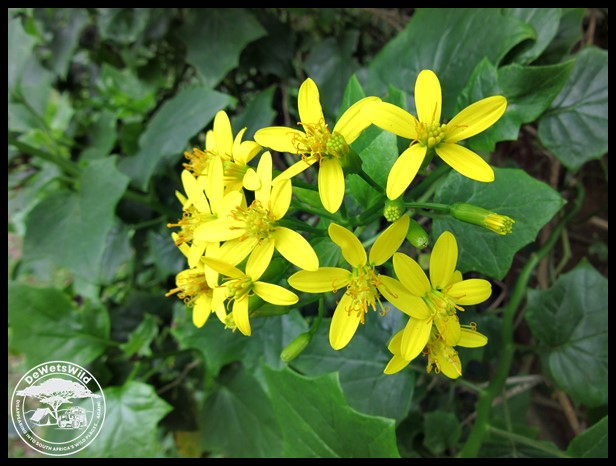
Sagewood

Buddleja salviifolia

With its sweetly-scented flowers, being a feature of our spring season, and its aromatic leaves, the Sagewood has become a popular garden plant frequented by a variety of birds and insects like bees and butterflies. It’s usual growth form is a shrub that may grow up to 4m tall. Sagewood occurs naturally throughout the wetter parts of South Africa, from the Western Cape to Limpopo, growing along streams and on hillsides. In traditional medicine the roots are boiled as a remedy for cough and colic, and in olden days the wood was used to make spears and fishing poles.

Wahlberg’s Striped Skink

Trachylepis striata wahlbergii

Wahlberg’s Striped Skink distribution centres in the Zambezi basin, from southern Angola, Zambia and western Mozambique into Zimbabwe, northern Botswana and northern Namibia. Some taxonomists consider it to be a species in own right, though more research is required to determine whether it is fact not only a subspecies of the Striped Skink, with which it shares many behavioural traits, including giving birth to live babies from eggs that develop and hatch inside the mother’s body instead of being laid. They are quite large and may grow to a length of 11cm, excluding the tail from the measurement.

Cuckoo Finch

Anomalospiza imberbis

The Cuckoo Finch is an uncommon and highly nomadic bird in South Africa, with a patchy distribution across parts of Gauteng, Limpopo, Mpumalanga and Kwazulu-Natal, and a much sought-after tick on the list of many avid local birdwatchers. These seed-eaters may migrate widely in response to rainfall and are usually seen in small flocks of between 8 and 50, though sometimes up to a thousand may move together. They’re also found over much of sub-Saharan Africa, though in a similarly patchily distributed and nomadic fashion.

Cuckoo Finches inhabit moist grasslands and wetlands and get their name from their habit of laying their own eggs in the nests of species of Cisticola and Prinia. Females lay up to 30 eggs during the summer season, leaving a single egg per nest after removing all the host’s own eggs from it. The chick hatches within two weeks and, being fed insects by its adoptive parents, grows quickly to the point where it is able to leave the nest before it is 3 weeks old. Its host parents will take care of it for several more weeks before it joins up with a flock of other Cuckoo Finches.

The IUCN lists the Cuckoo Finch as being of least concern.


Cape Skink

Trachylepis capensis

The Cape Skink inhabits a wide range of habitats and occurs in all South Africa’s provinces, in Namibia, Lesotho and parts of Eswatini, Zimbabwe and Botswana, and the IUCN considers the species to be of least concern. Sadly they suffer badly in urban areas due to predation by domestic cats. They tame easily and are quite gentle. These lizards are diurnal and hunt for insects in open patches. Females give birth to up to 18 live babies, usually in the summer months. Fully grown, and not including the tail, they may reach a length of 13cm.

Sickle-winged Chat

Emarginata sinuata

Many birds that live in arid habitats sport a rather dull colouration, and the Sickle-winged Chat, which inhabits fynbos, the open and arid Karoo plains and rocky mountain sides follows the same recipe for blending in with their sparsely vegetated surroundings. They feed mainly on insects and other invertebrates.

Sickle-winged Chats are usually seen alone or in pairs. They breed during the warmer parts of the year, building their nest on the ground at the base of a shrub of a tuft of grass and raising a clutch of 2-4 chicks.

The Sickle-winged Chat is endemic to Southern Africa, occurring in the western and central provinces of South Africa, throughout Lesotho and into southern Namibia. The IUCN considers it to be of least concern, given an apparently stable population and wide distribution.

Buquet’s Vagrant

Nepheronia buquetii

Buquet’s Vagrant – also sometimes called the Green-eyed Monster – is a species of butterfly occurring from the Western Cape, through coastal Eastern Cape and Kwazulu-Natal and into the Lowveld of Mpumalanga and Limpopo. Adults have a wingspan of about 5cm and can be seen throughout the year.