Tag Archives: nature

Kori Bustard

Ardeotis kori

Considered one of the world’s heaviest flying birds, Kori Bustard males weigh as much as 18kg or even more. They have a wingspan of up to 2.75m, and stand up to 1.2 meters tall. Females however are much lighter and seldom exceed 7kg in weight.

Kori Bustards occur in flat, open, dry habitats and have an omnivorous diet that includes carrion, seeds, berries, flowers, eggs, insects and small vertebrates, often following fires and herds of game to catch flushed prey. Their Afrikaans name, “Gompou“, comes from their liking for Acacia-tree gum. Where water is easily available, Kori Bustards will drink regularly. They normally forage alone or in small groups, but are sometimes seen in bigger groups numbering up to 40 in areas of abundant food or at waterholes. These bustards are mostly terrestrial, taking to the wing only when necessary and even preferring to escape threats by running or hiding, though they are strong flyers once airborne. They forage during the cooler hours of early morning and late afternoon, preferring to spend the heat of the day in the shade. Nesting occurs in the warmer months, when usually two eggs are laid in shallow hollows on the ground. Following an elaborate courtship display, males attempt to mate with as many females as possible, and play no part in incubating the eggs (which lasts for about 25 days) or rearing the precocial chicks. Large raptors and big mammalian predators prey on both adult and young Kori Bustards.

Ongoing declines in the Kori Bustard’s population across its range, which stretches from Ethiopia and The Sudan to South Africa’s Mpumalanga, Limpopo, North-West, Northern, Eastern and Western Cape Provinces, has prompted the IUCN to raise its conservation status to “Near Threatened“. The South African population is estimated at between 2,000 and 5,000, with hundreds dying annually due to collisions with powerlines. The threats of illegal hunting and habitat degradation is placing further pressure on their numbers, and the species may well soon be confined only to conservation areas like the Kruger National Park, where the population is estimated around 250 adult birds. They can also be found in the Mapungubwe, Mokala and Pilanesberg National Parks.

Secretarybird

Sagittarius serpentarius

The Secretarybird is a very unusual raptor, with a long neck, even longer legs and a bunch of quill-like feathers at the back of its head, like pens behind a secretary’s ear, possibly earning it its name. Another explanation for the name comes from a French corruption of an Arabic word, saqr-et-tair, meaning “hunter bird”, which is a great description of its lifestyle. They are up to 1.5m tall, with a wingspan of over 2 meters and a weight up to 5kg.

Secretarybirds roam savannas, grasslands and semi-deserts, usually singly or in pairs, walking along in search of prey, which ranges from eggs, insects and other invertebrates to small mammals (up to the size of hares), birds, amphibians and reptiles – even large, poisonous snakes – which they immobilise or kill by vigorously stomping on it with their feet. Secretarybirds breed throughout the year, in nests built of sticks atop flat-topped trees. Two to three eggs are laid and incubated mostly by the female for about 45 days, though both parents feed the chicks until they leave the nest at about 80 days old and then are taught how to hunt for themselves. At times they congregate in flocks of up to 50 birds at waterholes, but pairs are monogamous.

A Secretarybird features prominently on the coat of arms of South Africa, and can be found all over the country, although they are not very common and even less so outside the major conservation areas. Even in the Kruger National Park it is thought that the population stands at only about 250 – 300 adult birds. The IUCN considers them “Vulnerable” as their populations have declined severely, mostly due to habitat loss and hunting for traditional medicine (the belief being that their ground-up bones confers respect, power and fearlessness).

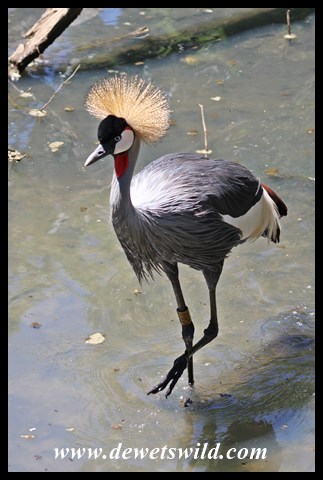
Grey Crowned Crane

Balearica regulorum

The Grey Crowned Crane with its eye-catching “hairstyle” must be one of the most easily identifiable birds in South Africa. Their Afrikaans name, Mahem, is a good imitation of their call. They stand about 1m high and weigh roughly 3.5kg.

Grey Crowned Cranes can be found in or near wetlands and flooded grasslands, and is one of the few crane species that will perch in trees. Their diet is omnivorous, ranging from grass-seeds and grains to insects, crabs and small vertebrates. Pairs are territorial during the nesting season, which stretches over the wetter seasons in South Africa. Nests are platforms built from grass and sedges in waterlogged areas. Courtship includes elaborate dances involving jumping and bowing. Two to five eggs are incubated for four weeks, and the precocial chicks fledge within 100 days of hatching. Outside the breeding season Grey Crowned Cranes flock and roost communally in groups numbering up to 200.

As a result of wide-spread habitat loss and illegal collection of eggs and live birds from the wild for the illegal wildlife trade and traditional uses, the IUCN considers the Grey Crowned Crane to be endangered, despite their wide distribution in Eastern, Central and Southern Africa. The population in South Africa is estimated at between 4,000 and 5,000 (out of a total population probably below 64,000 on the continent) and is mostly found in the provinces of the Eastern Cape, Kwazulu Natal, Free State and Mpumalanga.

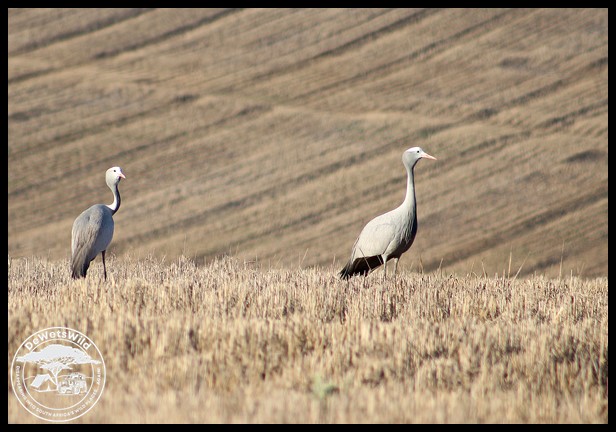
Blue Crane

Anthropoides paradiseus

South Africa’s national bird is a relatively small, blue-grey species of crane that stands around a meter high, with a wingspan of up to 2 meters and a weight up to 6kg.

Blue Cranes inhabit open grasslands, karoo-scrublands, fynbos and marshes, and have adapted to feeding in grainfields and pastures where these intrude into their preferred habitat. Grass and sedge seeds are their primary food source, though they’ll also take insects, frogs, crabs, and small reptiles and mammals. Blue Cranes are diurnal, roosting in wetlands at night.

Outside the summer breeding season Blue Cranes congregate in large (from 50 to 1000 birds), nomadic flocks, while in the breeding season they can be found in pairs or family groups. They perform an elaborate courtship dance, involving running, jumping, flapping and calling. Two eggs are laid in a simple nest constructed of reeds or grass in marshes and grasslands, and parents take turns to incubate the clutch for around 30 days. Any animal – human, herbivore or predator – is relentlessly attacked when they come too close the nest.

The IUCN considers the Blue Crane “Vulnerable” as their population has been seriously decreased by poisoning, loss of habitat and collisions with power lines. Population estimates put their numbers in the region of 25,000 in South Africa (almost half of which can be found in the Western Cape Province) with less than a 100 in neighbouring Namibia.

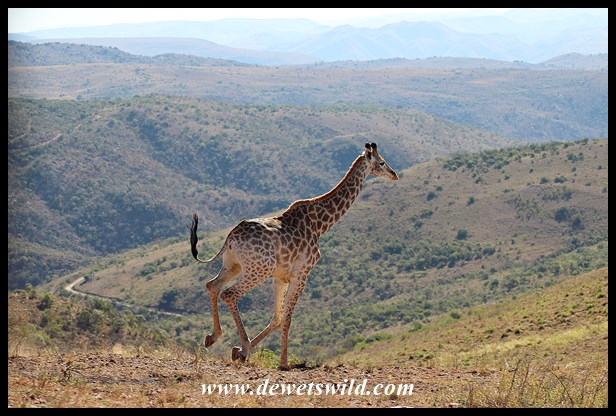
Giraffe

Giraffa camelopardalis

Out and about in South Africa’s wild places, the Giraffe is probably the closest thing you can get to a “gentle giant”, although I still wouldn’t venture too close to those powerful legs and heavy hooves if I were you! Towering up to 5 meters high, Giraffe are by far the tallest animal alive on earth today. Bulls can weigh up to 1,500kg, while cows are more delicately built and seldom reach a ton in weight.

Giraffes prefer open semi-desert and savanna habitats, especially where thorn trees proliferate. They feed on leaves, shoots, pods, flowers, thorns and fruit, consuming more than 50kg of browse daily. They also have a curious habit of chewing on old bones to supplement the calcium in their diet. When surface water is available, Giraffes will drink regularly, but in drier areas, like the Namib desert, they can survive without water for extended periods.

Giraffe society is a very fluid one. Adult cows and their calves congregate in herds numbering up to 30, but these are not very stable and individuals move between herds as they please. Adult bulls live mostly solitary lives, while younger bulls often associate in bachelor groups after leaving their maternal herds. Adult bulls establish their dominance through ritualised displays and fighting by using their long necks and heads as clubs, often knocking one another unconscious and sometimes even causing the death of one of the combatants through a broken neck or limb when they crash to the ground after a well placed blow. Although they seem ungainly, Giraffes can attain speeds of up to 60km/h, run for distances of up to 7km, and jump over fences 1.5m high! Giraffes have acute senses and other herbivore species often accompany them, as Giraffes are usually the first to detect the presence of predators. They are mostly diurnal, preferring to rest in the shade during the heat of the day.

Cows give birth standing up to single calves, although twins have been recorded, after a 15 month gestation. Giraffe calves are about 1.8m high and weigh up to 100kg at birth, and can stand within an hour of being born. Cows are very determined about protecting their calves, and many a lion has been kicked to death when attempting to catch a calf. Calves also fall prey to hyenas and leopards, while adults only really need to fear lions, of which they are a favourite prey. Giraffe can live to an age of up to 30 years in the wild.

Despite being classified as “Least Concern” by the IUCN, giraffe populations are declining across much of their range due to habitat loss and poaching, and the total African population now probably numbers less than 80,000 animals. Over 30,000 animals, representing the two southern subspecies, occur in Angola, Namibia, Zambia, Botswana, Zimbabwe, Mozambique and South Africa (where they have been extensively introduced outside their natural distribution range) and likely represent the only stable or increasing populations of giraffe on the continent. South Africa’s biggest population of giraffe occur in the Kruger National Park, but they are also regularly encountered in several other parks and reserves, including the uMkhuze section of the iSimangaliso Wetland ParkHluhluwe-Imfolozi Park, Mapungubwe, Marakele, Mokala and Pilanesberg National Parks, and Ithala Game Reserve, of which they are the emblem.

Recent genetic studies suggest that there may actually be four distinct species of giraffe, but it remains to be seen whether this becomes a widely accepted scientific view.

Enjoying the first Spring Rains at Rietvlei

This past weekend allowed us our first brief escape from city life of the new season. Our day at Rietvlei Nature Reserve was blessed with the first, and very welcome, rainfall of Spring, although accompanied by a terribly windy cold front which put an early end to our plans for a nice picnic next to the dam. Happily the reserve’s wildlife came out to greet us in their numbers, despite the inclement weather.


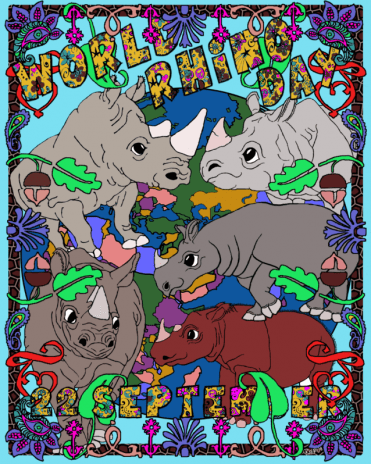
World Rhino Day 2016

The 22nd of September is World Rhino Day, a day to reflect on the large-scale slaughter these enigmatic animals are facing due to human greed and superstitious culture.

For the first time in years there is a reason for cautious optimism, with the South African Ministry of Environmental Affairs announcing on the 11th of September that, despite an enormous increase in the number of poaching incursions into the Kruger National Park, there has been an almost 18% decline in the number of rhinos killed by poachers in the period January to August in South Africa’s flagship Park, rightly attributed to the never-ending efforts of dedicated rangers and other people in law enforcement. Still, the 458 carcasses found in Kruger so far this year (compared to 557 for the same 8 month period last year) is a terrifying number, and it is even worse when considering that in our country as a whole at least 702 rhinos have been killed this year, bringing the total lost since the scourge started escalating in 2007 within sight of the 6,000 mark.

Today is also another chance to express our deep gratitude to those brave men and women out in the bush, fighting a war against the decimation of our wildlife, putting their lives on the line so that black and white rhinos remain a feature of Africa’s natural heritage for generations to come.

wrd16

A couple of de-horned White Rhinoceros in the Rietvlei Nature Reserve. De-horning is a drastic and costly measure to protect the animals, and sadly only a practical option in smaller populations.

wrd2016posterlores-638x798


Common Ostrich

Struthio camelus

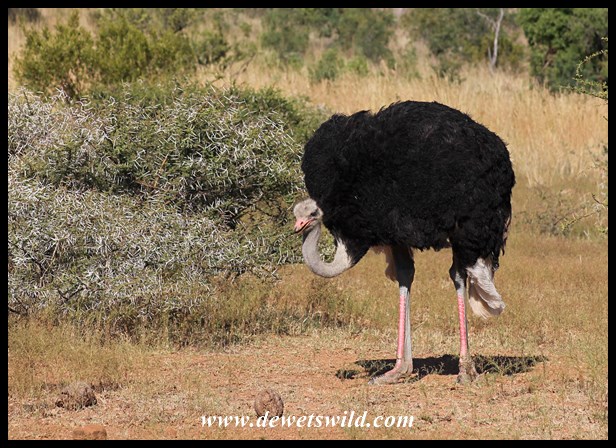
As the biggest bird on the planet, and the fastest creature on two legs, ostriches are familiar to most people. Males stand up to 2.8m tall and weigh up to 160kg, females are usually a lot lighter in build.

Ostriches occur in open habitats, and are commonly found in open grasslands, arid savannas, semi-deserts and even true deserts, where they are superbly adapted to cope with the hot and dry conditions. They feed mostly on plant material such as seeds, fruits, leaves, grass and flowers, but will also gobble up any invertebrates and small mammals and reptiles it comes across. They’ll swallow stones to assist in breaking down tough plant material in their gizzards. Ostriches do not need to drink water regularly, but when it is available they will drink readily and will even bathe to cool off.

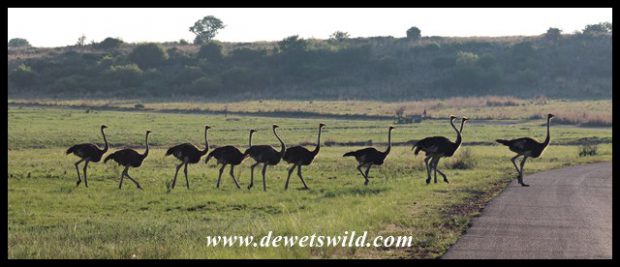
Ostriches are usually to be found in pairs or small flocks, though larger groups of up to 100 are not uncommon. They also often associate with herds of plains zebra and antelope, who also benefits from the ostriches’ exceptional eyesight. Ostriches are extremely capable runners, covering 3 to 5m in a single stride and reaching speeds of up to 80km/h – they can run the 100m in 5 seconds! Even a month-old chick can outrun a lion. They also have exceptional stamina and can run for half an hour at a speed of 50km/h. Their two-toed kick is legendary and armed by a long claw can easily kill a predator or human through disemboweling when they feel threatened or are protecting their offspring. These flightless birds are diurnal, and most active in the early morning and late afternoon. Like many other birds, ostriches are very fond of a regular dust bath.

Males utter an impressive booming “roar”, mostly at night during the breeding season, and not unlike that of a lion. Males are polygamous, and perform an elaborate dance for their females before mating. Several females will lay their eggs in the same shallowly scraped nest on the ground – eventually there may be up to 40 eggs in the nest. It is well known that ostrich eggs are huge – weighing as much as 1.4kg, one ostrich egg is equivalent to about 20 chicken eggs. Within each flock there is one dominant hen, and her eggs will be laid in the middle of the nest where they are most assured to be incubated, while “minor” hens’ eggs are pushed to the side – eventually only up to about 20 (usually 12 – 16) of the eggs in the nest will be successfully incubated. The differently coloured plumage assists in camouflaging them while incubating, as females mostly incubate the eggs by day, and the males by night. While on the nest, ostriches will often lie with their necks outstretched on the ground so that their characteristic outline does not attract unwanted attention on the open plains they inhabit (but they don’t bury their heads in the sand as is often thought). Eggs hatch after 40 – 48 days and the hatchlings are looked after by both parents. The cryptic colouration and markings of the young chicks are excellent camouflage. Hyenas actively search out ostrich nests to eat the eggs, and almost all Africa’s predatory mammals and larger birds of prey will go after chicks. Adults fall prey to lions, leopards, spotted hyenas, cheetahs and wild dogs. Though only about 15% of hatchlings survive to 1 year of age, ostriches can live up to 40 years in the wild, and even longer in domesticated situations.

Ostriches can be found across most of South Africa, in both state and private conservation areas, although the majority of these populations stem from hybrids bred for the feather trade and only a few flocks, such as those in the Kruger National Park and Kgalagadi Transfrontier Park, are truly wild. Ostriches are also farmed in large numbers for their feathers, leather and lean meat and some of these farms, notably around the town of Oudtshoorn, have become tourist attractions in their own right. Despite the fact that ostrich populations are declining due mostly to loss of habitat, the IUCN considers the species of least concern at the moment.

ostrich-20


Roan Antelope

Hippotragus equinus

Standing 1.5m high and weighing up to 300kg, the Roan Antelope is one of the biggest antelope occurring in South Africa. Their black-and-white face masks and curiously long ears make them easily recognisable.

Roan Antelope are grazers, occurring in lightly wooded savannas and preferring areas with long grass and easy access to drinking water.

Breeding herds, usually numbering between 2 and 15 animals, consist of a dominant bull, cows and calves that occupy a specific home range of up to 200km² (the size of which depends on the availability of quality grazing and water sources) for generations. While they are not strictly territorial, the lead bull will not tolerate other bulls coming closer than 300 – 500m from his harem.

Single calves are born at any time of the year, though mostly in spring and summer, and remain hidden for the first 2 – 6 weeks after birth with the mother returning to it twice daily for nursing. Calves form “creches” once they are introduced to the herd, rather than constantly sticking to their mothers’ side. The curved horns of the adults are formidable weapons, and even lions are wary of attacking them, though calves are easy prey as they’ll try to remain hidden and will seldom attempt to flee when threatened by a predator, explaining in part why up to 40% of calves die before reaching 5 months of age. Roan Antelope have a natural life expectancy of up to 19 years in the wild.

In Africa as a whole, the roan population is estimated at around 76,000 by the IUCN, with an overall decreasing trend due to poaching and habitat loss. In South Africa they are a rare species, numbering perhaps 1,500 in total, with small populations to be found in the Kruger, Marakele and Mokala National Parks, a few provincial nature reserves and on some private properties.

Gemsbok

Oryx gazella

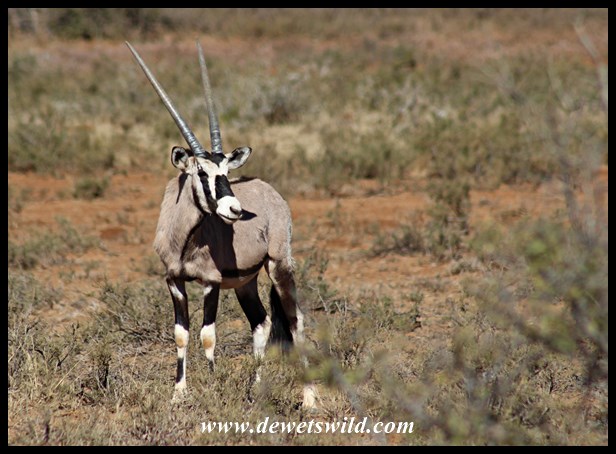
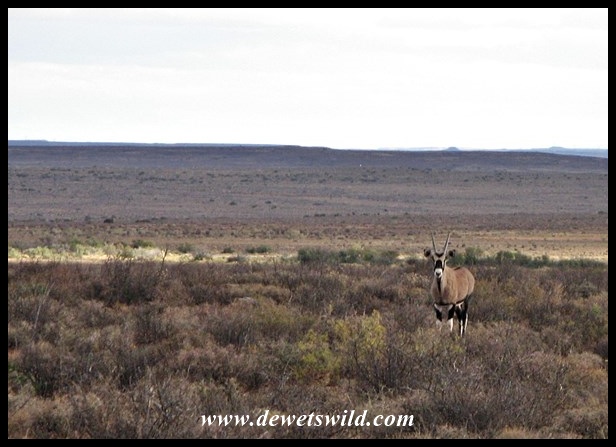
The large and beautiful Gemsbok (also known as the Southern Oryx) is synonymous with South Africa’s arid Karoo and Kalahari regions. They occur under the harshest imaginable conditions in the Namib desert, but also in a wide range of more hospitable environments, such as open thornveld, mopane shrub and open grasslands, and are often encountered on rocky hillsides in these areas. Gemsbok are mixed feeders, consuming mostly short grass, leaves and shoots, roots and tubers, fruits and seedpods, showing specific preferences in each season. They are entirely independent of drinking water, but will drink up to 9 liters a day when it is available.

Gemsbok (6)

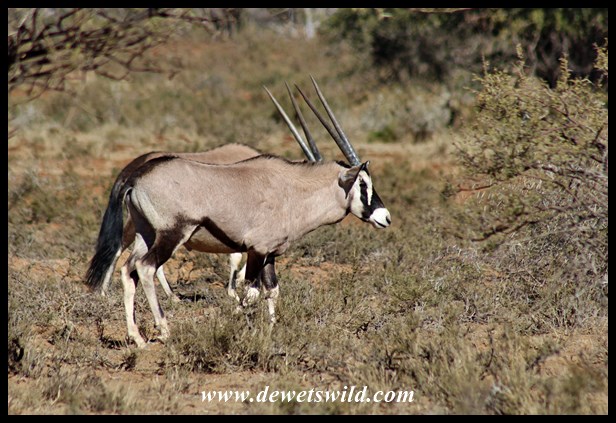
Gemsbok bulls can weigh up to 240kg and stand up to 1.3m high at the shoulder. Cows are slightly smaller in build, but usually have longer (and thinner) horns. For such large animals they are superbly adapted to a life in harsh, arid environments, being able to concentrate their urine and reabsorbing the maximum possible moisture from their dung. Gemsbok can even allow their body temperature to rise from a normal 36°C to 45°C before having to sweat and pant to cool down!

Gemsbok occur in herds consisting of cows, calves and non-breeding bulls that move over the territories of several dominant territorial breeding males. The mixed herds are normally quite small, numbering between 5 and 40 animals, but can at times form temporary aggregations of up to 300 strong in response to favourable localised conditions. Breeding herds can cover enormous home ranges, especially during times of drought. They are normally active in the early morning and late afternoon, and often throughout the night, resting up during the heat of the day in any available shade.

Gemsbok are brave and aggressive, and thus very dangerous, especially when wounded or cornered or when protecting their calves. Single calves are born away from the herd at the end of the dry season, and remain hidden for the first few weeks after birth. Mothers return to the calves twice daily for nursing until she introduces the calf to the herd at between 3 and 6 weeks of age. Adult Gemsbok are only attacked by lions and spotted hyenas, who are often killed in the process, but unattended calves are easy prey for most of Africa’s predators. Gemsbok have a natural life expectancy of up to 20 years.

Gemsbok (3)

Gemsbok occur in South Africa, Zimbabwe, Botswana and Namibia, with the IUCN estimating a total population of between 326,000 and 373,000 and recognising no major threats to their continued survival. South Africa’s biggest single population of Gemsbok occur in the Kgalagadi Transfrontier Park, but they can also be seen at Karoo, Mapungubwe, Marakele, Mokala and Mountain Zebra National Parks, several other game and nature reserves, and on many private farms, where they are a popular game ranching species. The Beisa Oryx (Oryx beisa) from East Africa is now considered a seperate species.