Tag Archives: nature

Stork Buffet at uMkhuze

While driving around the uMkhuze Game Reserve one afternoon in March, we happened upon a seemingly insatiable Woolly-Necked Stork catching juvenile catfish in a drying mudpool. We watched the stork gorge itself on one fish after another, amazed at the ease with which it could grab its slippery, squirming quarry from the “all you can eat buffet table”, until there was no more splashing from the pool at his approach…

Addo’s new Nyathi Rest Camp

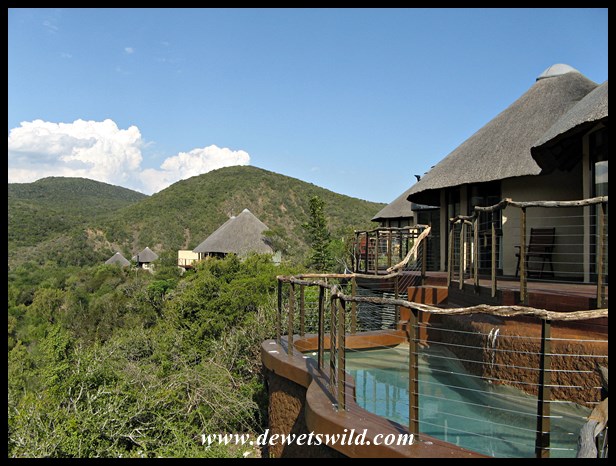
View from Addo’s new Nyathi Camp

SANParks has opened its newest accommodation offering in the Addo Elephant National Park: the luxurious new Nyathi Rest Camp. The new camp is set atop a hill with magnificent views from every spacious accommodation unit over the valley below and the rolling hills beyond, and a real possibility of seeing any of the “Big Five” from the comfort of your private veranda.

The camp offers eight 2-bed units, one 4-bed unit and two 6-bed units, each equipped with air-conditioning, satellite television, equipped kitchens, bathrooms with splendid views and private splash pools.

Amenities such as a restaurant, shop, fuel station and guided game drives are available at Addo’s main camp, an easy 20km drive away along sedan friendly gravel roads.


African Bullfrog

Pyxicephalus edulis

While I doubt it reached proportions that would convince the Pharaoh to allow the Israelites to leave Egypt, the “eruption” of little froglets we saw at uMkhuze Game Reserve during our recent visit was quite fascinating. Rain or shine, literally hundreds (if not more) of tiny frogs could be seen jumping around on the roads all over the reserve, making driving quite tricky if you didn’t want to squash them under the vehicle’s wheels.

Thanks to the help of the iSimangaliso Wetland Park the little ones were identified as juvenile African Bullfrogs (also known as Edible or Lesser Bullfrogs), a species that occurs over wide areas of Eastern, Central and Southern Africa, and indeed is eaten by humans in many countries where they occur. Though these newly metamorphosed juveniles were only about the size of a thumbnail, the African Bullfrog can grow to 12cm in length.

African Bullfrog

They can be found in seasonally flooded savannas and grassy woodlands, remaining dormant underground for most of the year (up to 10 months) and emerging only when sufficient rain has fallen for breeding to commence. During the breeding season males act very aggressively towards one another and will even kill each other. Eggs are laid in well vegetated, shallow, seasonal bodies of water where the males guard the eggs and tadpoles against other males and predators. Interestingly, when the tadpoles’ pools start drying up the males will dig channels to deeper pools. African Bullfrogs feed on a variety of invertebrates and small vertebrates, including other frogs, and feature in turn in the diets of various species of birds, reptiles and mammals (humans included).

During a visit to the Kruger National Park in December 2019 we witnessed the breeding habits of the African Bullfrog following a few days of continuous rain.


Two days in Kruger

How much can you see in only two days in the Kruger National Park? Well, as this gallery taken over less than 48 hours around Skukuza Rest Camp during March 2017 proves, a whole lot actually!


Skukuza Nightlife

One of our favourite activities when out visiting South Africa’s wild places is to search the grounds of the places where we are staying with a flashlight at night, looking for nocturnal wildlife. Skukuza, being the biggest of the camps in the Kruger National Park, is usually especially productive, as most of the wildlife inhabiting the camp is exceptionally used to having humans gawking at them!

The pond in front of Skukuza’s reception is a wonderful place to photograph a variety of amphibians – on our latest visit the reeds and rocks there were alive with the calls of male Painted Reed Frogs and Sharp-nosed Grass Frogs trying their best to impress their female counterparts.


Playing hide-and-seek with a leopard

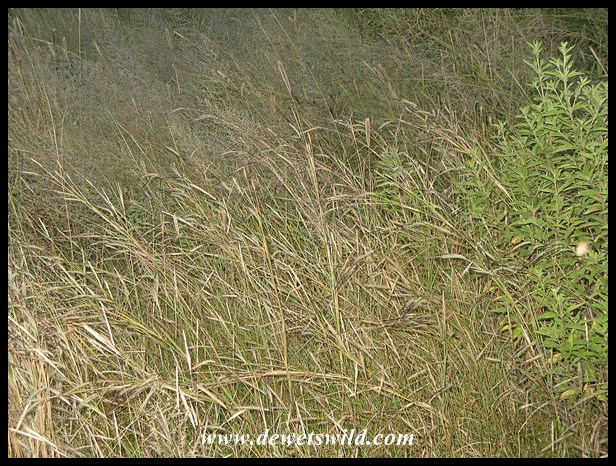
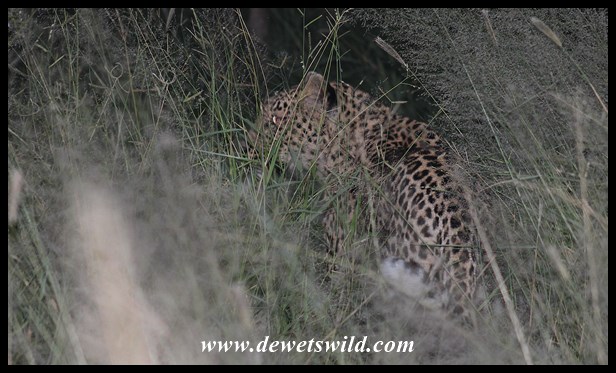
Believe it or not, but in the middle of this picture there’s a leopard hidden in the grass. Don’t worry; If I didn’t see her walk in there I wouldn’t have known it either.

Luckily she grew tired of her hiding spot, got up and walked into even denser vegetation, allowing just one quickly fired shot as proof…

This leopard was lying not two meters from our car and was totally invisible – what wonderful camouflage these cats have!

(Seen along the H3-road just south of Skukuza on Friday last week as we were departing from the Kruger National Park)

Alone time with the King of Beasts

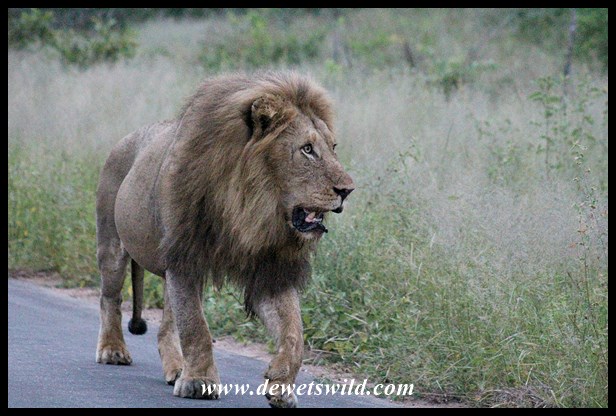
A week ago, on an early morning drive along the Sand River near Skukuza in the Kruger National Park, this magnificent male lion popped out of the thickets to patrol and mark his territory along the road.

After spending quite a bit of time with him as he walked at pace along the river road, mostly within arm’s length of the vehicle, another car arrived on the scene, and I drove off in order to allow them the thrill of some alone time with The King as well.

White Stork

Ciconia ciconia

Everyone will quickly recognise the White Stork as the legendary bird responsible for the delivery of newborn babies. These large, strikingly pied birds stand over a metre tall, has a wing span of up to 2 metres and weighs as much as 4kg.

White Storks migrate in enormous flocks (numbering hundreds or even thousands) from Europe, North Africa and Western Asia to Sub-Saharan Africa to spend the summer in our warm weather, the first birds arriving around September and the last departing again by April or May. At those times they are a regular sight in savannas, grasslands and cultivated fields right across South Africa, often close to water, feeding in flocks usually numbering from 10 to 50, though larger groups of several hundred are not uncommon. White Storks are diurnal in habit, roosting communally at night. They feed mainly on insects (but also rodents, reptiles and frogs), and often take advantage of fires to catch prey escaping the flames. Only a handful of pairs breed here, and only in the Western Cape. Nests are constructed of sticks in high trees or on top of buildings or other man-made structures, and often used for several consecutive years, even decades. As the nests are continuously expanded they can become quite huge over time, and are often shared by other kinds of birds. Pairs will build their nests in isolation or in loosely associated small colonies of up to 30 pairs. Up to 7 (more usually 4) eggs are laid and incubated for 33 days or so by both parents. The chicks stay in the nest for about two months after hatching.

The IUCN estimates the White Stork’s total global population at about 700,000 and growing, and considers them to be of least concern in conservation terms. The use of agricultural pesticides and subsequent poisoning, electrocution by overhead powerlines and habitat destruction are considered major local threats to the White Stork.

Fresh out of the bush

We’re fresh back from visits to the Kruger National Park and uMkhuze Game Reserve (part of the iSimangaliso Wetland Park) and of course we have lots of photos and stories to share – so stay tuned!

We’ll also be catching up with all the comments you’ve left for us while we were away in the coming days, I promise!

African Spoonbill

Platalea alba

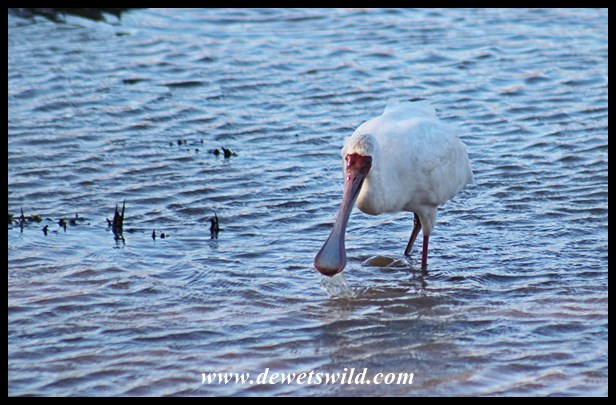
The African Spoonbill is a large wading bird (90cm long, weighing up to 1.8kg) with a characteristic spoon-shaped beak.

They can be found at shallow bodies of freshwater – natural and man-made lakes, pans, rivers, marshes, floodplains, estuaries and even sewerage works – where they feed on small fish and aquatic invertebrates caught by moving their bills sideways through the water. Spoonbills can often be seen close to hippos and crocodiles, hoping that these large animals will flush something edible. Breeding is timed to start just before or during the rains. They nest colonially in trees, reedbeds or on rocky islands and ledges, usually in groups numbering from 5 to 250 or more monogamous pairs and often together with other species of waterbirds as well. The nests are platforms built of sticks and reeds in which 3 to 5 eggs are incubated for around 4 weeks by both parents.

The African Spoonbill has a wide distribution and stable population, and is considered of least concern by the IUCN. They occur over almost all of South Africa with the exception of the arid northwestern corner of the country, and further range over most of Sub-Saharan Africa (except the equatorial forests) and Madagascar.