Tag Archives: Millipede

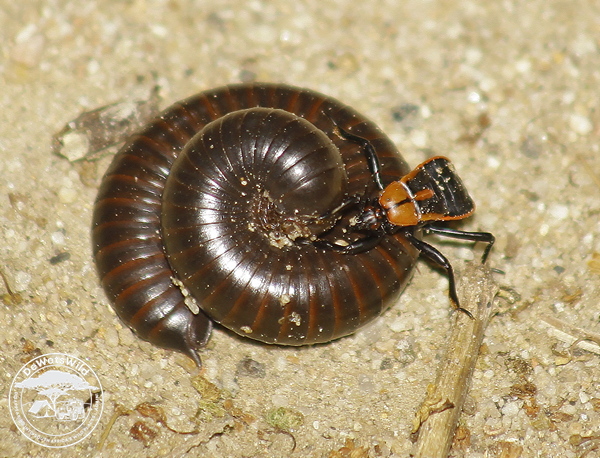
Summer Snapshots from Kruger: An assassin caught in the act

DeWetsWild conducted a two-week tour of the Kruger National Park with altogether nine people to see out 2025 and ring in 2026 and every day for the month of February I’ll be sharing just a few of the many memories our group collected.

One of the things I love to do with my guests in the evenings is to take a walk through our camp looking for nocturnal wildlife. On one occasion we were strolling through Tamboti Tented Camp when we came across an Assassin Bug attacking a rather large Millipede. Now matter how much the millipede squirmed, trying to wriggle and writhe the assassin bug off its body, this was a fight it was not going to win… We watched as the assassin stabbed its prey with its proboscis (modified mouth parts), injecting its victim with saliva that is a concoction of toxins and digestive enzymes which eventually kills the millipede and liquifies its insides, allowing the assassin bug to suck its fill.

If you’d like to join me on a guided tour of South Africa’s wild places, of even if you’d just like a bit of help putting your reservations together, don’t hesitate to reach out!

Millipedes

Millipedes are among the most ancient of animals in all of Creation, and more than 12,000 species populate the planet. Only one known species actually has a thousand (or more) feet as the translation of their name from Latin would imply, with most boasting anywhere between 40 and 400 legs – still a number huge enough to be deserving of all the jokes told of them being late for some event or another due to the time it takes to tie their shoelaces…

Millipedes feed on a wide range of decaying organic material, playing a massively important role in the nutrient cycle of the ecosystems in which they occur, ranging from tropical forests to deserts. Depending on the species females may lay up to 300 eggs, which hatch after a few weeks. The tiny hatchlings usually have only 6 legs, adding more segments and legs to their body every time they moult. Some species of millipede may live for up to 10 years.

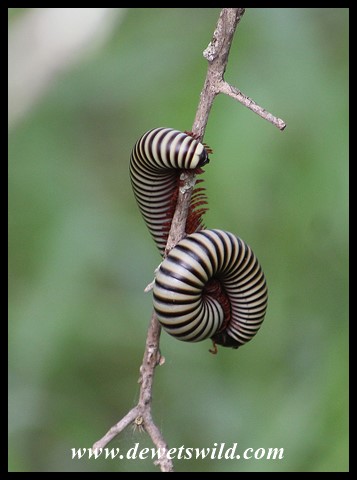
The most endearing trait exhibited by most species of Millipede, and also the primary protection measure they employ, is to roll into a tight coil that protects their legs and undersides. Others again may start wriggling manically to imitate a snake! Many species also excrete a noxious substance that make them unpalatable for almost all predators.

Millipedes range in size from tiny 2mm midgets to giants of 35cm in length.