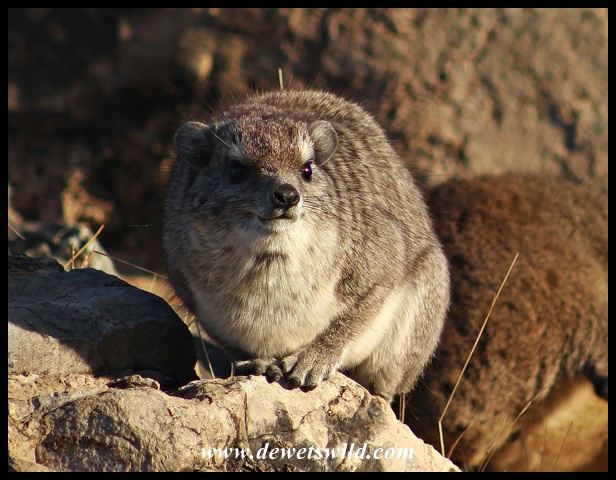
A fact that is not well-known, even among South Africans, is that our country is home to two different kinds of Dassie, or Hyrax, that live mainly in rocky terrain. We’ve already featured the species most people are acquainted with, the Rock Dassie (Procavia capensis), which is widely distributed throughout all our provinces. By contrast, in this country the Yellow-spotted Rock Dassie occurs only in our northernmost province, Limpopo, and often in mixed communities of both species numbering from a few to more than a hundred. The rugged Mapungubwe National Park is an excellent place to see them.


Heterohyrax brucei
Like their better known relatives, Yellow-spotted Rock Dassies are herbivores that feed on a wide variety of plant material, with leaves forming the bulk of their diet. They are fairly independent of drinking water. Yellow-spotted Rock Dassies are also diurnal and love basking in the sun. They’re excellent at climbing around in trees, which they do mostly for feeding as they’d usually take cover among the rocks in case of danger. One of the group is always on sentry duty while the rest feed.
The basic social unit of a colony of Yellow-spotted Rock Dassies consist of a dominant, territorial male with a harem of adult females and their young. They breed throughout the year, females usually giving birth to 2 babies. Adult Yellow-spotted Rock Dassies weigh between 1.5kg and 3.5kg and measure between 30cm and 50cm in length. They seldom live to older than 11 years in the wild, and usually much shorter.
With its distribution extending northwards well beyond Limpopo Province all the way to Sudan, the IUCN considers the Yellow-spotted Rock Hyrax to be of least concern.
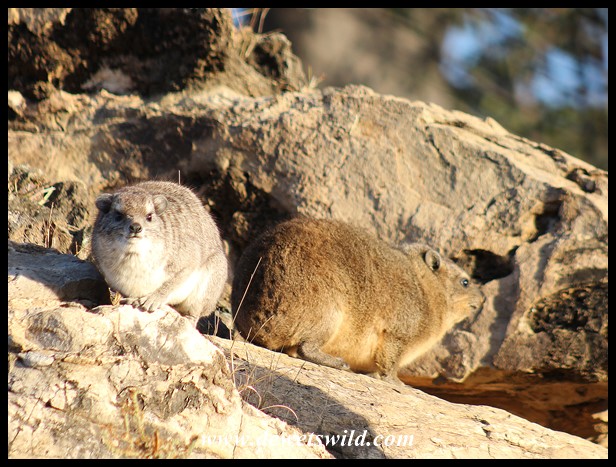
Yellow-spotted (left) and Rock Dassie (right) sharing the sun in Mapungubwe
 DeWetsWild