
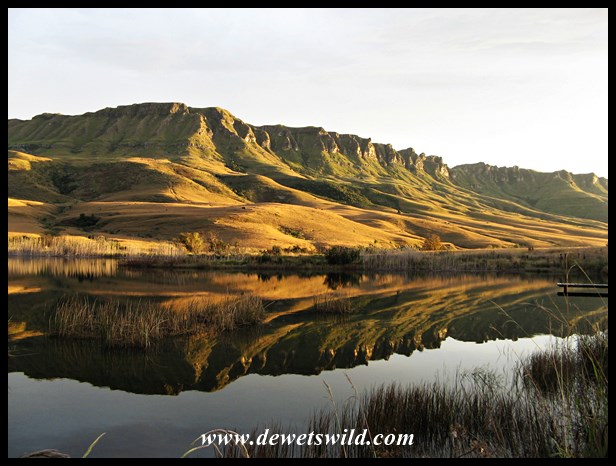
Talk about South Africa’s most scenic natural attractions, and the Drakensberg mountain range is sure to feature in the conversation. The Kamberg is a distinctive mountain, reminiscent of a comb (“kam” in Afrikaans, “berg” meaning mountain), in the foothills of the Drakensberg. The Kamberg Nature Reserve was originally proclaimed in 1951, covering only 2,232 hectares. Today it forms an integral part of the uKhahlamba Drakensberg Park‘s expansive 243,000 hectares of protected mountain paradise, recognised by UNESCO as a World Heritage Site of natural and cultural significance. Grasslands predominate, though forested sections exist in the sheltered valleys and extensive reedbeds and wetlands can be found along the Mooi (“pretty”) River, which forms a focal point for the reserve.


Whatever your energy levels, there’s ample opportunities to enjoy the refreshing mountain air at Kamberg. The reserve is well known in fly-fishing circles, with the Mooi River and two dams stocked with (admittedly exotic) trout. There’s three small, but well maintained, picnic sites – one in a copse of trees at the gate, one on the banks of Eland Dam, and one next to the river. Of course there are several trails leading down into the valleys and up into the mountains that may be explored on foot or mountain bike. And there’s a jungle gym and swings to keep the younger generation entertained within shouting distance of the chalets up at the camp.


The tiny camp at Kamberg, managed by Ezemvelo KZN Wildlife, is heaven-on-earth to any weary city dweller searching for peace and quiet, as there’s only 5 two-bedded chalets and one six-sleeper cottage at the camp. Eight kilometers from the main resort, the rustic and isolated Stillerust (Afrikaans for “quiet rest”) Farm House provides accommodation for ten guests. There’s a very limited selection of cooldrinks and sweets on sale at reception, and guests should bring along all their own provisions, firewood included. Just behind the camp, at the reception office, is the Kamberg San Rock Art Interpretive Centre where educational films on the San rock art of the Drakensberg are shown and from where the guided walks to the Game Pass Shelter departs. It’s a three-hour round trip to the internationally renowned cave, where high quality San paintings that were instrumental in deciphering the meaning behind the images left by these hunter-gatherers on rock faces across Southern Africa, can be appreciated. Unfortunately the prevailing weather conditions kept us from visiting the cave on this trip, but that’s reason enough in itself to return soon! For guests staying longer, Kamberg is also an ideal base from which to explore other destinations in the Drakensberg, such as nearby Giant’s Castle, and Midlands attractions like Midmar Dam, Karkloof Conservancy, Umgeni Valley Nature Reserve and Queen Elizabeth Park.


During our visit, the local wildlife mostly remained well hidden in the long, flowing grasslands through the day, except for a water mongoose that flashed across the trail next to Erskine Dam, a troop of baboons that sauntered through the camp one afternoon and a distant herd of black wildebeest we saw on the plains near Stillerust. At night however literally dozens of antelope; reedbuck, grey rhebuck and grey duiker, and hares and rabbits would come out to graze on the lawns between the chalets at the camp.


The Drakensberg is home to an amazingly diverse birdlife, with several rare and endemic species occurring at Kamberg. We were thrilled to see several pairs of grey crowned cranes in the wetlands, but absolutely overjoyed by our first ever sighting in the wild of the highly endangered wattled cranes, even if the breeding pair was quite far off in the distance and our photograph nothing more than proof of the sighting 😉


Speaking of cranes, we paid a quick visit to the Hlatikulu Crane Sanctuary on the nearby property of the Entabeni Education Centre where they take care of injured and orphaned blue, crowned and wattled cranes and do more than their share to preserve these special and endangered birds for South Africa’s future generations.


From Pretoria, it’s a drive of approximately 540km to Kamberg, following the N3 southwards to Mooi River. The road to the reserve turns off the R103 at Rosetta, between the Midlands towns of Mooi River and Howick. The 40km (30km tar and 10km gravel) stretch between Rosetta and Kamberg is a very scenic drive through green farmlands and the foothills that constitute the “Little ‘Berg”, and should not be rushed (the road is not in a good enough condition to travel on at speed in any case).
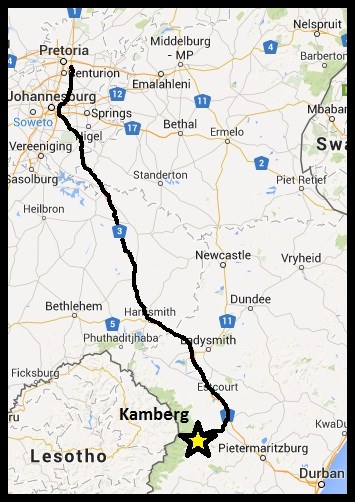
Pretoria to Kamberg (drawn from Google Maps)
Our first visit to Kamberg over a long weekend early in May 2015 opened only a tiny window onto the rich cultural and natural treasures protected there. We’ll be back for sure; there’s still so much to explore, experience and appreciate at this little known gem of “the ‘Berg”.
 DeWetsWild