Tag Archives: Eastern Shores

Summertide Diary: Exploring iSimangaliso (part three)

19 January 2021

The Grassland Loop is the first turnoff from the main tarred road you reach after leaving Cape Vidal. And because we just love taking the backroads while exploring South Africa’s wild places that is invariably the route we opt for – it criss-crosses a variety of habitats (from forest to grassland to swamp) and skirts the shores of Lake Bhangazi, which always has something interesting to see.

This morning we were particularly lucky with what we found on the Grassland Loop – a pack of four Spotted Hyenas who showed just a mild interest in a few Plains Zebras and Blue Wildebeest grazing nearby.

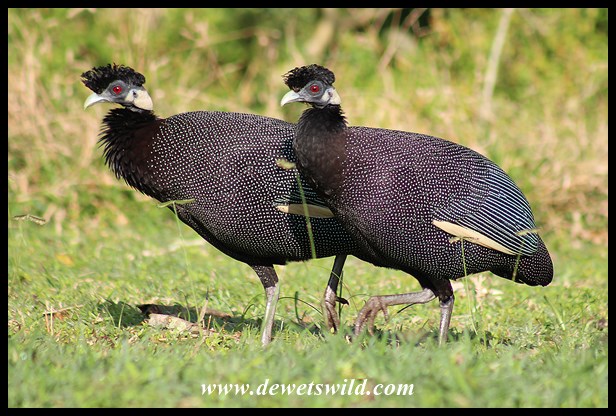
The Grassland Loop completed and now heading to our breakfast spot, an extended family of Crested Guineafowl crossed our path – not something we get to see often and very excited at the pictures we got of them.

Passing through a forested patch we were entertained by a troop of Vervet Monkeys and, while watching them, a few other denizens of the forest also came into view.

We needed to stock up on our fresh food and drinking water supply today, so headed south to Bhangazi Gate and the holiday town of Saint Lucia.

Right at the Bhangazi Gate the Crocodile Centre is always a worthwhile place to stop and learn more about the Nile Crocodile – a key component of the ecosystem of Lake St. Lucia. The centre houses some really impressive specimens, many of them rescued from poachers’ traps or after becoming problematic in nearby communities, and their progeny are then released back into the wild. Furthermore there are two other species of crocodiles from equatorial Africa and American alligators on show, and a myriad of other animals and birds have also made themselves at home at the centre.

After a relaxed hour or so at the Crocodile Centre we tackled the 4km round trip hike from the parking area at Sugarloaf to the mouth of Lake St. Lucia. While the distance isn’t daunting at all the heat and humidity and trudging through the hot, deep sand proved more of a challenge than we anticipated, and the sight of a huge Nile Crocodile basking on a sandbank was all the convincing we needed not to dare cool our feet in the water. In the end the beautiful scenes we enjoyed more than made up for the heat-stroke risk though.

Our shopping completed we headed back to Cape Vidal. In the midday heat there wasn’t much to be seen along the way. Only mad dogs and Englishmen… and the de Wets… venture out in the midday sun. An outing to the beach was on the cards for the afternoon. Yellow-billed Kites flying overhead regularly swooped down to catch an unwary crab, but they knew better than to trifle with the bluebottles drifting in the waves.

Walking back to our cabin there was an enormous commotion in the tree-tops owing to screeching Vervet Monkeys and alarm-calling Hadedas. Looking up, we’re just in time to see a Crowned Eagle flying off with a large prize in its talons and an empty hadeda nest… We then noticed another Crowned Eagle surveying the area from high in a Cassuarina-tree and watched it until it flew off in the direction of the cabins. More about them tomorrow…


Map of the eastern shores section of the iSimangaliso Wetland Park (from https://isimangaliso.com/)

Summertide Diary: Exploring iSimangaliso (part two)

18 January 2021

Our morning drive may just have been a relatively short circuit around the Grassland Loop, passing the shores of Lake Bhangazi, and then back to Cape Vidal, but we saw so much that it actually took quite a few hours to complete.

Cape Vidal really is the most wonderful combination of a beach holiday and a bush safari. I need to be honest here: I get bored on the beach reeeaaally quickly when it is high-tide. Therefore it is marvelous to be able to just walk over the first dune and start looking for forest birds and animals without having to distract Marilize and Joubert from whichever wet or sandy pursuit they’re enjoying at that point in time, and then quickly pop back over the dune every now-and-then to check that the sea hasn’t disappeared yet! 😀

Our very leisurely afternoon outing took us south to Catalina Bay and then slowly back to camp. A strong wind and ever darkening skies accompanied us all the way.


Map of the eastern shores section of the iSimangaliso Wetland Park (from https://isimangaliso.com/)


Summertide Diary: Exploring iSimangaliso (part one)

17 January 2021

It’s a cloudy start to the day at Cape Vidal and the route for our morning drive takes us along the Grassland Loop and then to the viewpoint at Catalina Bay on the shores of Lake St. Lucia. Recent rains have swelled the lake to proportions I don’t think we’ve seen on any of our numerous previous visits to the area.

We’re slowly making our way to the picnic site at Mission Rocks for breakfast.

On arrival at Mission Rocks we delay our breakfast of coffee-and-rusks just a little to first walk down to the rocky beach and look out over the ocean. But its windy and drizzly so we don’t stay at the seaside too long before going to hide in the forest, where the picnic tables are also frequented by some colourful birds with the same aching for something to eat that we had.

Driving further south the sun finally puts in appearance and the bush becomes alive as birds and animals come out of hiding.

We turn for camp at Amazibu Pan, where the hippos are kept from their sleep by a raucous assortment of birdlife.

Heading back to Cape Vidal there’s three short loop roads that offer an alternative to the busier tarred main road, and each of them offers a glimpse into a different ecosystem. The first of these is the Vlei Loop that passes several open pans where animals congregate to drink.

The Forest Loop passes the kuMfazana Hide, where we discover a butterfly paradise – more about that tomorrow!

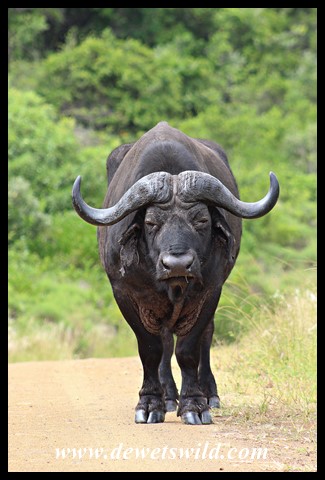
A turnoff from the Dune Loop leads to the Kwasheleni Tower – a new facility opened after our previous visit to iSimangaliso that we were very curious to see – but a sour old buffalo bull tried his best to keep us from reaching it.

Our patience paid off when the buffalo eventually relented and we could reach the viewing tower without further hindrance (unless you see the climbing up the dune and then the tower as an obstacle). The views afforded over Lake St. Lucia and the iSimangaliso Wetland Park from up the top of the tower was amazing.

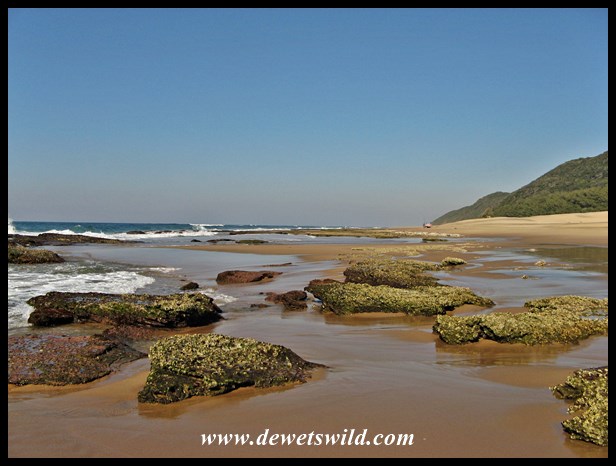
Arriving back at Cape Vidal around the same time the clouds did, we nevertheless didn’t want to pass on the opportunity to explore the rock pools at low tide.

Having lunch on the deck of our log cabin we were visited by a variety of the local wildlife.

We didn’t take a very long afternoon drive, just a two-hour excursion along the Grassland and Dune Loops and back to camp.


Map of the eastern shores section of the iSimangaliso Wetland Park (from https://isimangaliso.com/)


Summertide Diary: Arriving at Cape Vidal

16 January 2021

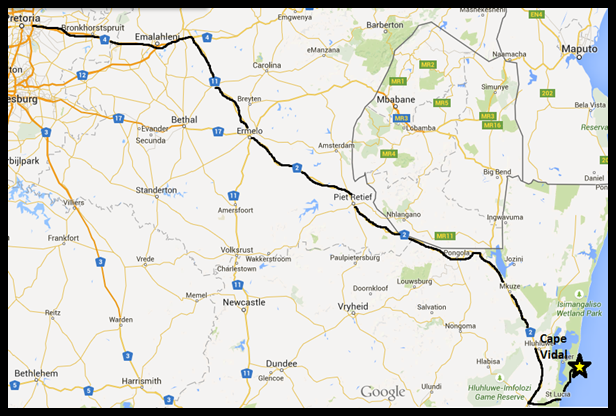
Thankfully our government didn’t opt to impose even stricter lockdown regulations following the festive season spike in covid-infections and so, after 13 days at home in Pretoria we could recommence our summertide rambles, this time heading to Cape Vidal on the eastern shores of Lake St. Lucia, in the iSimangaliso Wetland Park. After 7-and-a-half hours on the road we finally arrived in the holiday town of St Lucia and, after filling up on fuel and stocking up on eats and drinks we couldn’t wait to enter Bhangazi Gate for the 30km drive to Cape Vidal.

The Bhangazi gate into the Eastern Shores of Lake Saint Lucia lies roughly 610km South-East of Pretoria.
(Drawn using Google Maps)

This is one of our favourite destinations and sadly in the midst of South Africa’s first wave of the pandemic a booking we had to come to Cape Vidal in the winter holidays of 2020 had to be postponed. We were so grateful to be back now.

We were allocated log cabin #1 at Cape Vidal – although it’s the first unit as you drive into the accommodation area of the camp it was still very privately situated and surrounded by bush.

After settling into our accommodation there was only one place we wanted to go – the beach – even if by then some heavy cloud cover had started to move in from the Indian Ocean.


Map of the eastern shores section of the iSimangaliso Wetland Park (from https://isimangaliso.com/)


iSimangaliso’s Eastern Shores – A Photographic Journey (Part 4)

Time to wrap up the photographic trip report of our recent visit to the Eastern Shores of Lakes St. Lucia, with a gallery of some of the larger animals we encountered on land and sea in the place of miracles and wonders – the iSimangaliso Wetland Park.

Follow the links for more of our posts about St. Lucia town, Cape Vidal and Mission Rocks.


iSimangaliso’s Eastern Shores – A Photographic Journey (Part 3)

On the Eastern Shores of Lake St. Lucia, the amazing diversity of life forms comes in all sizes. The star of this collection of photos showcasing some of the smaller creatures that crossed our path on our recent visit must be the tiny frog that somehow got into my mug while we were enjoying coffee and rusks one morning at Mziki viewpoint near Mission Rocks. Exactly when it got into my coffee is unclear – I had put my mug down a few times to take pictures – and I have no idea how much of my coffee I had shared with the little guy. Joubert only noticed it sitting in the cup when I took my last swig as we started packing up to leave. Lucky for it, I drink a lot of milk in my coffee so it wouldn’t have been scalded.

Follow the links for more of our posts about St. Lucia town, Cape Vidal and Mission Rocks.

iSimangaliso’s Eastern Shores – A Photographic Journey (Part 2)

The iSimangaliso Wetland Park is a bird-watcher’s paradise – 526 bird species have been recorded within its borders!

During the few days we recently spent on the Eastern Shores of Lake St. Lucia, we managed to tick 109 kinds of birds, and had we been better at identifying the “Little Brown Jobs” our list would undoubtedly have been quite a bit longer still.

This incredible diversity is surely due to the Park’s rich variety of habitats, and our “success” in connecting with so many kinds of birds can only be ascribed to the terrific collection of roads, hides, picnic sites and other localities so easily accessible to visitors.

We hope you enjoy this sample of iSimangaliso’s birdlife!

Follow the links for more of our posts about St. Lucia town, Cape Vidal and Mission Rocks.

iSimangaliso’s Eastern Shores – A Photographic Journey (Part 1)

We’re fresh back from a terrific holiday in two very special wild places in northern Kwazulu-Natal. Our first destination was the iSimangaliso Wetland Park, and specifically the Eastern Shores of Lake St. Lucia, where we spent one night at Manzini Chalets in the holiday town of St. Lucia, and four nights in a log cabin at Cape Vidal.

I can’t think of a better way to start off the report back on our trip than with a few landscape photos that illustrates why iSimangaliso is a land of “miracles and wonders”, and one of our favourite destinations!

Follow the links for more of our posts about St. Lucia town, Cape Vidal and Mission Rocks.

A winter exploration of St. Lucia’s Eastern Shores

iSimangaliso Wetland Park, South Africa’s first World Heritage Site, is named after the isiZulu word meaning “Miracle” and “Wonder”. Our recent visit to the Park just reminded us again what an appropriate name that is.

Having visited the Western Shores in December last year, we focused our attention during our June visit on the Eastern Shores section of the Park, a diverse area lying between the Indian Ocean in the east, Lake Saint Lucia in the west, St. Lucia town and the lake’s estuary to the south and incorporating the popular destinations of Mission Rocks and Cape Vidal, where we stayed for three nights. The sunrises and sunsets alone made the trip worthwhile!

As always, the game and bird-viewing on the Eastern Shores could only be described as splendid, but the Park is clearly not escaping the ravages of the drought that has Kwazulu-Natal Province in a firm choke hold, and none of the pans close to the roads held any water. Indeed a stark contrast to the lush oases of reeds and waterlilies these waterholes normally are, complete with hippos, crocodiles and wading birds in residence. Even the Mfazana Pans, where there’s a brilliant photographic hide, was little more than an almost-dry puddle of mud.

We seem to have extraordinary luck with finding leopards here and this trip was no exception, with no less than four sightings of these beautiful cats. A late afternoon sighting of a serval, a much smaller but also spotted cat, being chased by a group of lapwings as it crossed a burnt field, was a very pleasant surprise. Unfortunately we didn’t see anything more than a footprint of iSimangaliso’s spotted hyenas during this visit. On the other side of the scale, a tiny snake, the variegated slug eater, was a first-ever encounter for us and one we’ll remember just as long as any of the leopard sightings.

We can never spend enough time at this wonderful place, and you’ll understand that we were not at all pleased that our long weekend flew past in the blink of an eye. Time to start making plans for the next visit then…

The Bhangazi gate into the Eastern Shores of Lake Saint Lucia lies roughly 640km South-East of Pretoria. (Drawn using Google Maps)

The Bhangazi gate into the Eastern Shores of Lake Saint Lucia lies roughly 640km South-East of Pretoria.
(Drawn using Google Maps)

Cape Vidal, the most beautiful beach

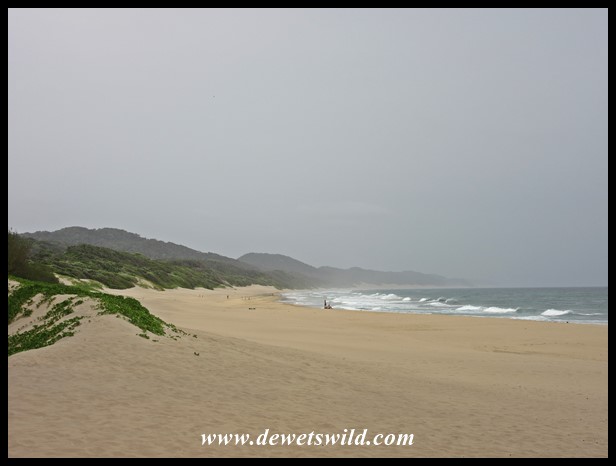
To us, there is no more beautiful a beach in this country than Cape Vidal. Miles of sand stretching as far as the eye can see, lined between densely forested dunes and the warm blue water of the Indian Ocean (in the waves of which dolphins and whales can often be seen), with rock pools harbouring fascinating marine life exposed at low tide.

Cape Vidal is named after Alexander Thomas Emeric Vidal, captain of the British surveying ship HMS Leven, that mapped this coastline in 1822. Today, this pristine area falls within the iSimangaliso Wetland Park, is one of the most popular destinations in the reserve and an excellent base from which to explore the Eastern Shores of Lake Saint Lucia. The accommodation and campsite is managed by Ezemvelo KZN Wildlife and often booked out months in advance. There’s a fuel station and a small shop selling only basic essentials, so it is best to stock-up on your groceries at St. Lucia town before entering through Bhangazi Gate 35km to the south of Cape Vidal. Apart from all the activities that the beach caters for, Cape Vidal is also one of the best spots in the country to easily see a wide variety of otherwise very shy forest birds and animals (like Samango Monkeys and Red Duiker).