Haliaeetus vocifer
If there is one sound that is symbolic of Africa’s waterways, it must be the call of the African Fish Eagle. It is the national bird of several African countries, and the South African presidential jet carries its Zulu name Inkwazi. They occur over almost all of Sub-Saharan Africa in close association with rivers, lakes, dams, swamps, estuaries and lagoons. As can be deduced from their name, African Fish Eagles subsist mainly on a diet of fish (weighing up to 2kg) snatched from the water in flight, though they will also catch baby crocodiles, terrapins, small mammals and other birds (up to the size of flamingos), scavenge the catches of other waterbirds like storks and herons and feed on carrion. Adults can weigh over 3kg and have a wingspan of almost 2.5m.
African Fish Eagle pairs are monogamous, pair for life and maintain their territories year-round, nesting in tall trees or on cliffs near water. Their nests are large, built of twigs and reeds. In South Africa the breeding season coincides with the drier months of the year, when fish are easier to catch in dwindling pools. Clutches contain up to three eggs, and are incubated mostly by the female for about 6 weeks. The parent birds are usually successful in raising all their chicks to fledging at about two-and-a-half months of age, whereafter the young stay with their parents for another three months or so. Newly independent juveniles often congregate in flocks that can number as many as 75 birds. African Fish Eagles have a life expectancy of up to 24 years in the wild.
The IUCN lists the African Fish Eagle as being of Least Concern, siting its large, stable population estimated at about 300,000, wide distribution and no real threat from humans. They can be found in all South Africa’s provinces – even penetrating the arid west along the course of the Orange River and its tributaries.

African Fish Eagle on the Letaba River

African Fish Eagle

African Fish Eagle flypast

African Fish Eagle

African Fish Eagle in low-level flight over Midmar

African Fish Eagle

African Fish Eagle

African Fish Eagle

African Fish Eagle

African Fish Eagle

African Fish Eagle

African Fish Eagle

African Fish Eagle

African Fish Eagle

African Fish Eagle

Immature Fish Eagle at Batlhako Dam

Immature Fish Eagle in flight

Immature African Fish Eagle

African Fish Eagle

African Fish Eagle

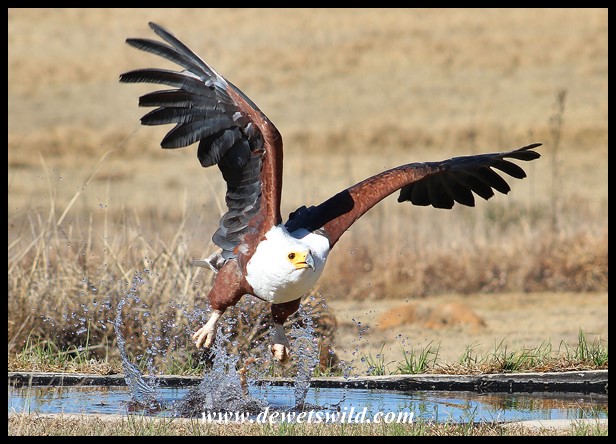
Fish Eagle taking off (Photo by Joubert)

African Fish Eagle

African Fish Eagle

Fish Eagle (photo by Joubert)

African Fish Eagle

African Fish Eagle in flight with nesting material

African Fish Eagle

Immature African Fish Eagle

African Fish Eagle

African Fish Eagle

Young Fish Eagle overhead

Fish Eagle

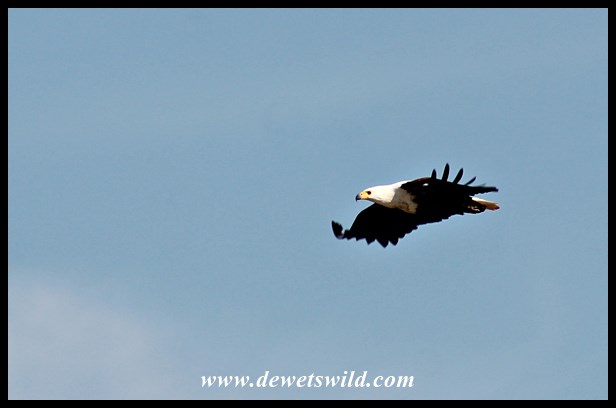
Fish Eagle in flight

Fish Eagle keeping watch over a pool in the Nwaswitsontso.

African Fish Eagle in flight

African Fish Eagle

African Fish Eagle

African Fish Eagle (photo by Joubert)

African Fish Eagle

African Fish Eagle

Fish Eagle (photo by Joubert)

Fish Eagle with prey

Adult African Fish Eagle in flight

Immature African Fish Eagle in flight

Fish Eagle (photo by Joubert)

African Fish Eagle in flight over the Nuwejaars Wetland

Immature African Fish Eagle

African Fish Eagle at Grootvlei Dam

African Fish Eagle in flight

African Fish Eagle in flight

African Fish Eagle

African Fish Eagle

African Fish Eagle

Immature African Fish Eagle

African Fish Eagle

African Fish Eagle

African Fish Eagle

African Fish Eagle

African Fish Eagle

A Fish Eagle flying over Transport Dam

Fish Eagle dropping in for a bite

Fish Eagle dropping in for a bite

African Fish Eagle

African Fish Eagle

Pair of African Fish Eagles calling

African Fish Eagle

African Fish Eagle

African Fish Eagle

African Fish Eagle

African Fish Eagle

African Fish Eagle




 DeWetsWild