Acinonyx jubatus

Few animals’ anatomy so clearly describes their way of life as that of a cheetah. With a small head, big chest, long legs, a supple back and a tail used as a rudder that enables it to change direction in a split second, the cheetah is absolutely built for incredible speed.

You may be lucky to see a cheetah near Orpen

Cheetah

Cheetah

Hyena and cheetah interaction at Orpen

Cheetah on the road to Orpen

Cheetah

Hunting Cheetah (photo by Joubert)

Hunting Cheetah

Cheetah

Cheetah

Cheetah
Cheetahs inhabit areas of open grasslands, bushveld and semi-deserts. Here they prey mostly on small and medium sized antelope, but also on rabbits, jackals and birds up to the size of kori bustards and ostriches. They are independent of water, but will drink when it is readily available.
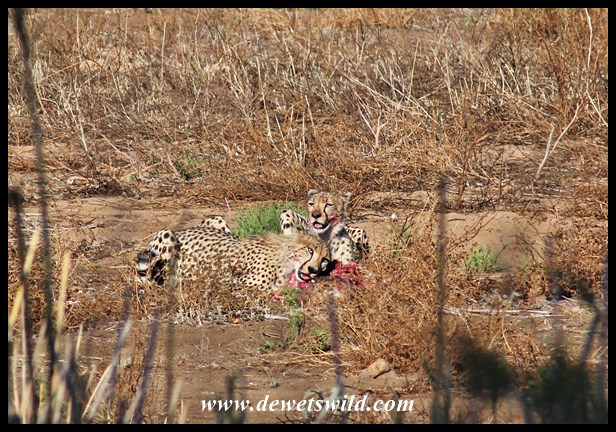
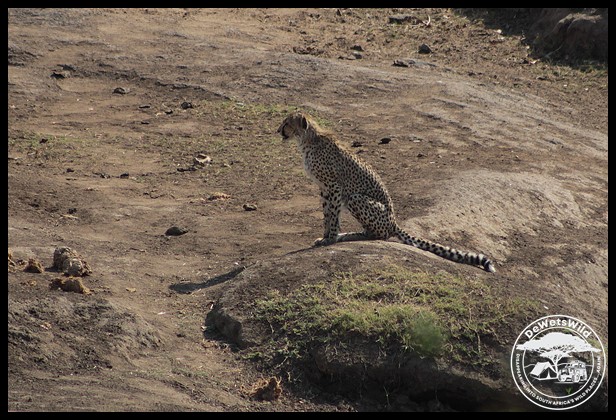
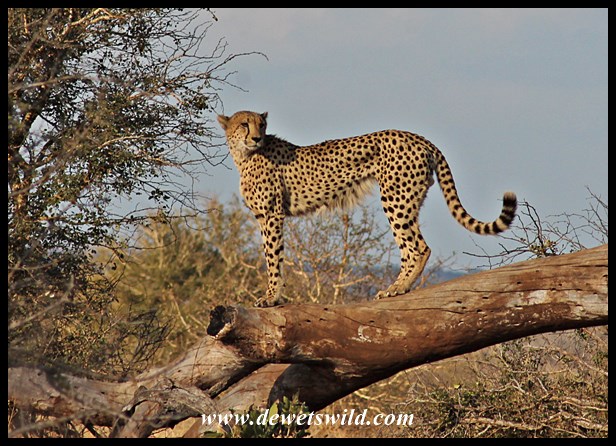
Cheetahs are diurnal cats, being most active in the early morning and late afternoon, resting up in shady vantage areas during the heat of the day. Both sexes mark and defend large territories, those of females usually being bigger in size than the males’. Females are solitary, except when accompanied by their cubs or a male suitor, while adult males often form coalitions of 2 or more that band together to defend a territory. While hunting and patrolling their territory, cheetahs will readily take to trees, termite mounds and small hills to scan their surroundings. Cheetahs are most famous for being the fastest mammals on the planet, capable of reaching speeds of 100km/h, which they can only maintain for a relatively short distance of 300 to 400m, in pursuit of prey. After such a chase, the cheetah normally takes a few minutes to catch its breath before feeding hastily, as other predators, even vultures and baboons, will rob them of their meal.

Cheetah on the lookout, Gudzani Road

Orpen cheetah sighting

Cheetahs near Shingwedzi, 27 September 2014

Cheetahs near Shingwedzi, 27 September 2014

Cheetahs near Shingwedzi, 27 September 2014

Cheetah cub

Cheetah cub

Cheetah cub

Cheetah female

Cheetah in the long grass

Cheetah with a tracking-collar

Cheetah with a tracking-collar

Cheetah – Hluhluwe-Imfolozi Park

Cheetah

The Cheetah female Rain and her latest cubs

Cheetah

Cheetah

Cheetah
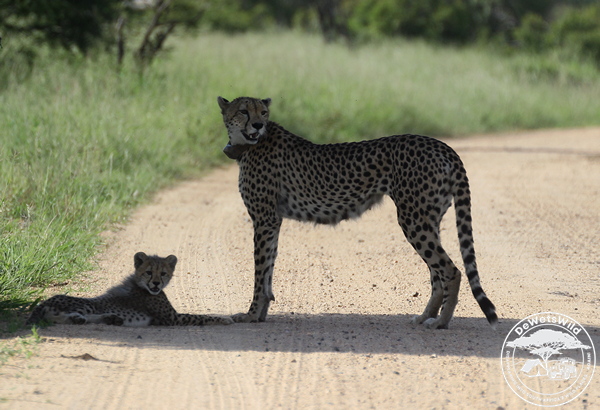
Cheetah females give birth to up to 6 cubs at a time. The cubs are hidden in long grass, thickets or rocky outcrops for the first month or two of their lives. They are weaned from as early as 3 months old and the female starts training them to hunt from about 4 months of age. The cubs become independent of their mother between 12 and 20 months after birth, at which time they are forced from her territory. The newly independent cubs roam widely and often have a difficult time of it, until they are successful in establishing a territory of their own. Lions, leopards and spotted hyenas are known to actively hunt and kill cheetahs, and they are susceptible to a variety of diseases. In some populations as few as 5% of cubs reach independence. In the wild, cheetahs live to between 10 and 16 years of age.

Orpen cheetah sighting
The King Cheetah is a beautiful and rare recessive genetic mutation of the cheetah in which the spots are fused into blotches and stripes. Seeing a King Cheetah in the wild occurs very rarely but there are a handful in captivity.

King Cheetah at the Hoedspruit Endangered Species Centre

King Cheetah at the Hoedspruit Endangered Species Centre
The 4th of December annually is commemorated as International Cheetah Day, to highlight the plight of these lithe big cats. The IUCN considers the cheetah vulnerable to extinction, with a total population of aproximately 7,500 which is believed to be decreasing further. They are threatened by habitat loss, the eradication of their prey base, conflict with livestock farmers and illegal hunting, and have seen tremendous declines in their distribution range. In South Africa wild cheetahs now probably number around 550 animals only, with a considerable percentage of this population persisting outside the big conservation areas in places where competition with larger predators are less of a threat. In our experience, the Hluhluwe-Imfolozi Park, Kruger National Park and Kgalagadi Transfrontier Park provides the best opportunities for encounters with wild cheetahs in South Africa.


Cheetah at the Rhino & Lion Nature Reserve

Cheetah at the Rhino & Lion Nature Reserve

Cheetahs at the Rhino & Lion Nature Reserve

Cheetah at the Rhino & Lion Nature Reserve

Cheetah at the Rhino & Lion Nature Reserve

Cheetah






 DeWetsWild