Category Archives: South African Wildlife

The inhabitants of South Africa’s wild places

Vervet Monkey

Chlorocebus pygerythrus

Along with the Chacma Baboon, the Vervet Monkey must be South Africa’s best known indigenous primate. Male Vervets are considerable stronger built than the females, weighing in at an average of 6kg compared to females at 4kg. Including their tail, Vervet Monkeys are usually just over a meter long.

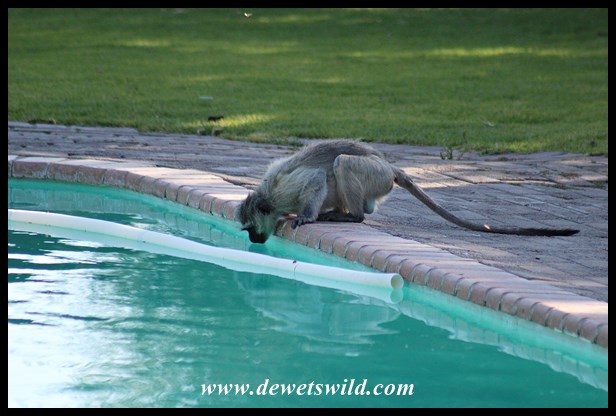
Vervet Monkeys inhabit coastal and mountain forests, woodland, bushveld, riverine thickets, and adjacent grasslands. They’ve adapted to suburban living in many of our towns and cities, and they’ll even forage in plantations and on beaches, provided there is sufficient natural vegetation nearby. Access to drinking water is a crucial habitat requirement for them. Vervet Monkeys follow an extremely wide diet, feeding on fruits and berries, seeds, pods, flowers, leaves, roots, bulbs, tree gum, grass, herbs, spiders and scorpions, snails, insects, eggs and small birds, other small vertebrates, and even marine organisms. Unfortunately they also quickly learn that humans are an easy source of food, either through deliberate feeding or irresponsible discarding of food waste, and can then become a dangerous nuisance.

A highly gregarious species, Vervet Monkeys live in troops numbering from 8 to 140 members (usually around 25) made up of a dominant male, several other males, females (who have their own pecking order) and their young. Troop members have strong bonds of friendship and alliances with others of similar status in the group. Vervets are diurnal, being most active in the morning and afternoon and resting in the midday heat. At night they sleep huddled in small groups in high trees or on inaccessible cliffs. They spend about an equal amount of time foraging in the trees and on the ground.

Female Vervet Monkeys give birth to a single baby – twins are very rare – at any time of the year, though most babies arrive in the spring or summer when food is more abundant, after a 7 month pregnancy. All troop members are very protective of the little ones. Females may live their entire lives in the troop they were born in, while males leave their maternal group at the age of about 4 years to join other troops, staying on average about 3 years with a troop before moving along to another again. Leopards, smaller wild cats, large raptors and pythons are the biggest predators of Vervet Monkeys, which can live to between 12 and 24 years old in the wild.

The Vervet Monkey occurs in a wide band from Somalia and Ethiopia in the north to South Africa, where they are found in all provinces and most of our conservation areas, though their occurrence in the arid west and open central parts of the country is restricted to major riverine arteries. They are regarded as a pest in farming communities and in suburbs, but being a widespread and abundant species the IUCN lists the Vervet Monkey as “Least Concern”.

In Northern Botswana and around the Victoria Falls occurs a different subspecies of Vervet Monkey, C. p. ngamiensis, which is characterised by the richer hues of its coat.

Crowned Lapwing

Vanellus coronatus

The Crowned Lapwing inhabits dry, open habitats like pastures, short grassy savannas, open patches in bushveld, shrublands, semi-deserts and cultivated fields, golf courses and sports fields, avoiding areas where the grass is any taller than 60mm. It is especially fond of overgrazed or recently burnt areas. They feed on insects, especially termites, and other invertebrates.

Outside of the breeding season, Crowned Lapwings come together in loosely associated flocks, usually numbering between 10 and 40 though occasionally as many as 150 individuals, and often associate with the closely related Blacksmith Lapwing. Crowned Lapwings pair for life. They prefer to nest in shallow scrapes on the ground, among newly sprouting grass following veld fires and often in the shade of trees. The nest is further camouflaged with little stones, dry dung, dried grass, etc. In areas with high density, nests are spaced between 25 and 50m apart. Spring is the peak breeding season although some pairs may nest throughout the year. Females are mainly responsible for incubating the eggs, of which there are 2 to 4 in a clutch, though the males will take over for short periods in hot weather. The chicks leave the nest within hours of hatching, walking around and searching for food with their parents. They fledge at about 4 weeks old but often stay with their parents until the start of the next breeding season.

Crowned Lapwings can live up to 20 years of age and weigh on average around 185g.

The IUCN considers the Crowned Lapwing of least concern – it has an increasing population (thanks in no small part to human modification of the environment) and wide distribution over East and Southern Africa. It is found in high densities in all South African provinces.

Common Moorhen

Gallinula chloropus meridionalis

Commonly seen singly, in pairs or small family groups, the Common Moorhen inhabits almost any freshwater habitat but prefers water bodies with thickly vegetated borders. They are omnivorous feeders, eating a wide range of algae, moss, other aquatic plants, green shoots, seeds, flowers, berries and fruits, worms, insects, crustaceans, molluscs, small fish and tadpoles and occasionally bird eggs. They have a wingspan up to 62cm and weigh around 250g.

In South Africa the Common Moorhen breeds throughout the year, with pairs isolating themselves from others of their species except for a few helpers from previous broods. The nest is a cup built of plant material, either floating on a platform on the water or raised above it in emergent vegetation, built by the female with material provided by the male. Clutches contain from 4 to 9 eggs, incubated for three weeks by both sexes. Chicks fledge when they’re about 2 months old.

With a stable population estimated at over 8-million birds, distributed widely over Asia, Europe and Africa, the Common Moorhen is listed as being of least concern by the IUCN. In South Africa it is mostly found in the wetter southern, central and eastern parts of the country, being absent from large areas of the arid western parts.

White-faced Whistling Duck

Dendrocygna viduata

Commonly found in vegetated freshwater habitats in open areas – lakes, swamps, large rivers, dams, estuaries, rice fields (can be a pest when they feed on young rice plants) and even sewage treatment installations, with mudbanks and sandbars for roosting, White-faced Whistling Ducks feed on grasses, seeds, buds, aquatic plants and algae, and aquatic invertebrates like worms, molluscs, insects and crustaceans. The sexes are quite alike, both weighing around 740g.

White-faced Whistling Ducks are most active at night, feeding from dusk to dawn, although they do become more diurnally active in winter. Outside of the breeding season White-faced Whistling Ducks often congregate in enormous flocks numbering several thousands – as many as 70,000 have been counted on river deltas in West Africa!

Breeding commences at the start of the wet season and lasts throughout, when they build their nests on dry ground in dense vegetation, mostly but not always near the water, and occasionally in loose groups or colonies. Pair bonds are very strong and they mate for life. Unusually for ducks, White-faced Whistling Duck males actively take part in the incubation of the eggs and care of the ducklings. The nest is a hollow lined with plant material, hidden in and under dense vegetation. The clutch consists of between 4 and 16 eggs, but normally about 7 to 11, and is incubated for about 4 weeks. Parents will feign a wing injury when predators approach, in order to distract its attention away from the ducklings. The ducklings grow quickly and start flying at about two months old, though they often stay with their parents until the next breeding cycle starts. Following the breeding season, adults undergo a three week period of flightlessness while they moult, keeping to densely vegetated wetlands during this time.

The IUCN estimates the global population of the White-faced Whistling Duck at as many as 2.8-million, and growing, and lists the species as being of least concern. It occurs widely and commonly in Madagascar, Sub-Saharan Africa, parts of South America and the Caribbean. In South Africa, this species is found along the coast in the Western and Eastern Cape, and throughout Kwazulu-Natal, the Free State, North West, Gauteng, Mpumalanga and Limpopo.


White-fronted Bee-eater

Merops bullockoides

White-fronted Bee-eaters inhabit wooded grasslands and savannas, mostly near large rivers or other reliable water bodies, where they feed mainly on flying insects caught on the wing – most notably honey bees, which make up about ¾ of their diet. They weigh between 30 and 40g.

White-fronted Bee-eaters have a complex and interesting social system. They roost and nest colonially (colonies can number between 20 and 300 birds), requiring large sandbanks in which to dig their tunnels, and will also utilise quarries and erosion ditches for this purpose. Each colony is made up of several distinct groups, known as clans, within which there are between 3 and 6 families made up of a monogamous breeding pair (mating for life) and between 1 and 5 non-breeding birds, usually offspring from previous broods, that will assist their parents to raise a brood. Breeding reaches a peak in spring and early summer. Nesting tunnels are 1-1.5m long with a chamber at the end and dug by both parents and their helpers at the onset of the breeding season. Females lay between 2 and 5 eggs, and cases have been noted of unattached females lying eggs in the nests of unrelated birds when they are not at their post. The eggs are incubated for three weeks by both parents and helpers, and the chicks then fledge at between 3 and 4 weeks old, after which their parents start teaching them to hunt.

The IUCN views the White-fronted Bee-eater as being of least concern, with a widespread, common and increasing population. In South Africa the species is distributed over most of the Free State, Kwazulu-Natal, Gauteng, North West, Limpopo and Mpumalanga and a few locations in the Northern and Eastern Cape into which it appears they are expanding their range of late. Outside of our borders, these bee-eaters are found in a wide area of East and Central Africa, avoiding the arid regions in the south-west.

Dark-capped Bulbul

Pycnonotus tricolor

The Dark-capped, or Black-eyed, Bulbul, occurs in savanna and woodland habitats with a reliable supply of fruiting trees and bushes, and is especially common in the gardens and parks of our towns and cities. They feed primarily on fruit, berries and seeds, but will also eat nectar, flower petals and small invertebrates (especially termites). Dark-capped Bulbuls are mostly seen singly, in pairs or in loosely associated small groups, and adults weigh between 30 and 48g.

Nests are cup-shaped formations of roots, grass and twigs placed among dense leaves in trees or bushes. In South Africa they breed almost through the year (except the harshest parts of winter), with a peak in the summer. The female incubates the clutch of 2-3 eggs for around two weeks while the male defends their territory and brings food back for her at the nest. The chicks leave the nest around two weeks after hatching, although they usually can’t fly by then and stick around their nesting tree for a while longer.

In South Africa the Dark-capped Bulbul is found in the Eastern Cape, Kwazulu-Natal, extreme eastern Free State, Mpumalanga, Limpopo, Gauteng and North West Provinces. It also occurs over most of Africa southwards from the Cameroon in the west and Ethiopia in the east, with the exception of the arid western parts of southern Africa. The IUCN considers the Dark-capped Bulbul to be a race of the Common Bulbul (P. barbarus) distributed over almost all of Sub-Saharan Africa, the Mediterranean coast of North Africa, and the Nile Valley, but it differs in having a conspicuously yellow vent compared to the white vent of the Common Bulbul.

Chinspot Batis

Batis molitor

The Chinspot Batis is a common inhabitant of savanna and woodland, and more recently also orchards and gardens, where it feeds almost exclusively on insects and spiders foraged from among the bark and leaves of trees and shrubs. They avoid forests and exotic plantations.

These very active little birds (adults weigh only about 12g) move around singly or in pairs, often in mixed groups together with other small insectivorous bird species.

Both sexes build the cup-shaped nest of shredded leaves bound together with spider web and camouflaged with lichen in a fork of a (often thorny) tree. Breeding takes place in spring and summer, when 1-4 eggs are incubated by the female for around 18 days. During this time the female rarely leaves the nest as the male supplies her with food. Both parents take care of the chicks, which leave the nest at around 16-18 days old but stay with their parents for another 6-14 weeks. The male defends the pair’s territory year round.

The Chinspot Batis occurs widely from Kenya (in the east) and Angola (in the west) southwards and is listed as being of least concern by the IUCN. In South Africa it can be found from the Eastern Cape, through Kwazulu-Natal, to Mpumalanga, Limpopo, Gauteng and the eastern parts of the North West Province.

Pink-backed Pelican

Pelecanus rufescens

Pink-backed Pelicans inhabit a variety of large water bodies and wetlands, including dams, lakes, slow-moving rivers, marshes, lagoons, estuaries and sheltered bays. They are diurnal in habit and feed exclusively on fish and amphibians caught underwater in their large bill pouches. Although one of the smaller kinds of pelican, at a weight of up to 7kg with a wingspan of up to 2.9m, it is still a very large bird.

Although they normally forage singly or in small groups, Pink-backed Pelicans breed communally in colonies numbering from 15-500 pairs, often associating with other species of waterbird at these localities. Pairs are monogamous, and usually build their stick-platform nests in the tops of trees (rarely on the ground) and use them for several consecutive years. In South Africa they breed in the summer rainy season, though further north breeding has been recorded throughout the year. Both sexes incubate the clutch of 1-4 eggs for a period of around 35 days. There’s much squabbling among the nestlings, often leading to smaller chicks dying of starvation or falling from the nest. The chicks start flying at about 3 months old.

The Pink-backed Pelican occurs patchily and irregularly in the provinces of South Africa’s northeast, with the iSimangaliso Wetland Park‘s Lake St. Lucia and Nsumo Pan probably the most reliable spots for viewing this species in our country, hosting an estimated 600 – 900 individuals at one of only three known nesting sites of this species in the country. They’re considered vulnerable in South Africa, suffering due to wetland loss and degradation. North of our borders the Pink-backed Pelican occurs over most of Sub-Saharan Africa and parts of the Arabian Peninsula and is considered of least concern, with a stable population, by the IUCN.


Tawny Eagle

Aquila rapax

A species of dry, open woodlands, savannas and semi-deserts, Tawny Eagles have a very wide prey base; hunting anything from amphibians to mammals up to the size of rabbits and young warthogs, and regularly feeding on roadkill or carrion or food stolen from other birds of prey. Tawny Eagles have a wingspan of up to 2m, and weigh up to 3kg.

These large eagles are mostly seen alone or in pairs as they are territorial and resident year-round. They breed on large nests built of sticks and bones on top of isolated trees or utility pylons. They’ll also take over the similarly constructed nests of other large birds like storks and vultures. In South Africa most pairs breed in winter. Clutches contain 1 – 3 eggs and is mainly incubated by the female for a month-and-a-half. For the first few days after hatching the female broods the chicks and the male brings back food to the nest for both her and the chicks. The chicks take their first flight at about 12 weeks old and remain with the parents for another 6 weeks or so thereafter.

Although the Tawny Eagle is still listed as “least concern”, the IUCN notes that its populations are declining over much of its African range, possibly due to persecution through poisoned carcasses and deliberate shooting. The largest part of the population occurs in Sub-Saharan Africa (with the exception of the equatorial forests and southern South Africa) and on the Indian subcontinent, with smaller populations in North Africa and the Arabian Peninsula. In South Africa, where they are considered vulnerable, Tawny Eagles are commonly encountered in the north of Kwazulu-Natal, the Lowveld of Mpumalanga and Limpopo (where there is an estimated 670 in the Kruger National Park), the Limpopo Valley and the Kgalagadi Tranfrontier Park, but seldom elsewhere, indicating that its populations in this country are now mostly confined to major conservation areas, as with many other large raptors.

African Jacana

Actophilornis africanus

Often seen walking across floating vegetation or the backs of hippos with its exceptionally long toes, the African Jacana is a species closely associated with permanent or seasonally flooded wetlands, pans, dams, ponds and rivers, with floating vegetation (especially waterlilies) and densely vegetated banks for cover. African Jacanas forage singly, in pairs or in family groups, sometimes gathering in small flocks, feeding on insects, worms, crustaceans and molluscs.

Male African Jacanas are highly territorial and, unlike most other kinds of birds, it is the male that is responsible for incubating the eggs and rearing the chicks – the female departs to find another mate as soon as the eggs have been laid, mating with several males over the course of the breeding season. While breeding has been recorded throughout the year there is a definite peak in the summer months. Three to five eggs are laid precariously on a platform of clammy plant material set down on floating vegetation, and incubated by the male alone for just over 3 weeks. The male then looks after the chicks for the next two months until they become independent. When they are small, the male picks up the chicks under his wings and carries them around. At an average of 140g, the male African Jacana is considerably more lightly built than the female (average 230g).

With a stable population, estimated at a million birds, distributed over most of Sub-Saharan Africa, the IUCN considers the African Jacana as being of least concern. In South Africa they occur widely and commonly in Gauteng, Limpopo, Mpumalanga and Kwazulu-Natal, is less commonly encountered in the Free State, North West, Western Cape and Eastern Cape provinces, and almost entirely absent from the Northern Cape.