Category Archives: South African Wildlife

The inhabitants of South Africa’s wild places

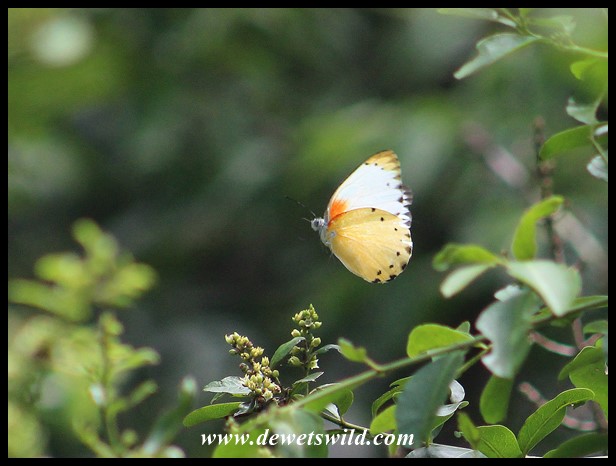
False Dotted Border

Belenois thysa

In South Africa the False Dotted Border occurs in and on the edges of coastal and riverine forest habitat in Kwazulu-Natal and the extreme eastern parts of the Eastern Cape. Adults fly slowly and settle often and are on the wing throughout the year. They have a wingspan of around 55mm. Larvae feed on plants from the genus Boscia, Capparis and Maerua.

Chestnut-vented Warbler

Sylvia subcoerulea

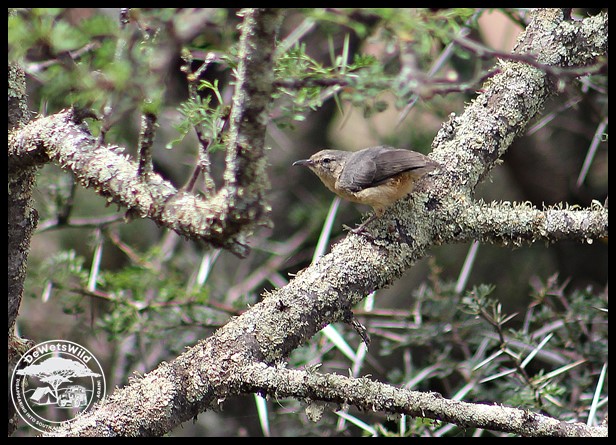
With an unfortunate English name drawing even more attention to its most noticeable characteristic, the Chestnut-vented Warbler (or Chestnut-vented Tit-babbler) would probably prefer to go by its Afrikaans name “Bosveldtjeriktik” which imitates the first notes of its cheerful song.

Chestnut-vented Warblers are found in dry savannas, woodlands and thickets along drainage lines and hillsides and will also venture into gardens in small towns. They are very active when foraging, looking for insects, fruits, seeds and nectar amongst the foliage and flowers of trees and shrubs. Chestnut-vented Warblers are common and confident little birds usually seen singly or in pairs.

Chestnut-vented Warblers may breed at anytime of year, though there is a distinct peak in spring. Their nests are thin-walled cups of dry grass and twigs built in a tree or shrub. The parents take turns to incubate the clutch of 2-4 eggs and feeding the hatchlings until they fledge, both stages taking around 14 days. Fully grown they measure around 15cm in length and weigh 16g.

The Chestnut-vented Warbler occurs throughout South Africa and also in Angola, Namibia, Botswana, Zimbabwe, Eswatini and marginally in Lesotho. The IUCN considers it to be of least concern.

Suni

Nesotragus moschatus

One of the smallest antelope occurring in South Africa, the Suni weighs only around 5kg and stands a measly 35cm tall at the shoulder. Only the ram carries the short horns, while the ewes are slightly more heavily built.

Sunis are very particular about their habitat, preferring dense, dry thickets in deciduous woodland and riverine forests, often on sandy soils. They are browsers, feeding selectively on nutrient-rich leaves, fruit, shoots, mushrooms and herbs.

Usually encountered singly and more infrequently in pairs or small groups, Sunis are most active from dusk to dawn and have favoured spots where they rest during the heat of the day. Rams mark their territories with their prominent pre-orbital scent glands and dung middens, and both sexes are inclined to use well-trodden paths through their home range, making them especially prone to predation and poaching.

Suni ewes give birth to single lambs, usually during the rainy season. The lambs are hidden for the first few weeks of life, with the ewe returning to them regularly through the day to nurse. The lambs are weaned when they’re 2-3 months old and sexually mature by the time they’re a year old. Their natural lifespan is estimated at 9 years maximum and usually much shorter.
While overall the IUCN lists the Suni as being of “least concern” with an estimated population of 365,000 individuals distributed along Africa’s eastern coast and adjacent interior from Kenya to South Africa, these diminutive antelope are considered to be endangered in South Africa, where they are found only in northern Kwazulu-Natal and the Pafuri and Punda Maria areas of the Kruger National Park (their numbers in Kruger were supplemented by several introductions from KZN, but confirmed sightings remain few and far between). The total population in Kwazulu-Natal is estimated at around 1,500, with the biggest single populations being the estimated 750 protected in the Tembe Elephant Park and around 360 in the uMkhuze Game Reserve. Poaching and loss of habitat are considered the major reasons for their decline in South Africa. Interestingly, burgeoning populations of elephant, nyala and large predators in conservation areas have a severely negative effect on the Suni, as they suffer heavily from predation and the larger herbivores denude the lower shrub layer so crucial to the Suni’s survival. Thankfully Sunis breed well in captivity and this offers hope for their reintroduction into areas from which they’ve disappeared locally.

Black-throated Canary

Crithagra atrogularis

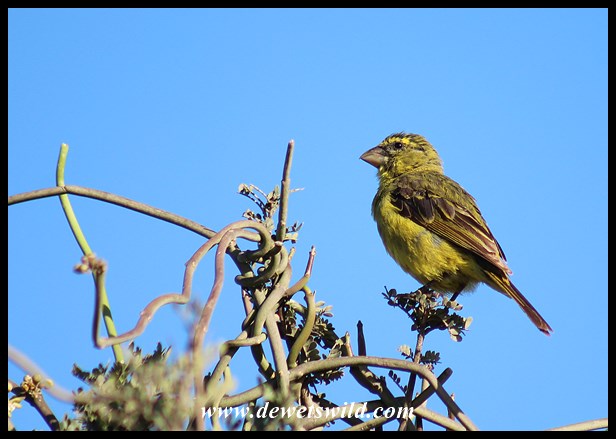
The Black-throated Canary is a timid and inconspicuous seed-eating bird inhabiting open and dry grasslands and savannas, usually near a reliable source of water. They forage mainly on the ground and, in addition to seeds, will also feed on flowers, nectar and soft-bodied insects.

Black-throated Canaries may breed throughout the year, but there’s a definite peak in the summer months. While they form flocks numbering up to five few dozen when not breeding , when nesting pairs are monogamous, solitary and territorial. Their nests are cup-shaped and built of grass and fine twigs in a fork on a tree branch or at the base of a palm frond. The female takes sole responsibility for the incubation of the clutch of 2-4 eggs over a 2 week period. Both parents feed the chicks, which are able to leave the nest when they’re between 2 and 3 weeks old. They are small birds; adults measure around 11cm in length and weigh only about 12g.

The Black-throated Canary is a common bird throughout most of South Africa and can be found in all our provinces with the exception of the Western Cape. Beyond our borders their distribution is very patchy but stretches as far as Gabon in the west and Uganda and Kenya in the east. The species is considered to be of least concern.

African Grass (Sooty) Blue Butterfly

Zizeeria knysna

The African Grass Blue, or Sooty Blue, Butterfly, is common and widespread in every corner of South Africa. Furthermore, they’re found throughout the rest of our continent, in Arabia, Cyprus and Spain. It occurs in every habitat, from desert to forest, and is one of the most abundant butterflies on suburban lawns, having a special fondness for open grassy areas. Adults are on the wing throughout the year and have a wingspan of only about 2-2.5cm.

Common Sandpiper

Actitis hypoleucos

The Common Sandpiper is one of the world widest-ranging bird species. Their breeding range encompasses almost all of Europe and northern Asia, stretching from Spain to the Russian Far East. During the northern winter these birds then migrate to southern climes, spanning from sub-Saharan Africa to Australia and the islands of Oceania. The IUCN considers them to be of least concern and estimate a total population of at least 2.6-million adult birds. During our summer they can be found virtually anywhere in South Africa where suitable wetland habitat is found, though much more rarely in the dry north-western parts of the country than elsewhere, with the first birds arriving in July already and most departing again by the end of April.

Common Sandpipers inhabit a very wide range of water-associated habitats, from sewerage works and farm dams to pristine wetlands and estuaries. Their diet includes invertebrates and small vertebrates, like tadpoles, and occasionally fine seeds plucked from the mud and shallow water. They’ll even pluck leeches from the backs of hippos and crocodiles! While feeding they’re usually solitary or in small groups, though larger numbers congregate to roost.

Adult Common Sandpipers have a wingspan of about 40cm, measure about 20cm in length, and weigh approximately 47g.

Black Mamba

Dendroaspis polylepis

Unquestionably one of the most deadly snakes on the planet, the Black Mamba is rightly feared wherever it occurs. It is found in three widely separate parts of the African continent and in South Africa it may be encountered in most of Kwazulu-Natal, Mpumalanga and Limpopo and parts of the North West Province.

Named for the black inside of its mouth rather than its body colour and sporting a characteristic and ominous coffin-shaped head, a Black Mamba may lift up to 40% of its body length upright – meaning a large Black Mamba could deliver a bite to the head or torso of a fully grown man. The venom of the Black Mamba is neurotoxic and causes paralysis of the voluntary and involuntary muscular systems. It will bite readily and repeatedly if cornered or threatened, delivering 100-400mg of venom in a single bite; 10mg is sufficient to kill an adult human from respiratory paralysis in less than an hour though more usually within 7 to 15 hours without treatment with the correct type of anti-venom.

The Black Mamba inhabits savannas and forests and are territorial with specific spots in its home range where it likes to rest, sun bathe, etc. They are diurnal and very active, fast and agile hunters both in the trees and on the ground. They feed on birds and small mammals.
After mating, usually in the months of spring and summer, female Black Mambas lay around 12 eggs in termite mounds or similar hide-aways. The eggs hatch about three months later. Young Black Mambas grow rapidly and from a length of 40-60cm when they hatch may grow to 2m in length by the time they’re a year old. Even newly hatched babies are deadly venomous. Adults measure up to 4.5m long, the biggest venomous snakes in Africa, and may have a lifespan of 20 years.

The IUCN considers the Black Mamba to be of least concern.

Amethyst Sunbird

Chalcomitra amethystina

The Amethyst Sunbird, also known as the Black Sunbird for the male’s dark plumage, is naturally a bird of coastal forests and moist savannas and woodlands that have become quite well adapted to suburban parks and gardens, and actually extended its distribution thanks to these most suitable, if unnatural, habitats. In common with most other members of the sunbird family their diet is mostly made up of nectar from a wide variety of plants and supplemented with occasional soft-bodied insects.

Amethyst Sunbirds breed throughout the year, with a peak in nesting during spring and summer. Despite being considered monogamous, the male plays surprisingly little part in the rearing process. The female builds the nest alone, using spiderwebs to hold together an oval-shaped structure consisting of leaves, bark, twigs and the stems and blades of grass with an entrance hole on the side. The female is also solely responsible for the incubation of the clutch of 1-3 eggs over a 3 week period. The male even leaves most of the feeding of the chicks, which fledge before they’re 3 weeks old, to the female.

Being one of the larger sunbirds, weighing around 15g and measuring about 14cm in length, Amethyst Sunbirds are quite aggressively dominant over most other members of the family when they mix at prized flowering plants. They are usually seen singly or in pairs.

The Amethyst Sunbird is widely distributed through South Africa – from Cape Town all along the southern Cape coast and through the Garden Route to the Eastern Cape, Kwazulu-Natal, north-eastern Free State, Mpumalanga, Limpopo, Gauteng and North West. Beyond our borders they’re found as far as the Congo, Uganda, Kenya and Somalia. The IUCN considers it to be of least concern.

Black Harrier

Circus maurus

The Black Harrier is an endangered bird of prey that is found only in South Africa, Lesotho and Namibia. The IUCN estimates that there are less than a 1000 birds left, and that their population is still declining due to loss of breeding habitat to agriculture, associated pesticides, alien plants and urban development.

Most Black Harriers breed along small streams and wetlands in the coastal and montane heathland of the Western and Eastern Cape during the months of late winter and spring, while outside the breeding season they roam further afield over the arid Karoo and grasslands of the Highveld and as far as the Midlands in Kwazulu-Natal. They form monogamous pairs when breeding (pair-bonds do not last beyond the season) with the male being responsible for defending the pair’s territory. Their nests are small platforms of twigs, leaves and grass built on the gound at the base of a bush or a tuft of grass or sedge, often quite close to the nests of other breeding pairs. Clutches consist of 1-5, usually 3, eggs which are incubated by the female for 5 weeks while the male provides food for her at the nest. The male continues provisioning food to the female and growing chicks for the first few weeks after they hatch. The chicks leave the nest when they’re about 6 weeks old and become fully independent two or three weeks later. Adult Black Harriers have a wingspan of about 1m and females, which are quite a bit larger than males, weigh around half a kilogram.

Black Harriers feed on frogs, birds, reptiles and small mammals like mice caught by flying very low over the ground and dropping hard onto their unsuspecting prey.

Rufous-eared Warbler

Malcorus pectoralis

The Rufous-eared Warbler is eminently at home in semi-desert scrublands and grasslands and, despite the sparse vegetation of its chosen habitat, can be frustratingly difficult to get a clear view of. It is shy and feeds close to or at ground-level, being very rodent-like in its movements, and subsisting mainly on invertebrates with seeds and small berries making up only a small portion of its diet.

Rufous-eared Warblers are seen singly, in monogamous pairs or in small family groups. They may breed throughout the year, though there is a peak in nesting activity after the first rainfall in their arid haunts. Their nests are untidy oval-shaped balls built in thorny shrubs just slightly above the ground. Clutches usually contain 2-4 eggs, but sometimes as many as 7, and are incubated for 2 weeks. The chicks grow quickly, being fed by both parents, and leave the nest two weeks after hatching. Adults have a total length of about 15cm and weigh only about 10g.

This delightful little bird occurs in South Africa’s drier western half and can be found widely in the Eastern, Northern and Western Cape and Free State Provinces. Beside South Africa, the Rufous-eared Warbler is also found in Botswana and Namibia, and the IUCN considers it to be of least concern.