Category Archives: South African Wildlife

The inhabitants of South Africa’s wild places

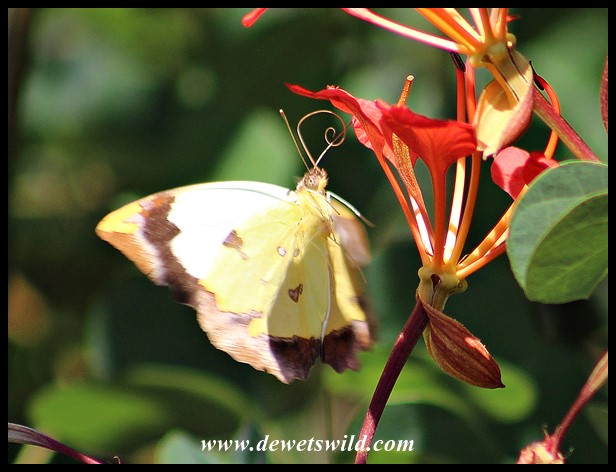
Vine-leaf Vagrant Butterfly

Eronia cleodora

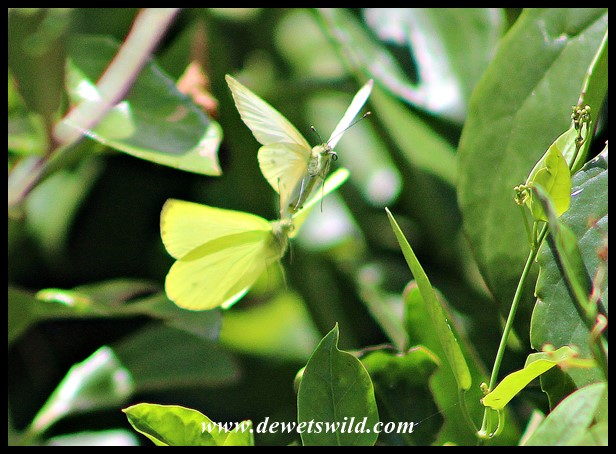
The Vine-leaf Vagrant is a medium-sized butterfly with a wingspan of around 6cm (males are usually a bit smaller than the females). They fly fast and wandering, often settling quickly on flowers as they go. These beautiful butterflies may be seen year-round, though their numbers usually peak in spring and late summer. Their larvae feed on the leaves of the caper-bushes (Capparis).

In South Africa the Vine-leaf Vagrant is found in forests and moist savannas from the Eastern Cape coast, through Kwazulu-Natal and into the Lowveld and escarpment of Mpumalanga and Limpopo.

Southern White-crowned Shrike

Eurocephalus anguitimens

The Southern White-crowned Shrike is a bird that is endemic to southern Africa, ranging from Angola to Mozambique through Namibia, Botswana, Zimbabwe and South Africa. In our country it occurs marginally in the Northern Cape and widely in the North West, northern Gauteng, Limpopo and Mpumalanga. According to the IUCN it is of least concern. These insectivorous birds live in savanna and open woodlands with a sparse ground cover.

Southern White-crowned Shrikes live in family groups consisting of a dominant pair and 1-6 helpers which assist in the breeding process by helping to build the nest – a neat cup constructed with fine plant material and spiderwebs in the fork of a tree – and looking after the chicks, of which 2-5 hatch after a 3 week incubation period. They breed during spring and summer with the chicks leaving the nest about 20 days after hatching. Outside of the breeding season they may form larger groups of up to 20.

Adults weigh about 70g and measure around 24cm in length.

Silver Cluster-leaf

Terminalia sericea

The Silver Cluster-leaf is a medium sized deciduous tree, usually not higher than 9m but occasionally growing up to 23m, that grows on sandy soils in open woodland habitats. Silver Cluster-leafs will colonize open areas, forming dense thickets. Even in mature mixed woodland it can be a dominant tree. The blue-green leaves from which it takes its name is densely covered in shiny hairs and are shed in autumn. Flowers are borne from September to January after the new leaves have appeared following the first rains and is probably pollinated by flies (the flowers have a rather unpleasant smell).

In traditional medicine the Silver Cluster-leaf’s roots and leaves are put to good use, being used as an antibiotic, to treat coughs, diarrhoea, stomach ache and to stop bleeding. The wood is used for cooking and fencing. It is an important food source to several kinds of caterpillars, particularly those of the guinea-fowl butterfly, and will be browsed by cattle during drought conditions.

In South Africa Silver-cluster leaf trees grow naturally in the north-east of Kwazulu-Natal, through the Lowveld of Mpumalanga, most of the bushveld regions of Limpopo, northern Gauteng, throughout the North West Province and widely in the Kalahari regions of the Northern Cape. Beyond our borders it is found as far north as Tanzania and the DRC.

Scarlet Tip Butterfly

Colotis annae

The Scarlet Tip Butterfly, especially the male, is one of the most striking of its genus. Fully grown adults have a wingspan of up to 5.5cm, though this varies between the seasonal forms. Where their food plants (wormbushes Cadaba and bead-bean Maerua) are abundant Scarlet Tips may form large swarms, especially in late summer and autumn, though there are adults to be seen on the wing throughout the year. They’re often seen together with the Sulphur Orange Tip butterfly, flying similarly slowly and close to the ground and settling often. Scarlet tips inhabit a wide range of savanna vegetation types. In South Africa they’re found from the Eastern Cape through Kwazulu-Natal to Mpumalanga and Limpopo

Spotted Flycatcher

Muscicapa striata

The Spotted Flycatcher is a migrant to sub-Saharan Africa, travelling here to escape the winter in its Eurasian breeding grounds. The birds arrive in South Africa during October and November and leave again by early April, and is one of the most numerous summer visitors. While here, they can be seen in any part of the country, though the highest densities occur in our northern and eastern provinces. The IUCN considers the Spotted Flycatcher to be of Least Concern, estimating a total population of at least 54-million.

While they’re visiting our country during our summer months, the Spotted Flycatcher is not picky about its habitat – any open haunt that provides them a low perch from which to hunt the insects they subsist on seems to do. They are usually seen alone in these parts. Fully grown they measure about 14cm in length and weigh approximately 15g.

Pygmy Hippopotamus

Today, on Endangered Species Day, we feature another African mammal that isn’t indigenous to South Africa.

Choeropsis liberiensis

With an adult population in the wild estimated at no higher than 2,500 animals and still declining, the IUCN considers the Pygmy Hippo to be an endangered species.  The biggest threats to their continued existence is hunting and the destruction of their forest habitat, with only a small proportion of the remaining population being found inside formally protected reserves and most of it being restricted to ever shrinking and increasingly isolated pockets of natural habitat. Today, wild populations are found in only four neighbouring countries in West Africa: Guinea, Sierra Leone, Liberia and Côte d’Ivoire. An isolated population in Nigeria probably went extinct in the 1940’s. An internationally coordinated captive breeding programme for the species holds about 380 individuals in facilities across the world, including here in South Africa.

As its name suggests, the Pygmy Hippo is much smaller than the only other extant species of hippopotamus, the Common Hippo. Adult males weigh up to 280kg, females up to 190kg, and they stand only 70-90cm high at the shoulder. While they live in close association with fresh water in lowland and swamp forests, the Pygmy Hippo spends much less time in the water than its larger cousin. They feed on swamp plants, leaves, roots and fruit (grass is the main fodder for the Common Hippo, but is in short supply in the forests the Pygmy Hippo inhabits). Pygmy Hippos are solitary, nocturnal creatures and the only associations are of mating couples or a cow and her single offspring, born after a 7 month gestation. Despite their comparatively diminutive size, Pygmy Hippos are aggressive and quite dangerous when cornered or wounded.

Monkey Oranges

Genus Strychnos

The genus Strychnos has about 9 representatives in South Africa, of which we are featuring two large-fruited species in this post. While the fruit pulp is edible and even delicious in certain species, if you are not certain with which species you are dealing the seeds should never be chewed or swallowed as many are extremely poisonous; the poisons strychnine and curare come from plants in this genus.

Both the Black and Green Monkey Oranges are small, deciduous trees with many branches and irregular growth forms. The fruit are huge (up to 12cm in diameter) and take very long to ripen, with a thick husk protecting the fleshy pulp and densely-packed seeds.

Monkey Orange leaves are browsed by a wide variety of animals, and the fruit is eaten by baboons, monkeys, large antelope and bushpigs. Humans eat the pulp of the fruit (it is often dried and powdered for preservation). The wood of the Green Monkey Orange lends itself to carving, as does the husks of the fruit of both species, which is often sold as ornaments in curio stalls. The roots of the Black Monkey Orange are ground and taken as a tea to induce vomiting. The root, bark and unripe fruit of the Green Monkey Orange is used in traditional medicine to treat venomous snake bites; it is thought that the strychnine or similar alkaloid it contains might counteract the effects of the snake venom. The seeds of the Green Monkey Orange should therefore definitely not be eaten, though the fruit pulp surrounding the seeds is apparently delicious.

While both species are well known from the savanna and forest regions of Limpopo, Mpumalanga and Kwazulu-Natal, only the Green Monkey Orange’s distribution extends into the Eastern Cape and as far as the Garden Route.

Black Monkey Orange – Strychnos madagascariensis

Green (Natal) Monkey Orange – Strychnos spinosa

Sulphur Orange Tip Butterfly

Colotis auxo

The Sulphur Orange Tip is a smallish butterfly with a wingspan of only about 4cm. It inhabits savanna habitats and adults may be seen year-round, being must numerous in late summer and autumn. Larvae feed on the leaves of the wormbushes (genus Cadaba). They are restless and fast fliers, usually staying close to the ground.

In South Africa the Sulphur Orange Tip is found along the coast and adjacent interior of the Eastern Cape, through most of Kwazulu-Natal, the Lowveld of Mpumalanga and throughout the Limpopo Province.

Autumn Adventure – uMkhuze’s Giant Carrion Flowers

Now this is a plant that really grabs your attention when visiting the uMkhuze Game Reserve in the iSimangaliso Wetland Park, especially if you have a chance to walk the grounds of the Mantuma Rest Camp where we stayed for 4 nights in March this year.

Stapelia gigantea

The Giant Carrion Flower is notable not only for the smell of its flowers, which really does smell like rotting meat (especially on a hot afternoon!), but also because it boasts the biggest flowers – up to 40cm across! – of any South African plant. These flowers can be borne at any time of year, though mainly in late summer and early autumn. Their succulent, green stems are small by comparison, growing around 25cm tall only. Probably not surprising, the flowers are pollinated by flies, and so convincing is the smell that flies often lie their eggs on the flower! The seedpod that develops from pollinated flowers carries lots of plumed seeds that are dispersed by the wind, but they can also be propagated vegetatively as the stems will easily re-root. Giant Carrion Flowers grow best in dry, hot areas and rocky outcrops.

Giant Carrion Flowers occur naturally in all the countries of Southern Africa (Angola, Zambia and Malawi southwards) and in all South Africa’s provinces. It is considered to be of least concern, but some wild populations are declining due to extensive collection for ornamental and medicinal use. In traditional medicine these plants are used to treat pain, constipation and bruising, and also as a magic charm against evil and lightning. They are popular and easy to keep in the garden or in pots, especially as it requires very little water.

Giant Carrion flowers in Mantuma Camp

Malachite Kingfisher

Corythornis cristatus

The beautiful Malachite Kingfisher is, true to its name, mainly a piscivore though it’ll also feed on frogs, tadpoles and aquatic insects. They hunt from preferred perches, diving into the water to snatch their prey. Its diet dictates that this species is always found near water, ranging from tiny streams and sewage ponds to large rivers, dams and estuaries, provided there is sufficient growth of plants in and along the water providing perches. They are usually seen alone or in pairs.

Nesting in burrows they dig themselves in the earthen banks of rivers and streams, monogamous pairs of Malachite Kingfishers may breed throughout the year but usually coinciding with the rainy season. Clutches of 3-6 eggs are incubated for 2 weeks by both parents, with the chicks fledging when they’re between 3 and 4 weeks old. They start fishing for themselves about a week after leaving the nest and become fully independent from the age of about 7 weeks.

Malachite Kingfishers are found almost all over sub-Saharan Africa, being absent only from the driest pockets, and is considered to be of least concern by the IUCN. In South Africa they’re found in every province, though restricted to the course of the Orange River in the Northern Cape.