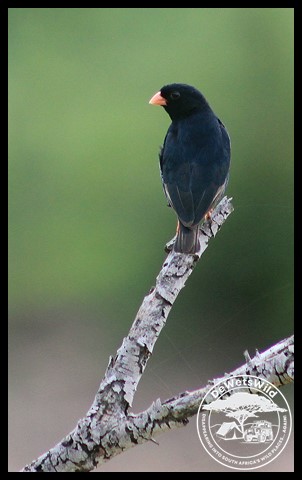
The Village Indigobird is a brood parasite, in which males mate with as many females as they can and the females in turn lay their eggs in the nests of other small finches – especially firefinches – even if the nest owner is in the nest! In this way each female Indigobird may produce up to 26 eggs in a breeding season, which spans December to June. The chicks are reared by their adoptive parents until they rejoin the Indigobird flock at about 4-5 weeks of age. These small birds weigh around 13g when they’re fully grown.
The Grey-headed Bush-shrike is distributed through most of Africa’s savanna regions, stretching from the Sahel in West Africa to Eritrea and Somalia in the east, and then southwards to South Africa, where they’re found in the north and east of our country. They’re found in denser habitat-types and are very shy, seldom venturing into the open. These Bush-shrikes are adept hunters, catching any prey from insects to lizards, chameleons and snakes and even other birds.
Grey-headed Bush-shrikes live in monogamous pairs, each pair controlling a sizable territory. The female constructs the cup-shaped nest in the fork of a tree, using materials that the male brings to her. They nest during spring and summer, when the female incubates a clutch of 2-4 eggs over a week period. While the female is on the eggs or brooding the chicks the male is entirely responsible for bringing back food to her and the growing chicks. The chicks leave the nest when they’re about 3 weeks old but may remain in their parents’ territory until they’re a year old. Fully grown, this is the largest species of the Bush-shrike family occurring in our country, measuring about 26cm in length and weighing around 77g.
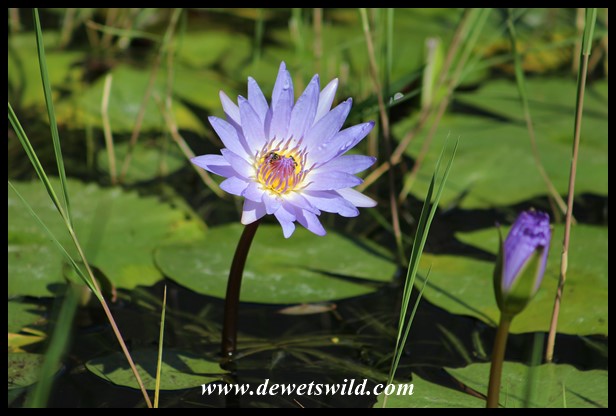
South Africa is home to two indigenous species of Water Lilies from the genus Nymphaea, named for the beautiful nymphs of Greek mythology. They are long-lived plants, growing from spongy rhizomes anchored in the mud by spreading roots, occurring in standing or slow-flowing water up to 90cm deep in swamps, ponds, marshes, small streams and rivers. Their flat leaves may be up to 40cm wide where they float on the pond surface. The flowers are borne throughout the warm spring and summer months, may measure up to 20cm across, are very fragrant and extremely popular with bees and other pollinators. Unfortunately an individual flower rarely lasts longer than 4 days.
The White Water Lily, also known as the Egyptian Water Lily or Egyptian Lotus, is found in the north-eastern provinces of South Africa, besides its wide occurrence throughout our neighbouring countries and into tropical Africa. The Blue, or Cape, Water Lily is distributed over a much larger part of our country and most of sub-Saharan Africa and along the Nile. The beautiful flowers of both species were highly regarded even during the reign of Egypt’s pharaohs, being cultivated for use as decorations and in ceremonies. Today they still feature in gardens the world over.
At a weight of about 250g and measuring about 24cm in length, Coqui Francolins are the smallest of their family occurring in South Africa. They’re widespread in the north of our country – from northern Kwazulu-Natal through Mpumalanga and Gauteng to Limpopo and the North West – but aren’t commonly encountered anywhere due to their shy nature (relying mostly on their camouflage and remaining perfectly still and close to the ground when danger is perceived). Beyond South Africa’s borders their distribution range extends patchily as far as Senegal and the IUCN considers the species to be of least concern. They’re found in savanna and woodland vegetation types with a well developed grass layer and feed on a wide variety of plant material and invertebrates. They form small flocks of up to 12 birds when not breeding.
Coqui Francolins nest at the end of the rainy season, when grass is lush and seeds are in ample supply. The nest is little more than a shallow hollow scraped in thick vegetation and lined with soft materials in which the female incubates a clutch of up to 6 eggs.
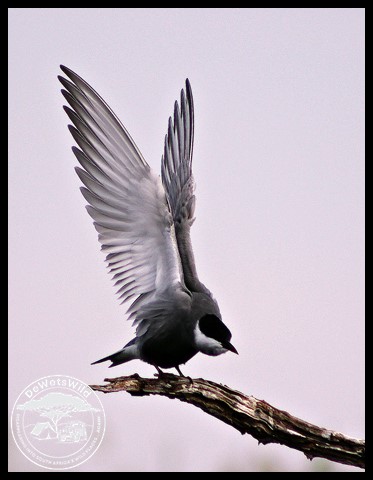
The Whiskered Tern is a bird of natural wetlands, being equally at home at freshwater wetlands and marshes (even farm dams!) than at estuaries and river mouths along the coast. They feed in loose flocks, flying low above the water, and catching anything from aquatic invertebrates to frogs and small fish.
Whiskered Terns breed opportunistically following good rains, establishing loose colonies of up to 80 monogamous pairs. Their nests are floating structures consisting of plant material and built by both partners. Clutches of up to 3 eggs are incubated over a 3 week period. The chicks can’t fly until they’re almost a month old, but can swim soon after hatching and uses this to good effect to temporarily abandon the nest if danger threatens, while the parents dive-bomb the intruders – even cattle and humans! Adults weigh about 100g and measure around 25cm in length.
The Yellow-billed Egret was previously considered to be the locally occurring race of the Intermediate Egret but was recently (September 2023) elevated to full species status. It is found over almost all of sub-Saharan Africa and in our country is absent from the arid western and central parts of the country, reflecting its preference for regularly flooded grasslands, wetlands and the shallows of dams, lakes and seasonal pans where they feed on small fish, frogs and aquatic invertebrates. They have been recorded as flying – almost hovering – behind hippos moving through the water to catch anything the large mammal disturbs.
Adult Yellow-billed Egrets weigh around 400g and measure approximately 70cm from bill to tail. They usually hunt alone, but groups of up to 20 may congregate at abundant food sources. During spring and summer they breed in colonies with others of their kind as well as other water birds, forming monogamous pairs that work together to build their platform nest in a tree or reedbed, with the male providing the female with sticks and reeds for the purpose. Clutches of 2 or 3 eggs are incubated in turns by both parents over a 4 week period. While the chicks leave the nest at about 3 weeks old they can’t fly until the age of about 2½ months.
Male Fan-tailed Widowbirds are territorial in the breeding season, which spans spring and summer, weaving up to eight ball-shaped grass nests, with a side-entrance, in a tuft of grass or other dense vegetation, usually in marshy areas. They then attempt to attract and mate with as many females as possible, but have no further parental role. The female incubates the clutch of 2 or 3 eggs for 2 weeks. The chicks stay in the nest for less than 3 weeks, and accompany their mom for about another 2 weeks after fledging before becoming independent. Adults are about 15cm in length and 26g in weight, with males slightly larger than females.
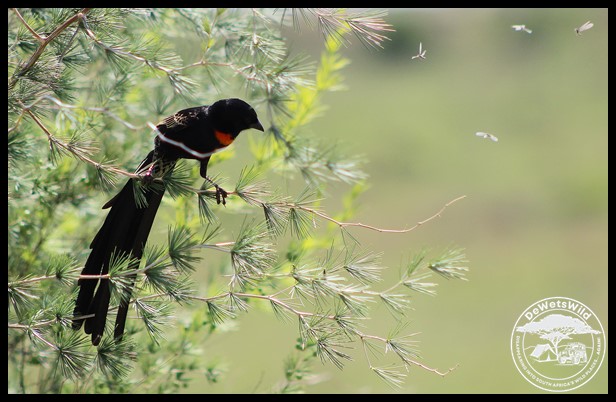
In their striking black breeding plumage with streaming tails it’s almost impossible to miss the male Red-collared Widowbird in its savanna habitat during summer, quite a contrast with the drab plumage they don during other parts of the year (and worn by females throughout). These birds are mainly seed-eaters but will also peck up ants and termites on occasion.
Outside of the breeding season, which spans from spring to autumn, Red-collared Widowbirds move around in large flocks, often associating with other seed-eating birds. When breeding however mature males are territorial, weaving several oval-shaped nests in trees, shrubs and tall grass to attract as many females as possible into his harem. Females incubate clutches of 2-6 eggs for a two week period and the male plays no parental role whatsoever. The chicks leave the nest when they’re 2-3 weeks old. Breeding males are up to 35cm long with their expansive tails included in the measurement, while females and non-breeding males are only about 12cm in length and weigh around 19g.
The Garden Fruit Chafer is considered a pest in gardens and orchards, due to the adults feeding on flowers, fruit and seeping gum, and widely distributed in large numbers throughout South Africa. It is about 2.5cm long. The larvae develop in compost heaps or manure and make hard oval clay cells in which they pupate.
One of the most memorable sightings of my recent tour of the iSimangaliso Wetland Park was of a small pod of Humpback Whales playing just offshore of the St. Lucia estuary one overcast morning.
Humpbacked Whale tail-slamming off St. Lucia
Humpbacked Whale fin-slapping off St. Lucia
Humpbacked Whale tail-slamming off St. Lucia
Humpbacked Whale fin-slapping off St. Lucia
Megaptera novaeangliae
Humpback Whales occur throughout the world’s oceans at different times of the year. Locally they migrate past our shores from about June to overwinter in the tropical waters off both Africa’s Atlantic and Indian Ocean coastlines, returning to their Antarctic feeding grounds from about November at the start of the austral summer and covering as much as 16,000km on these journeys. Humpback Whales feed mainly on krill, other plankton and schools of fish, gulped down in enormous quantities after being encircled by “curtains” of bubbles released from the blowholes of the circling whales. These whales are well known for their spectacular breaches out of the water as well as their playful tail-slamming and fin-slapping behaviour (as captured in the above video). They may dive up to 150m deep and stay underwater for up to 15 minutes. While usually seen in small groups and even as single cows with their latest calf, Humpback Whales may at times congregate in pods up to 200 strong in good feeding grounds.
While in the more tropical climes the females give birth to single calves after an almost year-long gestation. The calves will suckle for up to a year, though they start eating at about 6 months of age. Females calf every two years and mating also takes place in the tropical latitudes during winter. At birth the calves weigh about a metric ton and measure more than 4 metres in length; fully grown they will weigh approximately 40,000kg and reach up to 18m in length! It is estimated that Humpback Whales live to at least 50 years of age.
Citing an increasing population estimated at approximately 84,000 mature animals (of a total of 135,000) worldwide, the IUCN lists the Humpback Whale as being of least concern. When whaling was banned in 1966 there was probably only 5,000 Humpback Whales left.
Over the years we’ve been fortunate to see these enigmatic creatures a number of times while visiting some of South Africa’s wild places, most notably the Garden Route National Park and, of course, iSimangaliso. DeWetsWild will assist you with reservations and guided tours of these places and even arrange whale watching excursions with experienced skippers if you are interested in seeing Humpback Whales up close.









 DeWetsWild