The recent Women’s Day long weekend in South Africa allowed us the opportunity to visit Mokala National Park for the first time. Mokala is our country’s newest National Park, and in our opinion one of the most enchanting and underrated!
Mokala was proclaimed a National Park in 2007, and today covers over 28,000 hectares of sandy plains and rocky ridges, with plans to expand further. The Riet River forms a significant part of the Park’s northern border, while artificial water holes are dotted through the rest of the reserve. The thorny woodland vegetation is dominated by iconic Camel Thorn (Mokala in Tswana) and Umbrella Thorn (Mosu in Tswana, Haak-en-Steek in Afrikaans), with extensive areas of open grasslands. The Park gets an average of only around 400mm of rainfall annually, most of it in summer, when temperatures can soar into the forties on the Celsius scale. Temperatures on winter nights on the other hand often falls below freezing, which we can certainly vouch for having seen the Stofdam entirely frozen over on our last morning at Mokala.

Umbrella thorn with sociable weaver nest

Mokala sunrise

Small waterhole

Mokala road

Mokala landscape

Mokala sunrise

Mokala landscape, near Lilydale

Tsessebe at a windpump near Mosu

Mokala road and sociable weaver nest

Mokala landscape, with a lone blesbok

Black wildebeest and umbrella thorn

Open grasslands near Lilydale

Mokala scenery

Tsessebe in Mokala National Park

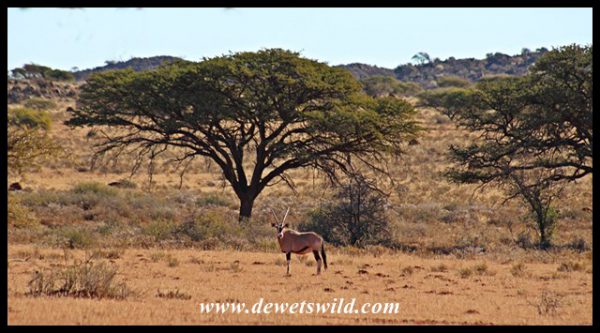
Gemsbok in thornveld

Kudu in a vast landscape

Kudu trying to drink from a frozen Stofdam

Mokala scenery
Mokala offers some brilliant visitor facilities. The two main accommodation options are self-catering chalets at Mosu Lodge and Lilydale Rest Camp (with grand views over the Riet River), each located near to one of the Park’s two entrance gates, while Mofele Lodge provides dormitory style accommodation for big groups. Haak-en-Steek Cottage is a private hide-away for small families (more on that in the next paragraph) and Stofdam Hide has four bunks that can be booked for one night at a time. The Park also has a stunning tree house available, with plans afoot to construct more. Each of the sites at the small Motswedi Camping Area provides a private kitchenette and ablution block with shower and toilet. The interpretation centre near Mofele offers fascinating insights into the Park’s history and management. The Park’s gravel road network is in fair condition, and for the most part easily traversable in a sedan. There’s no fuel station in the Park – the nearest is at Modder Rivier, a small town just a few kilometers from the Park. Mosu has only a tiny selection of souvenirs and a few essential groceries for sale, so it is best to stock up on provisions before arriving or to take your meals in Mosu’s excellent restaurant. Mosu also has a small venue for conferences. Two picnic sites cater for the needs of day visitors to the Park. Guided game drives and walks, including visits to San Rock Art sites, accompanied by knowledgeable ranger-guides can be booked through Mosu’s reception, while catch-and-release fly fishing for yellowfish in the Riet River is a popular excursion available from Lilydale.

Lilydale entrance to Mokala

Lilydale setting on the bank of the Riet River

Mokala interpretation centre

Mosu chalet

Mosu Lodge in the Mokala landcape

Mofele Lodge
We stayed at the secluded Haak-en-Steek Cottage, a lovely two-bedroomed unit with gas appliances in the small kitchen and solar powered lighting, in the west of the Park. The cottage has a fantastic view over its own waterhole, especially well frequented in the afternoon and early evening hours by a steady procession of game and birds coming to quench their thirst. A few campsites are available to house additional guests when Haak-en-Steek is booked by larger parties, but it is only ever sold to a single group at a time, offering fantastic privacy. Haak-en-Steek is not surrounded by a fence, and game often moves straight past the cottage on their way to the water.

Turnoff to Haak-en-Steek

Haak-en-Steek Cottage, Mokala National Park, August 2016

Haak-en-Steek is unfenced

Haak-en-Steek is unfenced

Evening mud bath

Gemsbok are regular visitors at Haak-en-Steek in Mokala

Eland and Tsessebe share Haak-en-Steek’s waterhole

A flock of sociable weavers at Haak-en-Steek’s waterhole

Big herd of blue wildebeest at the water

Sunset at Haak-en-Steek cottage
Mokala’s located in the transition zone between the arid west and wetter east of the country, and as such offers a haven to a wide variety of big game in impressive numbers. Black and White Rhinoceros, Buffalo, Giraffe, Plains Zebra and Warthog share the Park with no less than 17 species of antelope: Blue and Black Wildebeest, Red Hartebeest, Blesbok, Tsessebe, Springbok (including copper-coloured and black specimens), Grey Duiker, Steenbok, Klipspringer, Impala, Roan Antelope, Sable Antelope, Gemsbok (Oryx), Kudu, Nyala, Eland, Mountain Reedbuck and Waterbuck. In fact, the Park really deserves its tagline of “Where Endangered Species Roam”, as it is probably the best place in South Africa to see endangered Tsessebe and Roan Antelope (both of which we’ll feature in more detail soon here at de Wets Wild).

Blue wildebeest

Blue wildebeest

Black wildebeest

Blesbok

Tsessebe at a waterhole in Mokala National Park

Red hartebeest cow standing watch in Mokala

Red hartebeest resting in Mokala National Park

Grey (Common) Duiker

Springbok Ram

Springbok ewe

Copper Springbok

Black Springbok

Steenbok

Impala

Gemsbok on the run

Sub-adult Roan Antelope

Sable antelope in the distance

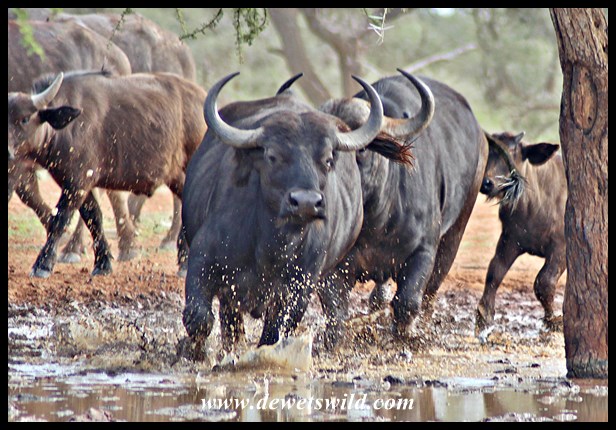
Buffalo

Impressive kudu bull

Nyala

Imposing Eland bull

Waterbuck cow

Giraffe family

Warthog

Plains Zebra

White Rhinoceros
Visitors should not however keep their eyes open only for the bigger mammals, as Mokala is also home to a wide variety of smaller creatures, many of them rarely seen in other reserves.

Rock monitor lizard on a Mokala road

Vervet monkey drinking at Stofdam

Black-backed jackal scaling a rocky outcrop

Bat-eared fox

Suricates (or meerkats) are frequently seen

Ground squirrels often share their burrow systems with suricates and mongooses

Yellow Mongoose

Scrub Hare at Haak-en-Steek
Although only recently proclaimed, Mokala’s bird list is already over 150 species strong, ranging from the booming population of ostrich to the sociable weavers with their spectacular mansions.

Black-winged Stilt at Stofdam

Northern Black Korhaan

Red-crested Korhaan

Pygmy Falcon at Mosu

Male Ostrich on the run

Fiscal Flycatcher at Haak-en-Steek

Red-headed finch (male)

Karoo Thrush at Lilydale

Familiar Chat

Red-faced Mousebird

Acacia Pied Barbet

Violet-eared Waxbills

Speckled Pigeon

Sociable Weaver

Spotted Thick-knee

African Red-eyed Bulbul
Mokala National Park is located in the Northern Cape Province, approximately 60 to 80km to the south of the historic diamond-mining city of Kimberley, depending on which gate you are heading for, and accessible from the N12 national highway, from which gravel roads leading to the gates at Mosu and Lilydale turn off. These roads are not always in the best condition, but you shouldn’t let that deter you from experiencing the thirst-land paradise that awaits you. We’ve already started planning our next trip to Mokala!

Mokala location




 DeWetsWild