Category Archives: Kwazulu Natal Province

Our experiences in the reserves of Kwazulu-Natal, South Africa

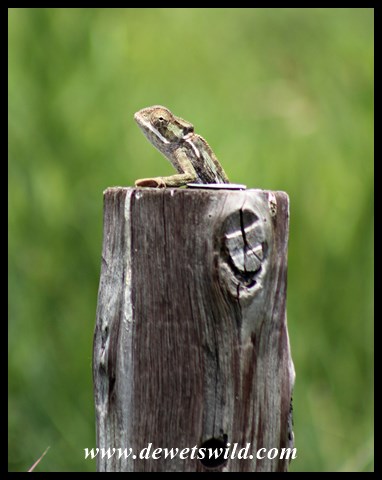
Drakensberg Dwarf Chameleon

Bradypodion dracomontanum

Just as we arrived at Royal Natal National Park in the Drakensberg for our visit in December, Joubert noticed this laid-back little chameleon resting an elbow on a fence post in the campsite at Rugged Glen.

drakensberg-dwarf-chameleon

Turns out he (or she) is a Drakensberg Dwarf Chameleon, a species found only in the Drakensberg mountain range in Kwazulu-Natal Province, where they inhabit sheltered forests and bushes in alpine vegetation at altitudes of between 1,500 and 2,500m and feed on small insects. They grow to a length of only about 14cm. Interestingly, dwarf chameleon females give birth to between 5 and 20 live young that develop in eggs inside the female (known as ovivivipary).

Our 2016 in pictures

Looking back on another year of enjoying South Africa’s beautiful wild places!

Quick wrap-up from Hluhluwe-Imfolozi Park

We’re back home in Pretoria after our 10 day Christmas-in-the-Bush holiday. We didn’t have very good internet connection at Hluhluwe-Imfolozi Park, the last stop-over on our trip, and couldn’t post our usual daily photo. For now though, herewith a few photographs from HIP just as a teaser with a promise of lots more to come soon!


Coming to you live from Hluhluwe-Imfolozi Park!

After a long drive from the Drakensberg we’ve arrived safely at the big game haven that is Hluhluwe-Imfolozi Park!

(Seems we struck it unexpectedly lucky with the connectivity this evening!)

hip-22dec16-2


Enjoying a sunnier Royal Natal

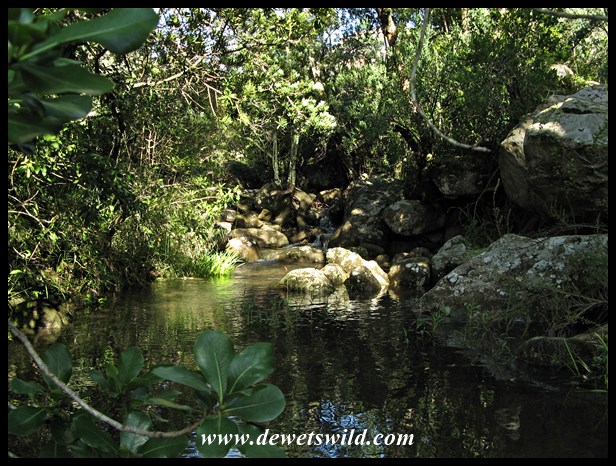
Good evening from a much drier Royal Natal National Park, where we used the opportunity provided by the shining sun to explore some of the myriad trails that traverses this beautiful piece of earth, enjoying scenes like this along the Mahai stream.

royal-natal-21dec16-wp

Tomorrow we’re heading for the Hluhluwe-Imfolozi Park, and may not be able to post regular updates until we get back home to Pretoria (though we will try). If you don’t hear from us again before then, here’s wishing all our friends at de Wets Wild a blessed Christmas!


A Century Old Royal

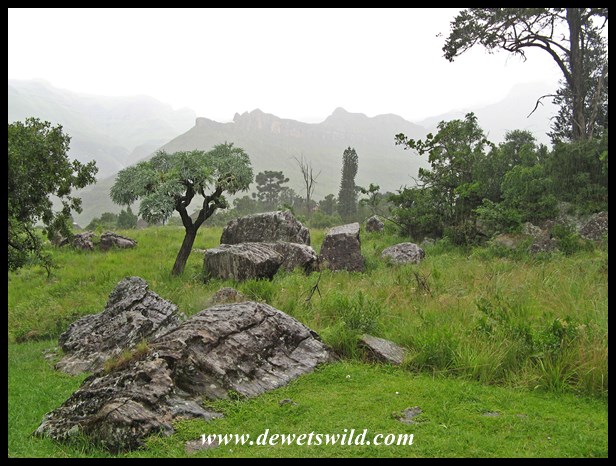
We’ve arrived to a stormy, wet reception at the next stop on our December holiday itinerary: the Royal Natal National Park, which celebrates its centenary this year.

royal-natal-20dec16-2


The fascinating world of Umlalazi’s Mangroves

No other kinds of tree are as well adapted to an existence in salty, tidal estuaries as the mangroves. Their roots are specifically adapted to not only anchor them in the muddy substrate but also allow them to “breathe” by sticking up above the mud and prevents the tree from drowning. Known as “pneumatophores”, these roots look different in the various genera of mangroves – those of the white mangrove (Avicennia marina) look like pencils sticking straight up out of the mud, the black mangrove (Bruguiera gymnorrhiza) has knee-like structures protruding before going back into the mud, and the red mangrove (Rhizophora mucronata) grow “struts” straight from the trunk. They have to contend with excessive salt in their tissues, and concentrates this in old leaves that are continuously shed and replaced. Mangrove fruit are also very interesting; seeds germinate while still attached to the flower, and some, like the black and red mangroves, even grow a cigar-shaped “root”, or “hypocotyl”, that is designed to anchor the seed in the muddy substrate when it drops from the tree.

These adaptations of the mangroves benefit the entire ecosystem by trapping silt, stabilising the substrate, and feeding the food chain. Mangrove snails (Cerithidea decollata) cling to the trunks of the trees during high tide, safely out of reach of estuarine fish that move in with the tide. At low tide, they then descend to feed on the muddy surface. Crabs abound in the mangroves. Sesarma is a genus of land-based crab that digs holes up to 2m deep into the mud and avidly collects fallen leaves into their burrows. Fiddler crabs (Uca-species), known for the males having one enormous pincer which which they display to one another and to interested females, feed by rolling scoops of mud into balls in their mouths, with the discarded balls leaving tell-tale trails where the crab has moved. Mudskippers, those uniquely adapted amphibious fish that seem to be as at home out of the water as in it, must be among the most curious of the mangrove swamps’ denizens. Estuaries in general and mangrove stands in particular are extremely important refuges and nurseries for several kinds of fish and crustaceans, making their protection an economic imperative if fisheries are to be sustained into the future and highlighting the value of conserved areas like Umlalazi.

Many kinds of wading birds feed on the rich invertebrate fauna in a mangrove swamp, with the woolly-necked stork being the most obvious at Umlalazi. The reserve’s mangroves also forms an important winter habitat for the mangrove kingfisher. Mangrove swamps, with their dense stands of trees and muddy terrain, are difficult areas for large mammals, with the exception of monkeys, to utilise.

At Umlalazi, a boardwalk constructed through a mangrove swamp allows easy access to this fascinating world – if you have only a little bit of time to explore Umlalazi, this is undoubtedly where you should spend it!

On the banks of the lazy Mlalazi

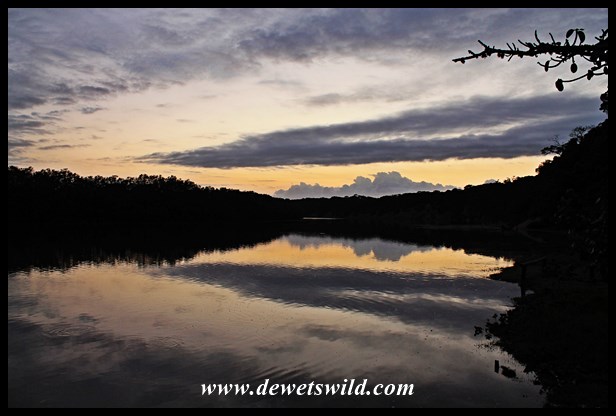
The Mlalazi River is an excellent example of an estuary in good natural condition, and considered among the twenty most important in conservation terms in South Africa. It is also a focal point for many visitors to Umlalazi Nature Reserve, who come here to enjoy a variety of watersports, or just picnic on the banks (to the delight of the clever vervet monkeys who’ll quickly raid unprotected baskets!)

One of Umlalazi’s trails leads all the way from the parking area at the lagoon to the mouth of the Mlalazi River where it empties into the Indian Ocean. Hikers can then return along the same route, or along the beach – a total distance of 8 or so kilometers. Unfortunately when I attempted the trail on our recent stay about half-way to the mouth I encountered a washed-away stream crossing, probably following the good rainfall the week before we arrived. After the thought of hungry crocodiles eyeing me from somewhere unseen crossed my mind, there was no way I was going to try and wade through a muddy backwater, and unfortunately had to turn around. Oh well, next time we’re at Umlalazi I will give it another go (the trail I mean, I’ll still refuse to wade through a muddy backwater if the bridge isnt fixed by then…)

Wandering around Umlalazi’s forests

A visit to Umlalazi Nature Reserve would not be complete without exploring the extensive tracts of pristine forests protected in the reserve.

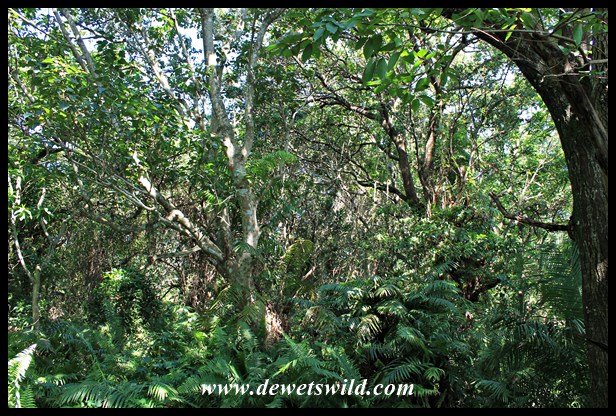
Umlalazi’s Siyaya Trail snakes through the forest, up and down over the densely vegetated dunes, for a distance of 3km. Enormous red and smaller white milkwoods (Mimusops obovata and Sideroxylon inerme respectively) predominate in the species-rich climax dune forests. The Siyaya Trail starts at the beach parking area and makes a large circle through the forest to end at the parking area again, but about half-way through a side-trail leads to a footbridge over the Siyayi stream and to the beach.

At the grove of Kosi palms (Raphia australis) a boardwalk has been constructed just above the level of the waterlogged forest floor, allowing easy access to these magnificent trees and the palm-nut vultures that feed and breed in them. Interestingly, the Kosi palms flower and fruit only once in their lifetime, when the tree is around 30 years old. Elsewhere in the swamp forests, a little further inland than the dune forest, ferns and the swamp fig (Ficus trichopoda) are the most noticeable species.

Umlalazi’s forests abound with insects and other invertebrates, numerous insectivorous and frugivorous forest birds, as well as forest dwelling mammals, of which the red duikers and vervet monkeys are the easiest to see.

A beach that goes on and on at Umlalazi

Whether you’re a sun worshipper, an adrenaline junky, a sports nut or just looking for a quiet position from where to contemplate your place in the world, the beach at Umlalazi definitely has a spot where you can enjoy the Indian Ocean just the way you like it.