Swazi Lily

Adenium obesum swazicum

The beautiful Swazi Lily is a small succulent shrub, growing only up to around 70cm high, that occurs in a small corner of South Africa’s Lowveld, northern Kwazulu-Natal, Mozambique and eSwatini (Swaziland). Sadly the Swazi Lily is critically endangered in South Africa, with over half of its habitat converted to sugarcane fields and the plants themselves subject to illegal harvesting for traditional medicine and collection by horticulturists. Up to 20% of the total population of these plants occur in the Kruger National Park, its last remaining stronghold in this country. The Lowveld National Botanical Gardens runs programs aimed at propagating the Swazi Lily and educating the public about its conservation.

Swazi Lilies loose all their leaves in winter, with both the leaves and flowers emerging at the same time at the onset of summer. The plants grow in well-drained sodic sandy and clay soils, is exceptionally drought resistant and slow-growing. The flowers are pollinated by hawk moths and the seeds dispersed by the wind. The sap of the Swazi Lily is extremely toxic and was used to make poisoned arrows for hunting. In traditional medicine applications it has to be highly diluted to treat heart ailments and skin conditions.

The Swazi Lily is a close relative of the Impala Lily, which flowers in winter.

Southern Black Tit

Melaniparus (Parus) niger

One of the trickiest birds to photograph in South Africa in my personal opinion, owing to the seemingly tireless fashion with which they move while foraging through the trees, is the Southern Black Tit.  It is a bird most closely associated with woodlands dominated by broad-leaved trees and less commonly found in Acacia savannas, forests, plantations and gardens. These tits feed mainly on insects, even pecking open seeds and thorns to reach larvae inside, though they will also consume fruit and nectar given the opportunity.

Southern Black Tits are usually encountered in small groups, consisting mostly of a territorial and monogamous breeding pair and up to four helpers, and often in association with other small insectivorous bird species. They breed during spring and summer, when the dominant female in the group furnishes her nest in a cavity in a tree using grass, lichen, hair and soft leaves and lays a clutch of one to six (usually 3) eggs. The female also takes sole responsibility for the incubation of the eggs over a two week period, during which she occasionally leaves the nest to go foraging. When the chicks hatch they are fed by all the group members, and although they fledge when they’re about 3-4 weeks old they don’t start feeding themselves for another two weeks or so afterwards. The chicks are fully independent at between 2 and 3 months of age. Adults weigh approximately 21g, measuring around 16cm in length.

In South Africa, Southern Black Tits can be found from the Eastern Cape, through Kwazulu-Natal, Mpumalanga and Gauteng to the Limpopo and North West provinces. They are also found in parts of eSwatini (Swaziland), Mozambique, Zimbabwe, Botswana, Namibia, Angola, Zambia and MalawiThe IUCN considers the Southern Black Tit to be of least concern, estimating the South African population alone at around 10-million.

Geranium Bronze

Cacyreus marshalli

The Geranium Bronze butterfly is a tiny (wingspan ≈2cm) but very well known inhabitant of most South African gardens, occurring in a wide range of natural and man-made habitats all over the country except in the driest parts of the Karoo and Kalahari. Their major larval food plants are from the geranium and pelargonium families, many of which are popular garden plants too – the species was inadvertently introduced to Europe and the UK with garden plants exported from here and are now considered a pest in those parts. Adults are weak fliers, seldom going higher than a meter above the ground, settling regularly for extended periods and often remaining in the same general area for days on end. Geranium Bronze butterflies are on the wing throughout the year, but they are most abundant in summer.

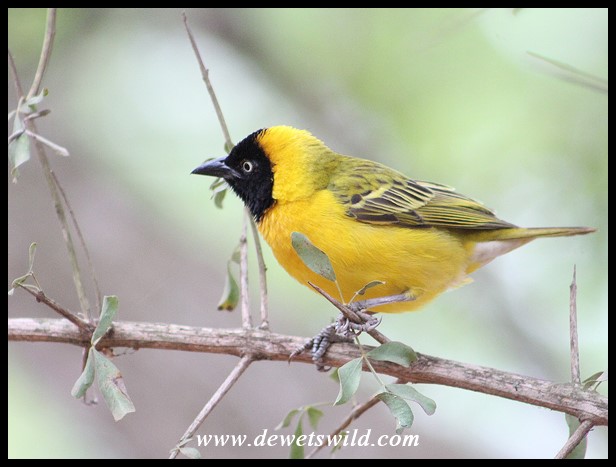
Lesser Masked Weaver

Ploceus intermedius

The Lesser Masked Weaver inhabits thorny savannas, usually near water, feeding on insects, seeds and nectar. They’ve also become more common in suburban parks and gardens of late. In South Africa they are found from northern Kwazulu-Natal, through Mpumalanga and Limpopo to Gauteng and marginally into North West Province, and, as far as the rest of the continent is concerned, patchily from our northern neighbouring states through to Ethiopia. While it is less numerous and widespread than the other two similarly-looking weavers in South Africa, being the Village and Southern Masked Weavers, the IUCN lists the Lesser Masked Weaver as being of least concern.

Lesser Masked Weavers nest in small colonies of up to 200 meticulously woven nests, usually fewer, built in trees and reedbeds, usually over water, during spring and summer. Sometimes they formed mixed colonies with Village Weavers. Males are polygamous, weaving nests for and mating with as many females as possible. Females are solely responsible for the incubation of the eggs (clutches number from 2-4 eggs) over a 2 week period, as well as rearing of the chicks, which fledge about two weeks after hatching. Adults Lesser Masked Weavers measure about 14cm in length and weigh around 21g.

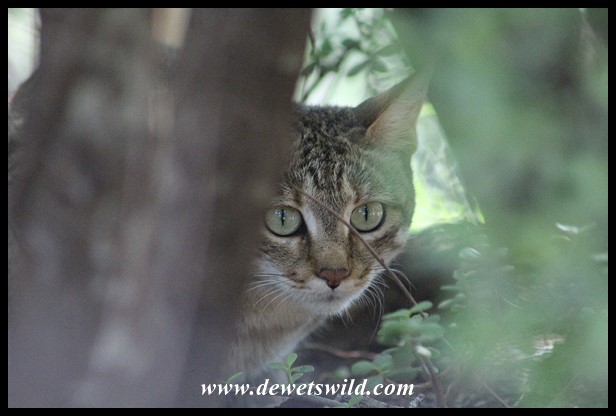
African Wild Cat

Felis lybica cafra

The African Wild Cat is probably our most numerous small felid, occurring in every corner of South Africa and widely into the rest of the continent. They occur in any habitat that offers shelter and prey, which mainly includes rodents and other small mammals (up to the size of hares), birds, reptiles, frogs and invertebrates. They are independent of drinking water.

African Wild Cats are nocturnal and solitary by nature, except when mating or when a female is accompanied by her young. Both sexes defend territories, with those of males much larger and encompassing the areas of three or more females. Wild Cats are excellent climbers, though they do most of their hunting on the ground. Females give birth to litters of 1-5 kittens at any time of year, using burrows, holes in trees or crevices in rocks as dens. The kittens become independent when they’re around 5 to 6 months old, and have a life expectancy of up to 20 years.

Distinguishable from domestic tabbies by their relatively longer legs, shorter tails and rufous backs of the ears, the African Wild Cat stands about 35cm high at the shoulder and weigh around 4.5kg. It is estimated that African Wild Cats were first tamed about 10,000 years ago and is the direct ancestor to the our present day domestic cats. So closely related are they that hybridization with domestic cats is the single biggest threat to the continued survival of the pure African Wild Cat. The IUCN considers the African Wild Cat to be a subspecies of the European Wild Cat (Felis silvestris), a species it lists as being of least concern throughout its wide distribution.

Knob-billed Duck

Sarkidiornis melanotos

The Knob-billed Duck, or African Comb Duck, is one of the larger waterfowl species in South Africa; at over 2.5kg in weight with a wingspan of 1.5m the male is considerably bigger than the female, though the large knob on its bill is his most conspicuous feature.

In South Africa, Knob-billed Ducks are found mainly in North West, Gauteng, Limpopo and Mpumalanga, marginally into the Free State and Kwazulu-Natal, with a handful of vagrants in other provinces. Furthermore they’re widely distributed over all of sub-Saharan Africa, Madagascar, India and South-east Asia. Within this range they roam widely, covering distances of over 3,500km, following the rains to recently inundated floodplains, marshes, pans, and more permanent waterbodies surrounded by woodland and savanna, at times disappearing almost completely from parts where they were still abundant just a few weeks earlier. Knob-billed Ducks are omnivores, feeding on seeds, small fruit, and a variety of aquatic animals and plants.

In the late-summer breeding season, Knob-billed Ducks are usually encountered in pairs or family groups consisting of a mature, territorial male, one or more mature females, and their ducklings, but outside of the breeding season they’re highly gregarious, coming together in flocks numbering from a few dozen into the thousands. They breed in holes in trees or large, abandoned nests, such as those of the hamerkop, always quite close to water and often using the same nest year-after-year. Clutches of 6-11 eggs are incubated by the female only for about 4 weeks, and shortly after hatching the ducklings have to jump out of their tree nest to follow their mother to water. The female is also solely responsible for caring for the ducklings, which become independent at around ten weeks old.

The IUCN considers the Knob-billed Duck to be of least concern, despite noting that its populations are in decline.

Guinea-fowl Butterfly

Hamanumida daedalus

The Guinea-fowl Butterfly occurs commonly from Kwazulu-Natal through Mpumalanga, Gauteng and Limpopo to the North West Province. They are also found through tropical Africa to Arabia, inhabiting savanna and forest habitats. Females lay single eggs on Combretum and Terminalia trees. Adults are on the wing year round, have a wingspan measuring between 5.5 and 8cm, and is attracted to rotting fruit. They fly slow and low, gliding over paths and bare patches, but are very nervous and will dart away at great speed when disturbed.

Ruff

Calidris pugnax

A large population of the Ruff migrates annually to South Africa to spend the austral summer here, the first birds arriving from August and the last departing back to breed in northern Europe and Siberia by April. A few individuals choose to remain here throughout our winter. They’re mostly seen at and around shallow dams, marshes, estuaries and along the beach, occasionally also spending time in adjacent grass- and farmlands. They feed in the water and on dry land, consuming seeds and a wide variety of invertebrates as well as small frogs and small fish.

Ruffs are social birds, usually seen in small groups here but often forming immense flocks while migrating. In their non-breeding plumage which we see here in South Africa, male and female Ruffs look very similar, except that the male, at around 200g in weight, is almost twice as big as the female. They have a wingspan of approximately 55cm.

With a global population estimated in the millions, the IUCN considers the Ruff to be of least concern. Their distribution range spans over Asia, Australia, Europe and Africa, sometimes straying to North America as well, depending on the time of year. During their time in South Africa they can be expected at almost any body of water throughout the country, even occurring at man-made impoundments in the arid west of the country.

African Common White Butterfly

Belenois creona

The African Common White is widely distributed on the continent south of the Sahara, extending into Arabia and also to Madagascar. In South Africa they can be found in the Eastern Cape, Kwazulu-Natal, Gauteng, Mpumalanga, Limpopo and marginally into the Free Sate and North West. This distribution reflects their preference for savanna habitats. Eggs are laid in clusters on plants from the closely related genusses Boscia, Capparis and Maerua which serve as larval food plants. Adults have a wingspan of around 4cm and can be seen year-round.

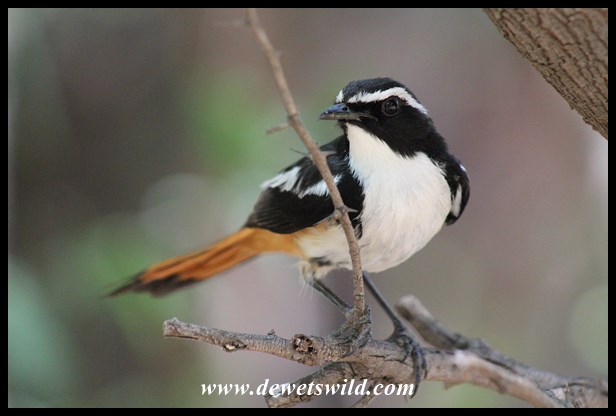
White-throated Robin-Chat

Dessonornis humeralis

The White-throated Robin-Chat is endemic to southern Africa, occurring in Botswana, Zimbabwe, Mozambique, Swaziland and South Africa’s North West, Gauteng, Limpopo, Mpumalanga and Kwazulu-Natal provinces, where it inhabits savanna habitats and riverine thickets and feeds on insects, other invertebrates, and fruit.

White-throated Robin-Chats are usually seen in monogamous pairs and breed in spring and early summer, building cup-shaped nests of fine materials on the ground in dense cover or other suitable shelter. Clutches consist of 2 or 3 eggs and are incubated by the female only over a 2 week period. The chicks fledge when they’re two weeks old but remain dependent on their parents for food for up to two months after leaving the nest.

The IUCN considers the White-throated Robin-Chat to be of least concern. Adults are about 15cm in length and weigh approximately 23g.