Our local Rietvlei Nature Reserve is often just what the doctor ordered when I need a quick nature fix. Located just 13km from our home, with a very fair rate of admission (R50 for adults currently, roughly $3.50), decent facilities, an extensive road network and an amazing diversity of wildlife, Rietvlei never fails to recharge the batteries! A week or so ago, in serious need of getting my head cleared following a few health worries, that’s exactly where I headed for a solo trip.
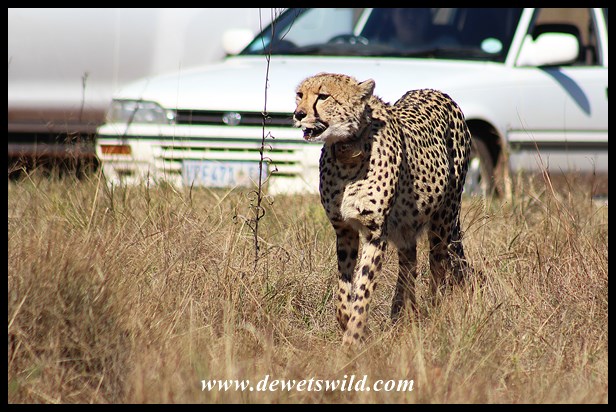
In all the years we’ve been visiting Rietvlei the reserve’s cheetahs have always eluded us – these large spotted cats are experts at hiding! I therefore felt extremely pleased when at long last I encountered a female with her three cubs, just after they had their fill of a freshly caught blesbok. I returned to the site several times later during the day, hoping that the family might still be in the vicinity, only to find the remains of the carcass variously attended by nervous black-backed jackals and pied crows squabbling over the left overs.
Cheetah female
The cheetahs’ blesbok meal
Cheetah female
Cheetah cubs
Cheetah cub
Cheetah cub
Cheetah cub
Black-backed Jackal
Black-backed Jackal nervously approaching the carcass
Pied crows at the remains of the blesbok
Pied crows at the remains of the blesbok
Pied crows at the remains of the blesbok
At one of the bird-viewing hides I had another encounter that will live in my memory forever. A reedbuck ewe hid her young lamb in a dense stand of reeds nearby, which is quite normal behaviour for the species. The curious (or should that be naughty?) youngster however did not want to stay put where his mom told him to, and quite unafraid approached me where I was sitting flat on the ground taking photos of him from a distance. Eventually he got so close that I had to get up and walk away, afraid that if he was to rub up against me his mother might catch my scent on him and abandon him. If I was pleased after the earlier cheetah sighting this experience really had me feeling utterly blessed!
Reedbuck lamb
Reedbuck lamb
Reedbuck lamb
Reedbuck lamb
Reedbuck lamb
Reedbuck lamb
Winter is getting a firm hold on South Africa’s Highveld now and early morning at Rietvlei is a pleasure to behold as mist rises from the waterways and the rising sun starts to thaw the frost covering the grass and trees.
Rietvlei Spruit
A frosty start to the morning at the Finfoot Hide
Mist rising over the Rietvlei spruit
Autumn colours still much in evidence
Rietvlei Spruit in the Rietvlei Nature Reserve
A view over the reedy wetland from which Rietvlei takes its name
For a reserve almost entirely surrounded by urban sprawl and industries, Rietvlei harbours an impressive collection of large and easily visible mammalian inhabitants. My sightings included black wildebeest, blesbok, buffalo, eland, meerkat, plains zebra, hartebeest, springbok, waterbuck, white rhinos and yellow mongoose (as well as the already mentioned cheetahs, jackals and reedbuck).
Black wildebeest
Blesbok
Buffalo
Buffalo
Buffalo
Buffalo herd
Eland
Meerkat sentry
Plains Zebra
Plains Zebra
Plains Zebra
Plains Zebra
Red Hartebeest
Springbok
Waterbuck
Waterbuck
Waterbuck
White Rhinos
White Rhino
White Rhino
White Rhino
Yellow Mongoose
Yellow Mongoose
I also managed to identify 55 different kinds of birds in the few hours I spent at Rietvlei!
African Hoopoe
Buffy Pipit
African Stonechat female
African Stonechat male
African Wattled Lapwing
Ant-eating Chat
Black-chested Snake Eagles
Black-winged Kite
Blacksmith Lapwing
Cape Glossy Starling
Cape Longclaw
Cape Turtle Dove
Common Fiscal
Crowned lapwing
Fiscal Flycatcher
Giant Kingfisher
Groundscraper Thrush
Hadeda
Helmeted Guineafowl
Laughing Dove
Female Lesser Masked Weaver
Long-tailed Widowbird female
Northern Black Korhaan male
Northern Black Korhaan female
Ostrich
Ostrich and Pied Crows
Pied Starling
Red-throated Wryneck
Reed Cormorant
Southern Masked Weaver
Swainson’s Spurfowl
Swainson’s Spurfowl
Western Cattle Egret
White-breasted Cormorant
White-fronted Bee-eater
Yellow-billed Duck
All in all a very pleasant day’s outing; one that certainly got my head back in the right place!
Although the Hippopotamus seldom needs any introduction, most people are entirely unaware of just how big these portly animals are. Bulls can reach 1.7m high at the shoulder and weigh as much as 3,200kg (though usually around 2 tons), while cows are smaller, reaching weights of 1,700kg.
Hippo close-up
Hippo on land showing their short legs and portly body
Hippo showing enormous gape
Hippo posturing at the Balule causeway
Hippo posturing
Hippo posturing
Hippo eyeing us from the Sabie River
Hippo pod (Photo by Joubert)
Hippo on land
Hippopotamus require deep, permanent pools in slow-flowing rivers, dams and lakes, usually with exposed banks and islands and easy access to grazing grounds. They consume 100kg or more of fodder daily, consisting mostly of grass but will also feed on fruits, reeds and other waterplants. Areas subject to heavy grazing by Hippo take on a park-like appearance, with short “mown” lawns. They have been recorded taking carrion from carcasses. In times of drought hippos will travel up to 30km in a night to reach grazing, and will try to make do with any water or mudhole as protection from the sun.
Hippos lazing in the water
Hippo hiding in the shade of a bush
Young hippo looking for something to eat
Hippos from N’wamanzi Viewpoint
Pod of hippos in the bed of the Olifants
Mazithi Dam was little more than a drying mud puddle crammed with tired hippos and flayling barbel
Hippopotamus yawn
Hippo pod in the Pioneer Dam
Hippos at Nkakane
Hippo pod (Photo by Joubert)
Hippos
Just look at that tiny hippo baby!
Hippo in the dark, grazing past our camp
Hippo making the most of the overcast conditions
Hippo tusk
Hippo in the Sabie River (photo by Joubert)
Hippos returning to the hippo pool in the early morning
Hippos in a quiet pool of the Sabie
The hippo has the pool all to himself
Hippo eyeing us from the waterhole
Hippo
Hippos live in herds consisting of a territorial bull, cows and calves, numbering from 2 to 200 (usually around 15). The territorial bull will tolerate other mature bulls in his area provided they act suitably submissively – if not, terrible fights will break out in which one or both combatants are often killed. Inside the group the cows also maintain a strict hierarchy. Territories are demarcated by dungpiles and scattering droppings on prominent bushes and rocks by flicking the tail. Hippos follow specific trails between their waterhole and feeding grounds, and is especially dangerous when encountered along these. In fact, Hippos are among the most dangerous of African animals and cause several human deaths annually. Instances have also been noted of Hippos killing (by drowning or biting) other herbivores or crocodiles which venture too close. They are surprisingly fast on land, capable of speeds in excess of 35km/h, and are just as fast in the water. Hippos are most active at night, preferring to spend the hot daylight hours lolling in the water or baking in the sun on a sandbank and then heading out to feed at dusk.
It is unusual to find hippos moving around on land during daylight
What seems a lazy yawn may be a threat display
Hippos in a deep pool
Hippos
Hippos baking on a sandbank
Young hippo resting on an adult
Hippos lazing on a sandbank in the Nwaswitsontso River
The normal view of hippos, lazing in a pool of water on the Sweni River
Hippo encountered on a night drive from Olifants
Another pod of hippos at the Ngotso weir
Hippo antics at Nsemani Dam
Hippos at Lake Panic
Hippo highway leading from the water
Hippopotamus
Hippopotamus
Hippos at kuMfazana Pan
Hippopotamus
Hippopotamus
Most Hippo calves are born in the rainy season, when cows give birth to a single offspring after a gestation of about 8 months. The calves are usually born in reedbeds, where they remain hidden for a few weeks before being introduced to the herd as bulls are known to kill calves, even their own. Cows are incredibly protective of their young and nursing usually takes place in the water. Thanks to their large size and aggressive nature, few Hippos succumb to predator attacks, though lions, hyenas and crocodiles will attempt to catch calves given an opportunity. Drought and starvation are the biggest cause of natural deaths in Hippo populations. They have a life expectancy of up to 50 years in the wild.
Playful baby hippos
Playful hippos
Chubby hippo calf and mom
Baby hippo
Hippopotamus
Baby Hippo at Mestel Dam
Hippo gang at Sunset Dam
Hippo becoming a temporary island for Marsh and Serrated Hinged Terrapins
Hippo walking back to Lake Bhangazi
Hippos lazing at Amazibu Pan
Hippos
Baby Hippo resting on mom’s back at Rathlogo
Hippo baby (photo by Joubert)
Hippo babies (photo by Joubert)
Lazy family of hippos at Mestel Dam
Pair of Hippos walking along the Letaba River
Hippo family at rest
Hippopotamus
Hippopotamus
Hippopotamus
Resting hippos
Hippos
Hippopotamus cow and calf
Hippopotamus calf
Owing to a declining population due to poaching and loss of habitat, the IUCN considers the Hippopotamus to be “Vulnerable” and estimate that the total African population numbers between 125,000 and 148,000. It is estimated that there are at least 5,000 (and probably considerably more) Hippos in South Africa, where they now occur naturally only in the Lowveld of the Mpumalanga and Limpopo Provinces and the north of Kwazulu-Natal, although reintroductions have occurred outside these areas. Reliable places to see Hippos in South Africa are the Kruger National Park, iSimangaliso Wetland Park and Pilanesberg National Park.
Hippos
Pod of Hippos in Sunset Dam
Pod of hippos seen in the river from Crocodile Bridge
Hippopotamus in the rapids below the causeway
Hippos yawn as a threat
Hippo going walkabout in broad daylight
Hippos in the Mfazana Swamps (photo by Joubert)
Hippo
Hippo Babies
Hippopotamus (photo by Joubert)
Hippos in a dam in the Manyeleti Nature Reserve
Lazy Hippos
Hippo in a dam in the Manyeleti Nature Reserve
Hippo in a dam in the Manyeleti Nature Reserve
Hippopotamus
A pod of Hippos on the shores of Lake St. Lucia at Catalina Bay
Hippopotamus
Pair of Hippopotamus
Pod of Hippopotamus in Nsumo Pan
Hippopotamus eyeing us with some suspicion from among the reeds
Hippopotamus
Hippos in Transport Dam
Baby Hippo
Hippopotamus
Hippos and a crocodile sharing a corner of Manyeleti’s biggest dam
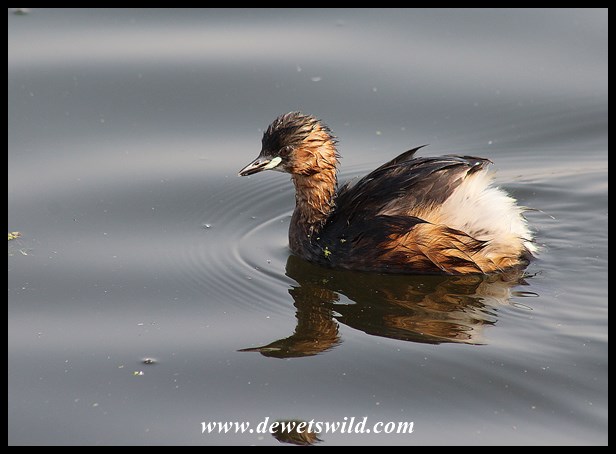
The Little Grebe, or Dabchick, is a small (120-190g, 20-29cm long) resident waterbird, commonly seen in pairs or small groups on shallow wetlands, ponds, lakes, pans, dams and other quiet freshwater habitats (rarely in fast flowing rivers). They feed on aquatic prey, including fish, amphibians, crustaceans and insects, mostly caught under water, and in turn are preyed upon by large predatory fish.
In South Africa, Little Grebes breed mostly in the spring and summer months. Solitary pairs build a floating platform of plantmaterial, anchored to some underwater structure, for a nest. Before leaving the nest the parent bird always covers the eggs, of which there may be up to seven in a clutch, with some nest material. After hatching the chicks are often carried on their parents’ backs when swimming. At the end of the breeding season the Little Grebes moult and are then flightless for a short time.
Despite a declining population, estimated at as many as 3.5-million, the IUCN consders the Little Grebe of Least Concern, owing to a wide distribution across Africa, Asia and Europe. Little Grebes occur all over South Africa wherever suitable habitat is to be found.
Little Grebe
Little Grebe
Little Grebe
Little Grebe
Little Grebe
Little Grebe
Little Grebe
Little Grebe with chicks
Little Grebe chick
Immature Dabchick
Little Grebe
Little Grebe
White-faced Whistling Duck surrounded by Little Grebes
The Great Crested Grebe is a relatively big (up to 1.5kg, 45-56cm long, with a wingspan of up to 73cm) waterbird inhabiting large bodies of open water (mostly dams, lakes and pans, and rarely rivermouths and protected bays) where they feed on fish, crustaceans, amphibians and aquatic insects pursued underwater.
Locally, breeding seems to occur at any time of the year, on platforms of floating plant material anchored to emergent plants such as reeds or in flooded thickets. These birds are well known for their elaborate mating display. Clutches usually contain only two eggs, and the chicks are often carried on the parents’ backs.
Great Crested Grebes have a wide distribution across Europe, Asia and Australasia, with a limited occurrence in Southern and East Africa. The IUCN estimates their population at as many as 1.4-million and considers the species of Least Concern. In years past this grebe suffered greatly due to hunting for the plume trade, but today gill-netting is a more serious threat to their survival, especially so in East Africa where they are now rare. Great Crested Grebes are locally common residents in South Africa and occur mostly on the central Highveld (Gauteng, Northwest, Mpumalanga and Free State Provinces) and the Eastern and Western Cape.
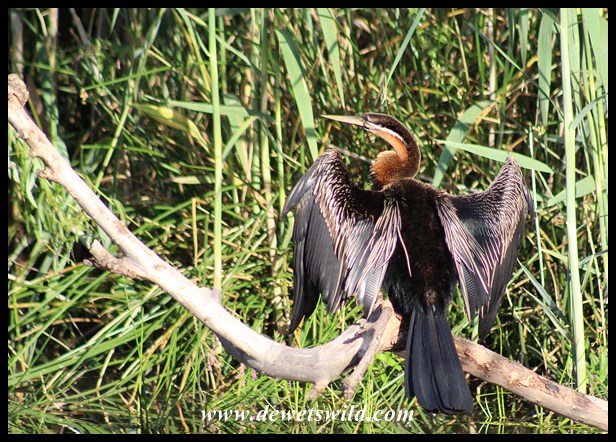
African Darters have a wingspan of up to 1.3m and weigh in at as much as 1.7kg.
Darters are common residents at most wetlands, lakes, dams and slow flowing rivers, and occasionally lagoons and estuaries. They swim low in the water, usually with only their neck and head above the water, and can stay underwater for up to a minute when pursuing prey. African Darters feed mostly on fish, and occasionally frogs, water snakes and crustaceans, which are swallowed whole and head first.
Breeding occurs in colonies (often mixed with other species) in trees and reedbeds, mostly during the summer months. Nests are platforms built of sticks, on which both parents incubate the 3-6 eggs with their feet. Darter feathers are not waterproof, explaining why they are often seen sunning themselves on rocks and dead tree branches with wings outstretched. Some birds loose all their feathers when they moult after the breeding season, and then are flightless for a short period.
African Darters occur over most of Africa south of the Sahara, and can be seen almost all over South Africa, even occurring in the arid west of the country along the course of the Orange River. Despite a declining population (estimated at between 25,000 and 127,000) in many range states, the IUCN considers the African Darter of “least concern”.
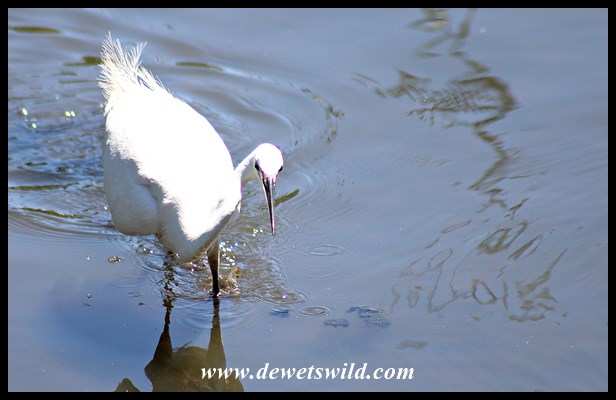
The Little Egret is a relatively small, white heron weighing about 500g with a wingspan of around a metre and characteristic yellow toes, believed to aid in attracting prey to within striking range.
Little Egrets forage singly or in small groups in shallow, open wetlands, on the margins of rivers, dams, lakes, lagoons and waterlogged pastures and agricultural fields, and in the intertidal belt along the coast. They feed mostly on small fish, amphibians, crustaceans, molluscs, insects and other invertebrates
Breeding in this species coincides with the rainy season (in South Africa mostly the summer months), usually nesting in colonies numbering dozens up to thousands of pairs and often in association with other species of egret, heron, ibis and cormorant. They build their nests of sticks on cliffs, in reedbeds or trees, usually over the water, or on the ground on safe islands. Clutches of up to 5 eggs are incubated by both parents for a little over 3 weeks, and the chicks fledge at about 6 weeks old.
The IUCN estimates that there may be over 3-million (and the population is growing) Little Egrets distributed over Africa, Europe, Asia and Australia. Vagrants have become established in the Caribbean and now appear to be spreading into North and South America. In South Africa the Little Egret is a common resident (subject to local movements to the coast during winter) all over the country, with the exception of the arid Northern Cape where it is mostly seen only along the course of the Orange River.
The well-known Cattle Egret is a small (280-450g) white heron (egret) with a wingspan of less than a metre.
Cattle Egrets usually forage in small groups numbering 10 – 20, but can at times be found in flocks of thousands where food is abundant. These birds inhabit open grasslands, savannas, pastures and meadows, swamps and marshes. They’re a familiar sight wherever large wild or domestic herbivores are grazing, catching insects and small vertebrates disturbed by their big neighbours’ movements. They will also peck ticks and other parasites from these bigger animals.
As with most other egrets, Cattle Egrets breed colonially in groups numbering from a dozen to several thousand pairs, often in mixed species congregations. Nests are built of sticks in trees and reedbeds, often over or surrounded by water. In South Africa breeding reaches a peak in the summer months. Clutches of one to five eggs are incubated by both parent birds for about three weeks, while chicks become independent at about 45 days old.
With a growing population estimated at as many as 10-million, and an expanding distribution on every continent except Antarctica, the IUCN considers the Cattle Egret to be of Least Concern. Their rapid range expansion in the past 100 years is directly correlated with the expansion of cattle farming across the globe. In South Africa they occur in every province, although they’re not very common in the xeric northwest of the country. They’re also much more numerous during the warm summer months, with many birds migrating to central Africa to escape the harshest of winter in our southern climes.
Western Cattle Egret
Western Cattle Egret
Western Cattle Egret
Western Cattle Egret
Western Cattle Egret
Western Cattle Egret
Western Cattle Egret
Western Cattle Egret
Western Cattle Egret
Western Cattle Egret
Western Cattle Egret
Western Cattle Egret
Western Cattle Egret
Western Cattle Egret
Cattle Egret
Cattle Egret
Cattle Egret
Cattle Egrets (photo by Joubert)
Cattle Egret
Cattle Egret
Cattle Egrets
Cattle Egrets in flight over the sea at the estuary of Lake St. Lucia
At the end of April, we had the privilege of visiting the Kruger National Park with a wonderful group of friends; altogether 21 adults and children from 5 families and by far the biggest group we’ve ever accompanied to the Park! Our base for the four nights was the camping area at Satara Rest Camp, allowing us to introduce our friends to many of our favourite places in the central section of the Park.
A wonderful group of friends enjoying the scenery at Nwanedzi
Our previous visit to the Satara area was in the winter holidays of 2016, at the height of one of the worst droughts on record in South Africa. What a pleasure seeing the region transformed into a sea of lush green vegetation now at the end of the summer rainfall season, and experiencing a few of the final showers rolling over the Lowveld before winter sets in!
Wonderful to see so much water in the Park – here at Nsemani Dam
Satara scenery
Scenery along the S100
Dusty sunset on the S100
Scenery along the S100
Wonderful to see so much water in the Park – here at Gudzani Dam
Wonderful to see so much water in the Park – here at a stream crossing on the S41
Sunset at Nsemani Dam
Downpour approaching along the Olifants River valley
Downpour approaching along the Olifants River valley
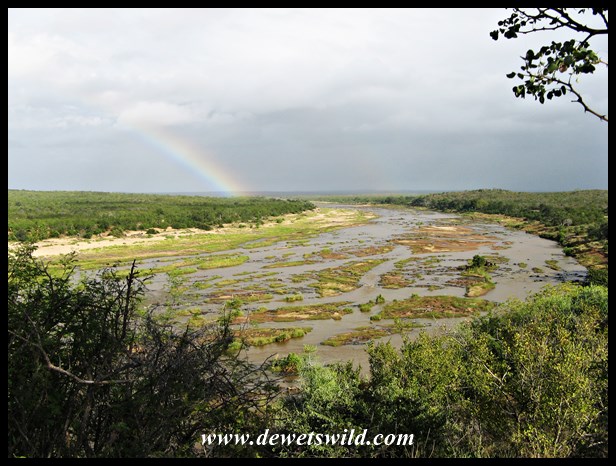
Rainbow over the Olifants
Sunset at Satara
Of course the dense vegetation made game-viewing very tricky, and in stark contrast with our visit last year when there seemed to be predators resident at every one of the few remaining pools of water, we really had to work hard to find the meat-eaters for which Satara is so famous on this visit. We don’t consider ourselves “Big-5” chasers, but when you’re introducing a couple of newbies to Kruger’s wonders you do want her to put her best foot forward, and luckily Satara remained true to her reputation as one of the best game-viewing areas in the Park. Even if the predators kept us in suspense at their appearance, there were still a myriad of other species of game to be found in good numbers and keeping us enthralled on our drives, and even in camp! Of course, we expected to find high concentrations of plains zebra, blue wildebeest and giraffe roaming the central plains, but we were very surprised to find so many elephants around Satara!
Waterbuck among the spiderwebs
Banded mongoose
Hippos at sunset
African Wild Cat visiting our campsite in Satara
Kudu cow
African Buffalo
African Buffalo
Huge herd of impala
Spotted Hyena on a night drive
Waterbuck calf
Well camouflaged Foam Nest Frog
There seemed to be armoured crickets everywhere you looked! This one was feasting on a trampled comrade in Satara’s parking area…
Pride of lion just north of Tshokwane
Pride of lion just north of Tshokwane
Lion hiding from the rain
Big warthog boar
Blue wildebeest
Giraffe
Plains Zebra
Blue wildebeest
Plains Zebra
Plains Zebra
Giraffe
Giraffe
Plains Zebra
Plains Zebra
Giraffe in rainstorm
Plains Zebras caught in rainstorm
Elephant
Elephant cow with deformed right tusk
Elephant
Wary elephant trio
Big Bull showing off (photo by Joubert)
Elephant in a downpour
For anyone looking for birds, Kruger could never disappoint, however on this visit the Park seemed to be bursting at the seems with feathered inhabitants even more than usually. We’ve shown you the enormous flocks (rather swarms!) of queleas in an earlier post, but notably we’ve also seen bigger flocks of marabou stork and wattled starling on this trip than ever before – no doubt in response to an eruption of food in the form of grass-seeds and the insects that feed on it.
Juvenlie Bateleur
Saddle-billed Stork
Saddle-billed Stork
Saddle-billed Stork
Wattled Starling
Wattled Starling
Marabou
Marabou
Marabou
Marabou
African Mourning Dove
Marabou
Marabou
Burchell’s Starling
Lilac-breasted Roller
Ostrich
Swainson’s Spurfowl
Pied crows
Egyptian Goose
Brown Snake-Eagle
Wattled Starling
African Scops Owl
At the end of our stay we had to contend with every camper’s worst nightmare – having to break up camp in pouring rain! They say that any friendship that survives going on holiday together will remain standing come what may, and happily it seems despite the hardships of dripping wet, muddy bodies and thoroughly soaked camping equipment, our friendship with the Bernards, Krugers, Nels and Therons have come through the tribulations with flying colours.
Camping at Satara, Kruger National Park, April 2017 – click the image for an enlarged view
(If you’d like to find out more about Satara and surrounds, have a look at the dedicated blog post we published about this popular part of the Kruger National Park)
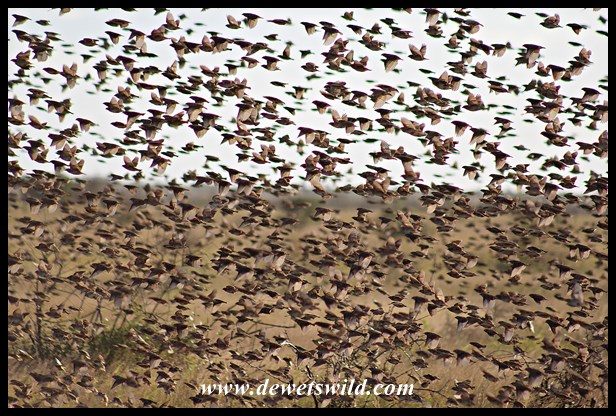
Some of the most impressive sights of our recent visit to the Satara area of the Kruger National Park was the enormous flocks of Red-billed Quelea occupying the grasslands of the central plains. Following the good rains that bought respite from an awful drought, the savannas are heavy with a rich harvest of seeding grasses, and literally millions of the little birds are making the most of the abundant foodsource. When their population reaches a peak, as it currently has, there could be as many as 33-million Red-billed Queleas swirling in cloudy swarms over the Park!
Red-billed Queleas at Satara in April 2017
Red-billed Queleas at Satara in April 2017
Red-billed Queleas at Satara in April 2017
Red-billed Queleas at Satara in April 2017
Red-billed Queleas at Satara in April 2017
Red-billed Queleas at Satara in April 2017
Red-billed Queleas at Satara in April 2017
Red-billed Queleas at Satara in April 2017
Red-billed Queleas at Satara in April 2017
Red-billed Queleas at Satara in April 2017
The Red-billed Quelea is a small (20g) seed-eating sparrow-like nomad inhabiting grasslands and grainfields (causing enormous losses to farming communities). Swarms that could number in the millions descend on watering holes at least twice daily. While feeding they “roll” over the grasslands in a wave-like motion, most impressive to witness! While seeds make up the vast majority of their diet they do catch small insects as well, especially when raising chicks.
Nesting occurs communally in the rainy months and hundreds, even thousands, of nests are woven per tree (prefers thorn trees) by the males. Breeding colonies could consist of more than 2 million monogamous pairs, and is a magnet for every imaginable predatory bird, reptile and mammal that is large enough to take adults and chicks. Clutches normally number three eggs and the female incubates them for only 12 days, whereafter the chicks fledge within another two weeks!
The Red-billed Quelea may well be the most abundant bird on the planet, with an estimated population as large as ten billion, and as such is considered as being of least concern by the IUCN. It occurs widely in the savannas of Sub-Saharan Africa and can be found in every one of South Africa’s provinces, where it must number in the hundreds of millions.
(The photos in the following gallery were taken on visits to the Kruger Park and elsewhere)
We’re fresh back from a wonderful breakaway in the Kruger National Park, and of course have lots to share with you from our latest trip to the bush, so stay tuned!
Today also marks the fifth birthday of de Wets Wild – Thank you to everyone who has supported and encouraged us along the way!