iSimangaliso’s Eastern Shores – A Photographic Journey (Part 3)

On the Eastern Shores of Lake St. Lucia, the amazing diversity of life forms comes in all sizes. The star of this collection of photos showcasing some of the smaller creatures that crossed our path on our recent visit must be the tiny frog that somehow got into my mug while we were enjoying coffee and rusks one morning at Mziki viewpoint near Mission Rocks. Exactly when it got into my coffee is unclear – I had put my mug down a few times to take pictures – and I have no idea how much of my coffee I had shared with the little guy. Joubert only noticed it sitting in the cup when I took my last swig as we started packing up to leave. Lucky for it, I drink a lot of milk in my coffee so it wouldn’t have been scalded.

Follow the links for more of our posts about St. Lucia town, Cape Vidal and Mission Rocks.

iSimangaliso’s Eastern Shores – A Photographic Journey (Part 2)

The iSimangaliso Wetland Park is a bird-watcher’s paradise – 526 bird species have been recorded within its borders!

During the few days we recently spent on the Eastern Shores of Lake St. Lucia, we managed to tick 109 kinds of birds, and had we been better at identifying the “Little Brown Jobs” our list would undoubtedly have been quite a bit longer still.

This incredible diversity is surely due to the Park’s rich variety of habitats, and our “success” in connecting with so many kinds of birds can only be ascribed to the terrific collection of roads, hides, picnic sites and other localities so easily accessible to visitors.

We hope you enjoy this sample of iSimangaliso’s birdlife!

Follow the links for more of our posts about St. Lucia town, Cape Vidal and Mission Rocks.

iSimangaliso’s Eastern Shores – A Photographic Journey (Part 1)

We’re fresh back from a terrific holiday in two very special wild places in northern Kwazulu-Natal. Our first destination was the iSimangaliso Wetland Park, and specifically the Eastern Shores of Lake St. Lucia, where we spent one night at Manzini Chalets in the holiday town of St. Lucia, and four nights in a log cabin at Cape Vidal.

I can’t think of a better way to start off the report back on our trip than with a few landscape photos that illustrates why iSimangaliso is a land of “miracles and wonders”, and one of our favourite destinations!

Follow the links for more of our posts about St. Lucia town, Cape Vidal and Mission Rocks.

Back from the Bush

We’ve just arrived back home after a wonderful ten days in the bush, visiting the iSimangaliso Wetland Park and Hluhluwe-Imfolozi Park in South Africa’s Kwazulu-Natal Province.

While we get busy responding to the comments you left on the scheduled posts that published in our absence, here’s a small gallery of what you can expect when we report back on our trip in the coming days…

Water Thick-knee

Burhinus vermiculatus

The Water Thick-knee, or Water Dikkop, is a nocturnal bird species inhabiting riverbanks, lake shores, swamps, estuaries and occasionally beaches with sufficient cover in the form of shrubs and bushes. By day they hide in deep shade near the water. Their diet includes invertebrates like insects, crustaceans and molluscs, tadpoles and frogs, and seeds. They weigh about 300g, with a wingspan of about 75cm.

Outside of the breeding season the Water Dikkop congregates in groups of up to 30 birds. The breeding season usually coincides with the end of the dry season, preferring to nest on sand bars in low-flowing rivers or on the shores of other water bodies. The nest is just a scrape in the ground, usually adjacent to a rock, piece of driftwood or other similar structure, but the eggs and chicks are superbly camouflaged. 1-3 eggs are incubated by both parents for just over 3 weeks, with the chicks fledging at about 2 months old.

The Water Thick-knee has a wide, albeit patchy, distribution over Sub-Saharan Africa and is listed as Least Concern by the IUCN. In South Africa the species occurs along the coast of the Cape Provinces, through large parts of Kwazulu Natal, into the Lowveld of Mpumalanga and Limpopo Provinces, along the Limpopo Valley and south along the course of the Crocodile River into Gauteng.

Pied Kingfisher

Ceryle rudis

The Pied Kingfisher can be expected at almost any body of fresh or brackish water, and at times even at tidal pools, with suitable perches as vantage points from which it can hunt fish, tadpoles, frogs, crustaceans and aquatic insects, often hovering above the water before launching a diving attack. Large prey is pounded repeatedly against a favourite perch to kill it and soften it up before swallowing. They are usually seen in pairs or small family groups and have been recorded up to 5km from the nearest land over the open water of large lakes. With a weight of up to 110g, and a length of up to 25cm, it is the second biggest kingfisher found in South Africa.

Though nesting has been observed throughout the year, the breeding season of the Pied Kingfisher peaks in spring, when pairs nest in burrows of up to 2.5m long that they dig themselves in earth banks, with up to 7 eggs laid in a wide chamber at the end. Incubation takes about 18 days and is mainly the female’s responsibility. The chicks stay in the nest for another 3 to 4 weeks and then start to learn to hunt, becoming independent by about 3 months of age. Usually a pair has helpers from previous broods assisting in the feeding of the present clutch.

The IUCN considers the Pied Kingfisher to be of least concern, thanks to its wide distribution over Sub-Saharan Africa, the Middle East, Indian Subcontinent and South-East Asia. It may be one of the three most numerous kinds of kingfishers, but some populations however are in decline due to poisoning and habitat loss, while others are thriving. In South Africa they are commonly found from the Western Cape and along the coast and adjacent interior of the Eastern Cape, through Kwazulu-Natal into Mpumalanga, Limpopo, Gauteng, North West and the Free State. They also occur along the length of the Orange River in the otherwise arid Northern Cape.

Reed Cormorant

Microcarbo africanus

Reed Cormorants inhabit most freshwater habitats, with the exception of fast flowing rivers, preferring quiet, sheltered, shallow and well vegetated water bodies where they hunt underwater, primarily for fish as well as frogs, crustaceans and molluscs, either singly or in small groups.

Reed Cormorants are diurnal, being most active in the early morning and late afternoon. At night they roost in large communities, often mixed with other species. The Reed Cormorant is subject to some nomadic movements in response to fluctuating water levels. It is a relatively small cormorant, with a wingspan of 85cm and a weight of about half a kilogram. They often rest with wings outstretched to dry.

Reed Cormorants often breed in groups of 1 – 50 pairs in mixed-species colonies with herons, ibises and other cormorants. They nest at any time of year, though there is a peak in spring and summer. Their nests are built of twigs and other vegetation over water, either in trees or reedbeds or on cliffs, and clutches contain 1 – 6 (usually 3 or 4) eggs that are incubated by both parents for just over 3 weeks. The chicks become independent at about two months of age.

The Reed Cormorant occurs widely across Sub-Saharan Africa and Madagascar, and is considered as being of least concern by the IUCN, despite a declining population as a result of persecution by fish farmers and disturbance by human activities. In South Africa they can be found in all provinces, even occurring in the arid Northern Cape along the courses of the Orange and Vaal Rivers and their large tributaries.

White-bellied Sunbird

Cinnyris talatala

An inhabitant of open woodlands, riparian thickets, bushveld and suburban gardens, the tiny (6-9g) White-bellied Sunbird feeds mainly on nectar from a variety of flowers, although insects and other invertebrates also makes up a sizable portion of its diet.

White-bellied Sunbirds breed throughout the year, with a peak in spring and summer. The nest is built by the female, of dry plant material bound together by spider web, often in a very thorny plant or near a wasp nest. The female is also singly responsible for incubating the clutch of 1-3 eggs for about two weeks, but both parents feed the chicks until they fledge after another two weeks.

In South Africa, White-bellied Sunbirds occur in Kwazulu-Natal, the Free State, North West, Gauteng, Mpumalanga and Limpopo Provinces. It is also found in Angola, Botswana, Malawi, Mozambique, Namibia, Swaziland, Tanzania, Zambia and Zimbabwe, and with an abundant, stable population is regarded as being of least concern by the IUCN.

As you can see from this gallery, Joubert and I have great fun photographing the White-bellied Sunbirds visiting the Cape Honeysuckle and other flowering shrubs in our small garden.

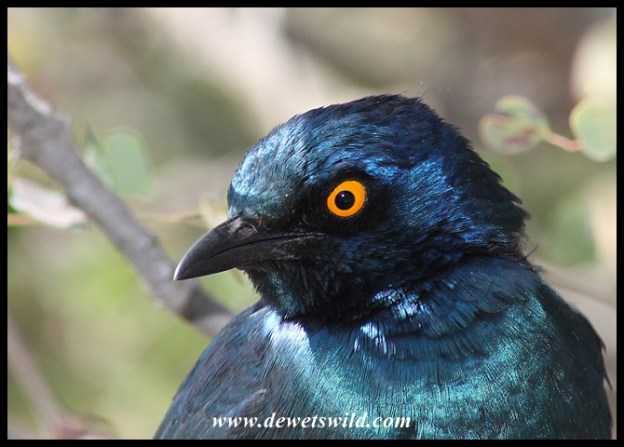
Cape Glossy Starling

Lamprotornis nitens

Cape Glossy Starlings are a common feature of bushveld-savanna (especially thornveld) and woodland habitats in Southern Africa, and have of late become increasingly abundant in towns and suburbs where it takes advantage of discarded scraps and garden bird feeders. Its natural diet consists of fruit and insects.

They are gregarious birds, forming large flocks outside of the summer breeding season and often also associating with other kinds of starlings. Nests are built in holes in trees (or similar artificial structures, even post boxes!) and often used for many consecutive years by the same pair. Clutches are made up of between 2 and 6 eggs, incubated by the female. Mating pairs often have as many as 6 helpers assisting in the feeding of the latest brood.

The Cape Glossy Starling has a common and stable population throughout its range, which includes Angola, Botswana, Lesotho, Mozambique, Namibia, South Africa (all provinces except the Western Cape), Swaziland, Zambia and Zimbabwe, and is considered of least concern by the IUCN.

Natal Spurfowl

Pternistis natalensis

An inhabitant of woodland, savanna, riverine thickets, wooded hills and coastal forests, the Natal Spurfowl subsists on an omnivorous diet of seeds, bulbs, roots, fruit and insects, often pecking undigested items from the dung of large herbivores. They’ll also exploit agricultural fields adjacent to their preferred habitats. Natal Spurfowl weigh in at around 400g.

Natal Spurfowl move around in pairs or family groups. Nests are scraped in the ground among dense vegetation, and lined with soft plant material and feathers. Clutches contain up to 7 eggs, incubated by the female for 3 weeks. Breeding has been recorded throughout the year, with a peak in summer and autumn.

The Natal Spurfowl occurs in Botswana, Zambia, Zimbabwe, Mozambique, Swaziland and South Africa, where they can be found in the provinces of Kwazulu-Natal, Free State, North West, Gauteng, Limpopo and Mpumalanga. They are common throughout their range and listed as “least concern” by the IUCN.