Author Archives: DeWetsWild

Unknown's avatar

About DeWetsWild

Nature and wildlife enthusiast and tour guide, based in Pretoria, South Africa.

The results of the 2018 South African Blog Awards have been announced!

We are so grateful to everyone that supported us in the 2018 South African Blog Awards, the results of which were announced last night. Thanks to you, de Wets Wild has not only been announced as runners up in the Best Environmental Blog Category, but we’ve also been voted the winners in the Best Travel Blog category for the second year running! Thank you so much, again, for all the support and encouragement you’ve given us! We consider ourselves blessed for being able to call this beautiful country home, and being able to share its wildlife treasures with you all.

Our thanks also goes to the organisers and judges of the 2018 awards, with hearty congratulations to all the other great blogs featured in the results!

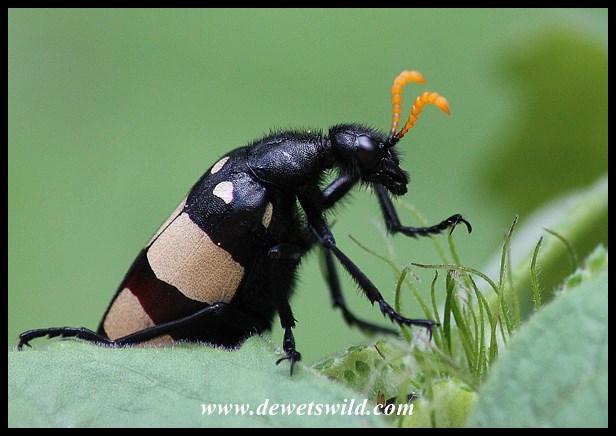
CMR Blister Beetle

Mylabris oculata

The CMR Blister Beetle is a large (4cm long) and colourfully-marked beetle in the family Meloidae, notorious for excreting the toxin cantharidin in defence against predators – this can cause blisters when making contact with skin and can even be fatal if ingested, both to humans and livestock.

After mating, the female lays her eggs in the ground. After hatching the larvae of the CMR Blister Beetle feeds on grasshopper eggs (including those of plague-causing locusts), while the adults feed on flowers and, often congregating in large numbers on flowering plants, are considered a pest in gardens and orchards. They are slow-flying insects. Adults are most often seen between late spring and early autumn. CMR Blister Beetles have very few specific habitat requirements and occur in almost every corner of South Africa.

The “CMR” acronym in this blister beetle’s name comes from the Cape Mounted Rifles, a military unit from South Africa’s colonial past whose colours resembled this beetle’s. In turn, the CMR Blister Beetle then became part of the Cape Mounted Rifles’ insignia.


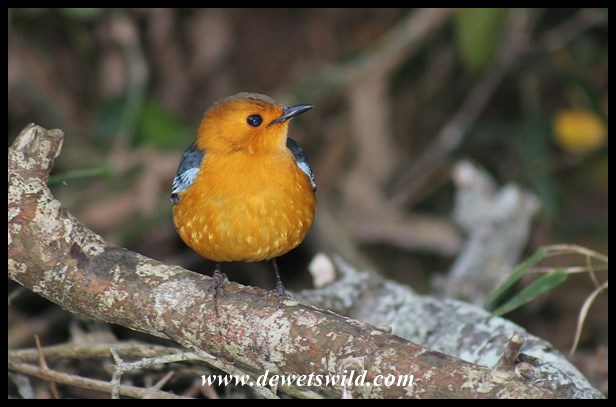
Red-capped Robin-Chat

Cossypha natalensis

The Red-capped Robin-Chat is an inhabitant of forests and dense woodlands, in South Africa to be found from the Eastern Cape through Kwazulu-Natal into the Lowveld and escarpment of Mpumalanga and Limpopo, and north of our borders widely through central and east Africa into southern Ethiopia. Insects make up the bulk of their diet and they are usually seen singly or in pairs.

Red-capped Robin-Chats breed in spring and summer. Pairs are monogamous and build cup-shaped nests in dense foliage or inside holes in trees, laying clutches of 2-4 eggs. This species occasionally hybridizes with the Chorister Robin-Chat. They are talented songbirds that can mimic up to 40 other kinds of birds, the whistling of a human and even the barking of a dog! Adults weigh around 32g with a length of about 16cm.

The IUCN classifies the Red-capped Robin-Chat as being of least concern.

Natal Green Snake

Philothamnus natalensis

The Natal Green Snake occurs only in southern Mozambique, Swaziland and South Africa (from the Garden Route, along the coast through the Eastern Cape into Kwazulu-Natal, Mpumalanga, Limpopo and Gauteng) with two subspecies – Eastern and Western – being recognized. It inhabits forests and woodland habitats, often near houses, where they feed mainly on frogs, small reptiles, chicks and large insects. This is an alert, active and agile snake that is entirely lacking in venom and thus harmless to humans. They breed in early summer, with females laying small clutches of 3-8 eggs (occasionally as many as 14). Adults grow to a length of about a meter.

The IUCN considers the species to be of least concern.

While visiting Umlalazi Nature Reserve in December 2018, Marilize was first to notice this Eastern Natal Green Snake one afternoon while enjoying the early evening hours on the patio of our accommodation unit. It was remarkably relaxed and unperturbed by our presence, and allowed us a few photographs before sneaking off while we weren’t watching.

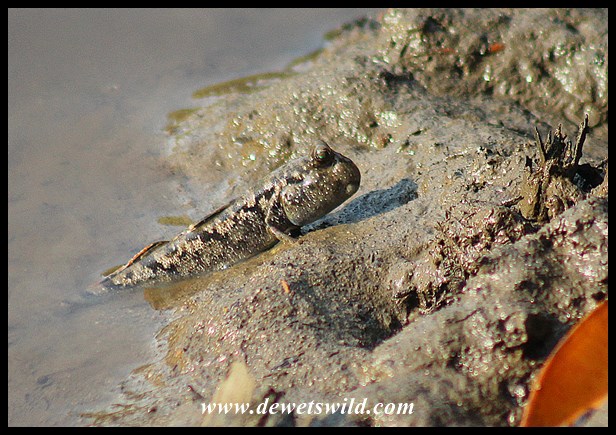
African Mudhopper

Periophthalmus kalolo (P. koelreuteri africanus)

As a kid, the first time I learned about the existence of mudskippers, or mudhoppers, I was flabbergasted. Here was a fish-out-of-water that actually didn’t mind that at all! To this day I still find the idea absolutely fascinating. Mudskippers are amphibious fish that can survive out of water for considerable lengths of time by holding oxygenated water in their gill chambers and “breathing” through their wet skin and throat. Their pelvic fins are fused into suckers, allowing them to attach themselves to rocks and branches. And if that wasn’t astounding enough, they can use their fins and tails as legs and actually walk, run, hop, skip and jump on dry land!

The African Mudhopper is a small fish, growing to a maximum of about 14cm in length. They are carnivorous, feeding mainly on crustaceans, other invertebrates and smaller fish and spending most of their time looking for food on land rather than in water. When resting they usually do so with their tails in the water and bodies on the shore. Mudskippers live in the intertidal zone of river mouths, lagoons and estuaries, where the influence of the river, sea and tides conspire to create a challenging and constantly changing world of varying salinity and water levels. When their preferred mud flats become inundated by the incoming tide they hide from predatory fish in burrows that they dig themselves or they may use those of other creatures, like crabs, for the purpose. Males are territorial and display their colourful fins prominently to intimidate challengers and attract mates. Females lay their eggs inside the male’s nesting tunnels after mating, and the pair then cares for the eggs until they hatch.

The alternative name of “Common Mudskipper” is actually much more appropriate for this species, as they occur widely along the Indian and Pacific Ocean coastlines of Africa, Asia and Australasia. In our experience one of the very best places in our country to see these unique fish is the boardwalk through the mangrove swamp at Umlalazi Nature Reserve on the Kwazulu-Natal north coast.

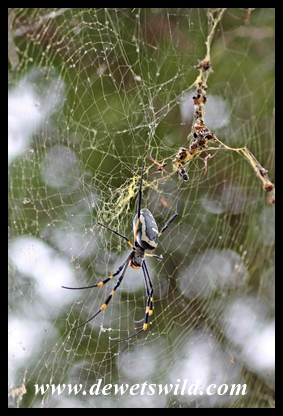
Golden Orb-Web Spider

Genus Nephila

The Golden Orb-web Spiders are some of the most impressive, and noticeable, arachnids you’ll encounter in South Africa. With a body length of up to 6cm and legspan of 10cm or more, female Golden Orb-Web Spiders are much larger than the males (whose bodies are usually less than a cm long), whom are often found sharing a web with a female. The web from which their name is derived is extremely large; often over a meter wide and straddling the space between adjoining trees, bushes and fenceposts, woven in a wagon-wheel shape with concentric strands and strong enough to entrap even small birds, though insects are their main target. Several such webs are often found in close proximity to one another. These diurnal spiders can deliver a painful bite, but the venom of the Golden Orb-Web Spiders is not harmful to humans.

From his position at the edge of her web, the male will attempt to approach the female and mate with her while she is consuming her prey, for fear of becoming a meal himself (which often happens). Female Golden Orb-Web Spiders produce up to four egg sacs annually, each containing hundreds of eggs that take about two months to hatch.

There is eleven species of this genus in Africa.

The stork was busy at Imfolozi pre-Christmas

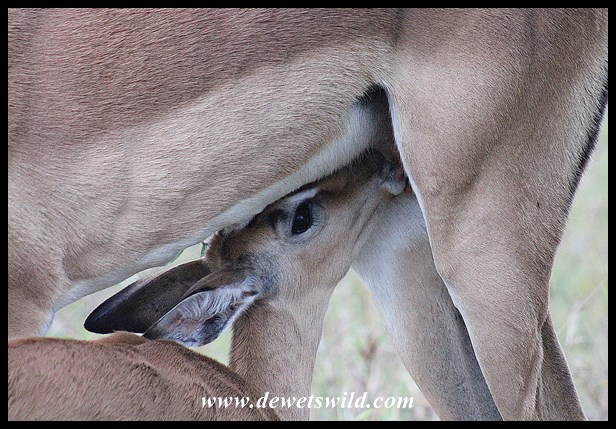
One of the greatest pleasures of visiting our wild places in the summer is seeing the great number of cute new baby mammals that made their recent entrance into the world, and our December visit to Hluhluwe-Imfolozi Park certainly had no shortage of cute babies to photograph!

Things that go “bump” in the night…

Mpila Camp in the Hluhluwe-Imfolozi Park is not fenced, and any animals, dangerous kinds included, can and do roam between the accommodation units at night (and often during the day too!). I have a basic little camera-trap that I sometimes set up overnight when we visit South Africa’s wild places to see what happens when we’re soundly sleeping, and here’s a few images it captured of Spotted Hyenas roaming outside our cottage at Mpila when we visited in December 2018.

A familiar favourite: Hluhluwe-Imfolozi Park in December

Our December 2019 bush breakaway concluded at the Hluhluwe-Imfolozi Park, one of the oldest game reserves in Africa and a place that is very dear to our hearts. We spent five nights there, accommodated in Chalet #16 at wonderfully wild Mpila Camp.

Hluhluwe-Imfolozi is looking as green and lush as we’ve ever seen it, with the rivers flowing strongly, and that is a heartening sight to behold considering that not so long ago the Park was in the grips of a terrible and prolonged drought that tested the metal of plant and animal life alike. Compare the images in the gallery below with those we took during a visit in 2015, at the height of the drought.

A place as magnificent as Hluhluwe-Imfolozi is home to a countless variety of wildlife. Depicted in the following gallery is just a smidgen of the array of invertebrate life that crossed our path during our visit – we enjoyed them all of course, except those pesky mosquitoes… Regular spells of rain resulted in eruptions of termite and ant alates taking to the wing to establish new nests, providing a glut of food for a wide variety of insectivorous fauna.

The warm, wet weather and ample insect buffet meant that amphibians and reptiles were quite regularly seen, especially in the camp and at other places where you are allowed to exit your vehicle. These ranged in size and danger from frogs and geckos to monitor lizards and nile crocodiles and even a snake or two.

Hluhluwe-Imfolozi is a bird paradise at any time of year, and even more so during the warm summer months when their numbers swell with migrants from northern latitudes. These are just a few of the over 100 species we recorded during this visit.

What would an African game reserve be without charismatic big mammals? Hluhluwe-Imfolozi certainly delivers on that score, but the occasional and usually unexpected glimpses of small or lesser seen furry creatures – mice, hares, bats and the like – can be just as pleasing!

Even the magnificent King of Beasts provided us a few memorable encounters, and the lions at Hluhluwe-Imfolozi definitely are as regal as any elsewhere on the continent.

A visit to Hluhluwe-Imfolozi is just never long enough, no matter how long we stay. We exited the Park at Memorial Gate as we headed back to Pretoria to spend Christmas with our family, which of course is always a great treat, but truth be told it would have been so much nicer if the rest of the family could’ve joined us in HIP to spend Christmas in paradise…

The route from Pretoria to Memorial Gate
(drawn with Google Maps)


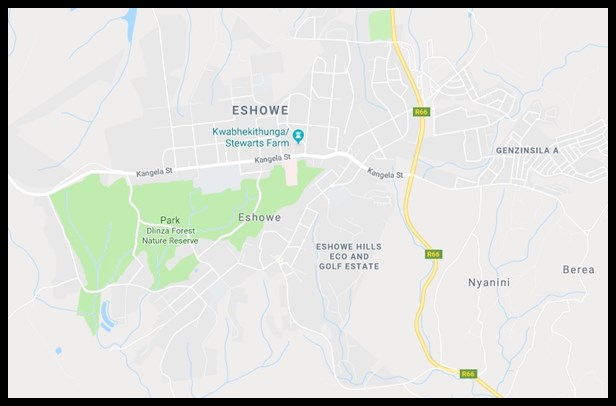
Dlinza Forest Nature Reserve

The Dlinza Forest Nature Reserve is a 319-hectare pocket of indigenous forest, rich in a stunning variety of trees, other plants, birds and other wildlife – several species of which is rare or endangered.

View from the Dlinza Reserve’s Aerial Boardwalk

The Aerial Boardwalk is Dlinza’s main attraction, extending a distance of 125m and allowing easy access to the lower, middle and upper stories of the forest, thereby providing visitors with a glimpse into a world they’d seldom be able to experience otherwise. The boardwalk ends at an observation tower 20m high that emerges above the treetops.

Two walking trails, the iMpunzi (1.3km) and uNkonka (1.8km), lead through the forest – be warned though that there are some steep sections along the way and sturdy footwear would be an advantage. Along the way you’ll be enchanted by the sights, sounds and smells of the forest and you really do not want to be rushed while hiking at Dlinza, so be sure to allow yourself enough time! Roughly half-way along the uNkonka trail you’ll reach a lovely clearing in the forest called Bishop’s seat as it was a favourite spot for a local clergyman in years gone by.

Expert local bird guides can escort visitors through the forest – best to arrange this before your visit. Aside from the boardwalk and trails, visitors can enjoy a leisurely picnic in the grounds at the visitor centre. A rough and narrow road, the Royal Drive, passes through the forest but attempting it in a vehicle with low ground clearance would not be advisable.

Situated in the town of Eshowe in northern Kwazulu-Natal, the Dlinza Forest must be one of the most accessible of its kind in the country, although being entirely surrounded by the town does bring with it several management problems, not least of which is feral pets straying into the forest and killing wildlife, and exotic garden plants establishing themselves within the reserve.  There’s no accommodation in the reserve, but the town has a number of lovely bed-and-breakfast establishments or you could drive through from nearby towns, as we did from Mtunzini while staying in the Umlalazi Nature Reserve half an hour’s drive away.