
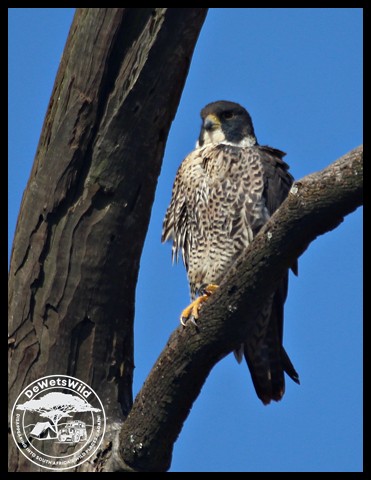
Falco peregrinus
The Peregrine Falcon is a cosmopolitan bird, found on every continent except Antarctica. According to the IUCN the species is growing in number and therefore considered to be of least concern. Though widely distributed in South Africa they’re not common here. Most local birds are resident throughout the year, though some migrants join them during our summer months.
Peregrine Falcons are fond of mountainous areas, where they breed on the cliffs. In urban locations city skyscrapers are useful alternatives to cliffs and as a result they can be a very effective biological control agent of pigeon population in city centres, as Peregrine Falcons feed mainly on birds caught and killed in flight – in a dive they can reach speeds of 300km/h, usually killing their prey instantly when striking it with their talons at high speed.
Peregrine Falcons form permanent monogamous pairs, building a stick platform nest on a ledge or cavity (natural or man-made) in which they usually lay a clutch of 1-4 eggs at the end of winter or early spring. The female is mostly responsible for incubating the eggs over a 5 week period, while the male will provide food for her at the nest. The chicks make their first flight at about 7 weeks of age but only become independent at about 4-5 months old.


During a visit to the Dullstroom Bird of Prey and Rehabilitation Centre in September 2020 we were treated to a display of the Peregrine Falcon’s prowess in the sky by Charlie, a hand-raised bird being cared for at the centre.
 DeWetsWild
Love, love, love. 🙂
It is lovely to find a post from you waiting to be read! You are obviously kept very busy these days – which is good. Thank you for bringing this falcon to our attention. blhphotoblog‘s comment about the pigeons is interesting too.
Thank you very much, Anne. Indeed, the past few months have been super busy, for which I am very grateful. Slowly starting to find more time for blogging and I hope I’ll be able to catch up with Something Over Tea soon!
In a nearby town they nest on the church along with the pigeons! Apparently due to the way the falcon hunts the pigeons are quite safe if they stay close.
Maybe a church is considered neutral – even holy? – ground, Brian! 😀
Dit is darem maar ‘n ongelooflike mooi voel die! Was so lanklaas hier!
Ek self het bitter min tyd gehad die afgelope paar maande vir die blog-deel van ons webwerf, Aletta. Dis lekker om weer van jou te hoor!
Ja, die Swerfvalk is voorwaar n besonders mooie voel, en so perfek geskape vir sy rol in die natuur.