Hydrictis (Lutra) maculicollis
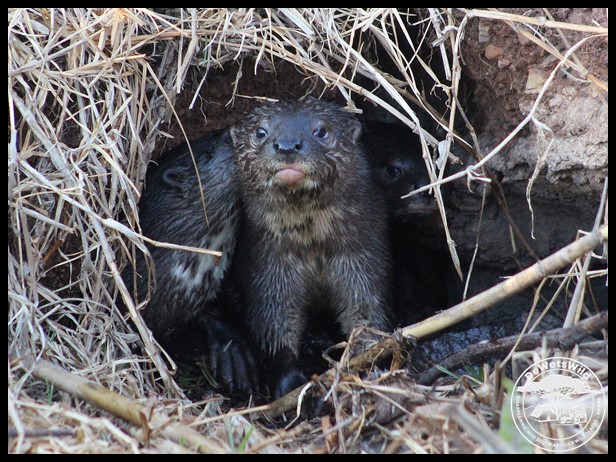
The Spotted-neck Otter inhabits freshwater habitats with good water quality and well vegetated margins. They feed mainly on fish, crabs, frogs and occasionally waterbird chicks. These otters hunt by sight and are consequently mainly diurnal and most active at sunrise and sunset. By night they sleep in tunnels in river banks, in dense vegetation or among logs and rocks.
Spotted-necked Otters live in family groups of 2-6 individuals consisting of an adult pair and their latest offspring. They’re very intelligent, curious and playful. Cubs are born after a two month gestation, with births in South Africa peaking in the summer months. The babies stay in their den for up to 3 months and have to be taught to swim, a task undertaken mostly by their mother. The little ones remain with their parents until the next litter is born. Fully grown Spotted-necked Otters weigh between 3 and 6kg, with males being considerably bigger than the females. They’re about a metre long.
The IUCN considers the Spotted-necked Otter to be near-threatened, concerned by the degradation of the otter’s habitat throughout its wide distribution over most of sub-Saharan Africa. In South Africa, Spotted-necked Otters occur mainly on the highveld of the Free State, Gauteng and Mpumalanga and in adjacent parts of the Eastern Cape and Kwazulu-Natal. In our country their population is estimated at a maximum of 10,000 animals and they’re considered to be vulnerable to extinction, with habitat destruction being the major threat. Our local Rietvlei Nature Reserve on the outskirts of Pretoria is one of the best places to see these endearing creatures, and all the following photographs were taken there.


 DeWetsWild
It’s good there is a Reserve for these otters near Pretoria!
It is wonderful indeed, Hien!
What a joy to see them!
Gets me excited every time, Anne!
Watching them swim is such a joy.
And they do it so effortlessly!
Lyk soos interessante diere. Nog nooit ‘n lewendige een gesien nie.
Dit is n jammerte dat hulle so skaars raak, Ineke.