
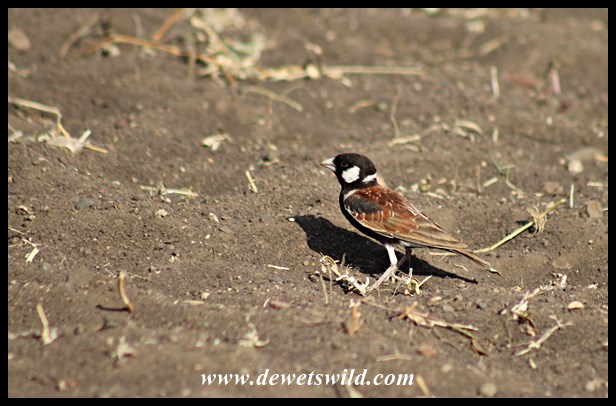
Eremopterix leucotis
The Chestnut-backed Sparrow-Lark is a nomadic bird that inhabits open savannas with short grass and bare patches (especially recently burnt). They feed mainly on seeds, though insects and other invertebrates also feature in their diet and especially so in the breeding season. Chestnut-backed Sparrow-Larks are social and is usually seen in flocks numbering from 5 to 50 and sometimes several hundred individuals. They drink regularly when water is available but also occur far from water.
Chestnut-backed Sparrow-Larks form monogamous pairs in the breeding season, which may be at anytime of year following good rainfall. They build the nest together, using a shallow depression next to a tuft of grass or rock in which to place the cup-shaped nest built with soft plant material. The clutch of 1-3 eggs are incubated by both parents and hatch in less than 2 weeks. The chicks leave the nest when they’re only 2 weeks old and before they’re fully capable of flying. Fully grown they weigh around 22g and measure 13cm in length.
Chestnut-backed Sparrow-Larks occur in northern South Africa (from the Free State and Kwazulu-Natal northwards) and patchily throughout Africa’s savanna regions. The IUCN considers the species to be of least concern.


 DeWetsWild
Shame, dis ook maar ‘n harde lewe vir die ou voëltjie wat op net 2 weke oud al moet koers kies!
Beautiful lark with very visible markings! Great shots!
Thanks very much, Hien. Our larks are for the most part very cryptically coloured, so it is nice to be able to feature one that is easy to identify!
Lovely to see birds that are way beyond my radar 🙂
Next time you are in the north of the country, Anne, you should look out for these little birds hopping around on open patches. In the next installment we’ll be showcasing the closely-related Grey-backed Sparrow-Lark, which might be more familiar in your part of the world.
An attractive little bird!
My World Cup nightmare is coming true: my two teams will have to play each other and only one move on. This is not right!! I really think that the way the teams were seeded was not done well. The top four teams should be in four different brackets. Grrrrr!
I’ve never been a fan of this “pool” system, especially in sports like cricket and rugby where there’s a relatively small number of countries taking part in a “World Cup”. I like the way the Cricket World Cup is doing it this year. Ten teams qualified to take part, and they all play each other in the first round of the tournament. The top 4 at the end of those 45 “round robin” matches then qualify to contend the semi-finals. The effect of that should be that the 4 most consistent teams throughout the tournament ends up as the top 4. Much fairer I think.
They leave the nest before they can fully fly? At two weeks old? Where do they go? How do they get food? Where are mom and dad? So many questions…!
Though they can’t fly yet the chicks are quite precocious, Lois. They’re adept at running and hiding. Their parents will still be bringing them a lot of food, but they’ll also start pecking up insects for themselves and start transitioning to seeds.