
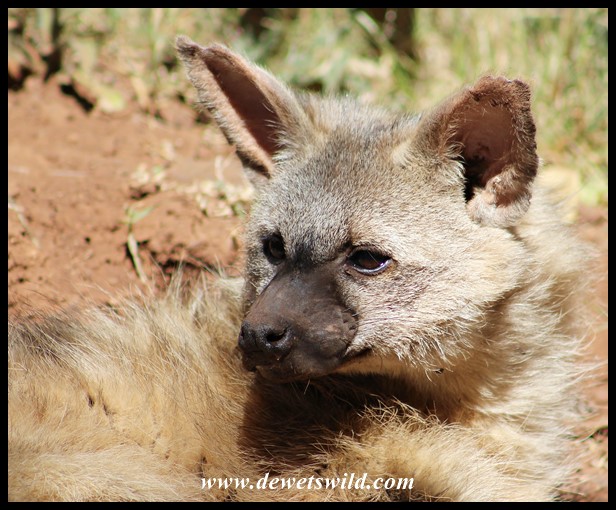
Proteles cristata
The Aardwolf (Afrikaans for “earthwolf”) is the smallest species of hyena. Adults stand about 45cm high at the shoulder and weight around 9kg. Unlike other hyenas that feed mainly on mammals carcasses, the Aardwolf’s diet consists almost exclusively of termites – they may eat between 200,000 and 300,000 termites a day! – with other insects and their larvae also featuring occasionally. Aardwolves can be found in any habitat where termites occur, from semi-deserts to densely vegetated savannas.
Although they’re normally observed singly while feeding, Aardwolves form monogamous pairs that inhabit a territory with their youngest offspring. The boundaries of the territory is marked by latrines and scent glands. They’re usually active between dusk and dawn, sleeping by day in burrows that they dig themselves or take over from other animals. All of Africa’s large predators will attack Aardwolves and so when threatened they raise the mane on their backs to make themselves look larger and more intimidating. Females give birth to 1-4 pups, usually during the wet season, and though the young are fully grown at about about 9 months of age they’d normally remain in their parents’ home range until the next litter is born. In the wild, Aardwolves have a life expectancy of about 12 years.
The Aardwolf occurs in two distinct parts of Africa. Their southern distribution area (subspecies P. c. cristata) includes all of South Africa and extends into all our neighbouring countries and as far as Angola and Zambia, while the East African range (subspecies P. c. septentrionalis) stretches from Tanzania to southern Egypt. According to the IUCN the Aardwolf is of least concern, despite not being common anywhere, and while they were previously widely persecuted as suspected predators of livestock, modern farmers understand that the Aardwolf is incapable of killing small stock and protect the species due to their important role in limiting termite populations.


 DeWetsWild
Ek sien van die kommentaar hierbo noem dat hulle nie so lelik is nie. Maar ek onthou ‘n keer wat ek ‘n aardwolf in die skemer in die myngebied van Alexanderbaai gesien het. Vir my was dit toe nogal ‘n skrikwekkende gesig 👀 … dalk omdat alles meer sinister lyk as dit half donker is!
Ja-Nee, alles lyk groter en gevaarliker in die donker ne!
They’re actually kind of cute!
Most certainly, Kathy. Why anyone could ever think they’d kill a lamb is hard to believe!
Another new animal for me, and apparently a very beneficial one! Thank you!
Indeed so, Hien. A large, uncontrolled population of harvester termites can decimate a grazing land terribly quickly.
Wonderful sightings you have had!
They’re not easy to see and even less easy to photograph, Anne, so we’re always pleased to cross paths with an aardwolf.
What a sweetie, Dries. Reminds me of Ama. About the same size too.
I’m sure they’d have become pets long ago together with cats and dogs if it weren’t for their specialised diet, Tracy.
Good thing for them. 🙂
This is one mammal I would love to see. Never seen it on my trips. Thanks for sharing.
I’ll holds thumbs that you’ll get to see one on your next trip, Michael. Include a night drive at Mountain Zebra National Park in your next itinerary.
Many thanks 🙏
Hulle is darem ook baie mooier as ‘n hyena! Kom hulle in die Kruger wild tuin ook voor?
Aardwolwe kom omtrent in elke hoek van ons land voor, Aletta, insluitend Krugerwildtuin. Ons sien hulle egter meer dikwels in die Karoo en Bergkwagga Parke (selfs daar staan hulle nie sommer stil vir n foto nie)
Ek dink nie dat ek al een gesien het nie, wel die hyenas in die Kruger wildtuin gesien
Eks bly om te hoor dat hy nie meer beskuldig word dat hy vee vang nie. Hul het ook nie die wrede hïena uitkyk of wildehond houding nie.
Die verandering in houding jeens aardwolwe gee mens darem hoop dat die bewaringsboodskap stadig maar seker orals uitkom waar dit moet.