
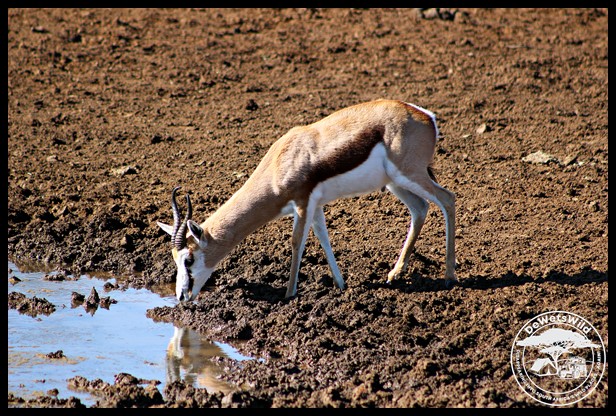
Almost smack in the middle of the Mokala National Park you will find the Stofdam Hide; an excellent place to stop for a while, stretch your legs and wait for the wildlife to come to you instead of driving around to find them.

Walkway to Stofdam Hide

The Stofdam Waterhole

Acacia Pied Barbet

Pin-tailed Whydah

Egyptian Goose

Red-billed Quelea

Red-billed Queleas

Red-billed Firefinch

Red-eyed Bulbul

Violet-eared Waxbill (female)

Neddicky

Blue Waxbill

Black-faced Waxbill

Black-faced Waxbills

Black-faced Waxbill

Springbok

Chacma Baboon

Grey-headed Sparrows

Common Duiker

Fiscal Flycatcher

Orange River White-eye (thank you Don Reid for helping with the ID!)

Green-winged Pytilia

Vervet Monkey

Red-billed Firefinch

Cape Wagtail

Cape Glossy Starling

White-backed Mousebird

Black Springbok

Springbok

Springbok

Female Red-headed Finch

Impala

Warthog

Yellow Canary

Yellow Canary
This is a little compilation of sightings Hannes and I had one morning at Stofdam while visiting Mokala earlier in June.
We’ll soon be announcing a very exciting spring-time tour to the Mokala National Park – and we’re sure to spend some time at Stofdam on that trip! Do keep an eye on DeWetsWild’s facebook page so that you don’t miss out!
 DeWetsWild
♥️♥️♥️
The waxbills have beautiful, colorful plumage. Great shots!
I am also very fond of the waxbills – there are several kinds of them in South Africa and they’re all a joy, and challenge, to photograph!
Dis beslis ‘n lekker plek om net te sit en die diere te sien kom en gaan. Ek het dit nou geniet om die springbokkies wat so spelerig is dop te hou op die video … dit het amper gevoel of ek saam met julle by die Stofdam Hide gesit het 🙂.
Wat n voorreg sal dit nie wees as ons dit regtig met julle kan deel nie!
Wonderful video. Are the horns of the young springbok always first curl forward because I see the older ones are turning inwards to the centre? Stofdam, is dit mensgemaak of waar kom water vandaan. Beslis baie stof in die water!
You are spot on, Ineke. The young Springbok rams’ horns are all slightly bent forward at that age, and then later the tips start pointing inwards as the horns get longer.
Stofdam is n mensgemaakte wal in die spruitjie wat met boorgatwater aangevul word sodat daar regdeur die jaar water beskikbaar is en nie net wanneer die spruitjie loop in die reenseisoen nie.
Interessant, beide antwoorde. Horings wat inkrul en en dam wat vol gehou word. Eers gedink om te vra of daar nie krokodille in dam is nie maar dink ek nee wat. Die bokke was tog in ‘n mate versigtig en op hul hoede terwyl hul gedrink het.
Ek dink dit is maar instink wat hulle so skrikkerig langs die water maak, Ineke. Roofdiere op land en in die water wag dikwels in n hinderlaag by die water. Maar ek dink Stofdam in die winter is ver te koud vir n krokodil om in te leef.
I like the waxwing and the canary. I enjoyed the mix of stills and live in the video. Takes some practice to go closer and farther while still staying in focus, doesn’t it? Love the impala and kudu and you had springboks!! Did you spot any Blitzboks? They’re my favorite. 🙂 The one springbok youngster really had the other on the run, didn’t he.
It really was fun watching those Springbok rams push each other around playfully! I suppose there’s a similar camaraderie in the Blitzboks team! 😀
I need lots and lots and lots of practice with the videos, Janet – do I have your permission to go live in the bush permanently so that I can practice day in and day out?
If your family agrees. 😉.
Pragtige verskeidenheid!
Ongelooflik dat mens vir n uur of wat daar kan sit en soveel sien!
Dis wonderlik.
I am really enjoying your series on Mokala! Lovely images and what a great variety of species
Do have another look at your photo of the White-eye – it looks good for an Orange River White-eye with those peachy coloured flanks
This is a place I need to visit sometime
Thank you very much, Don, for helping me with a confirmation on the White-eye’s identity – I thought it might just be my colour-blindness playing me for the fool! I also thought it had sufficient yellow in front of the eyes to be the rarer species.
Knowing how much you love the Karoo and the Kalahari I can assure you that you will have a wonderful time at Mokala. It is so easy to get to and yet never crowded. The beautiful camelthorns and umbrella thorns alone make the trip worthwhile!
There’s my little Blue Waxbill. ❤
I really was hoping you’ll notice her, Lois. She came to say hi especially for you!
Thank you so much, Dries!
What an amazing set of photos. Thanks for sharing. Looks really nice 😀
Leisurely game-viewing at its best, Paul. Thanks for visiting!