
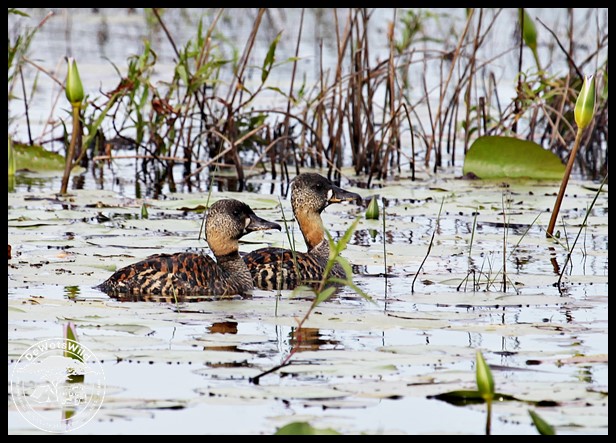
Thalassornis leuconotus
Another bird of which sightings come highly regarded in South Africa is the White-backed Duck and I was very excited to finally catch sight of them during my recent trip to St. Lucia in Kwazulu-Natal.


A nomadic diving duck that feeds mainly on submerged plant material, the White-backed Duck inhabits natural and man-made dams and pans of any size and permanence with clear water and abundant floating and emergent plants, where they are exquisitely camouflaged and easily overlooked. The white patch on their backs from which they get their name is only seen in flight. They are usually seen in pairs or family groups but occasionally form larger flocks of over a hundred. White-backed Ducks rarely venture onto dry land.
Monogamous pairs of White-backed Ducks (perhaps life-long bonds) breed year-round in dense reed beds or other thick plant material standing in the water. Clutches of up to 9 eggs are laid on a nest platform built of the surrounding plant material, and incubated by both parents for 4-5 weeks. The ducklings are able to follow their parents onto and into the water less than a day after hatching and are fully grown by the time they’re 4 months old. Adults measure about 43cm in length and weigh around 650g.
In South Africa, the White-backed Duck has a rather patchy distribution, with concentrations in the Highveld grassland areas, in Kwazulu-Natal, the Garden Route and the Cape Winelands. Beyond our borders their range stretches to Ethiopia and Madagascar, with isolated populations in the Sahel. According to the IUCN it is of least concern.


 DeWetsWild
Ek hou baie van die eende,Dries. Dink nie ek het dit al gesien nie. Die water lelis is so mooi!
Dit maak nogal n mooi prentjie, Aletta – selfs nog meer in die regte lewe!
What a great sighting and the blue waterlily flowers are an added bonus!
I was very chuffed at this find, Carol – and then saw them twice more in the week we spent at St. Lucia!
What lucky treats!
I checked my own photos of this species dating back to 2010 and have nothing anywhere near as good as yours! They always seem to be in the middle of a large dam and just too far for a decent image, so you can be very proud of these images
I’m sure you’ll understand my joy at seeing them for the first time, Don. What a thrill! Thanks for the kind words.
Ag, dis ‘n mooi voel. Smelt mooi saam met sy omgewing … ek hou baie van die foto’s waar die eend tussen die waterlelies swem – so idillies.
Hulle gebruik die lelies wonderlik om agter / onder te skuil, Corna. En om hulle in die regte lewe so te kan dophou is regtig so mooi as wat die fotos mens laat dink.
I love ducks of any kind in the wild – these ones are special, however.
A very rare treat this, Anne.
That’s a new duck for me! We have the Canvasback Duck. Thanks, D. 🙂
I had to go google the Canvasback Duck now, H.J. What a sharp bill it has!
A very striking duck, glad you finally got to photograph them.
I was more than a little chuffed, Brian!
They certainly look lovely among the lily pads.
Thanks, Lois! I also thought so.