
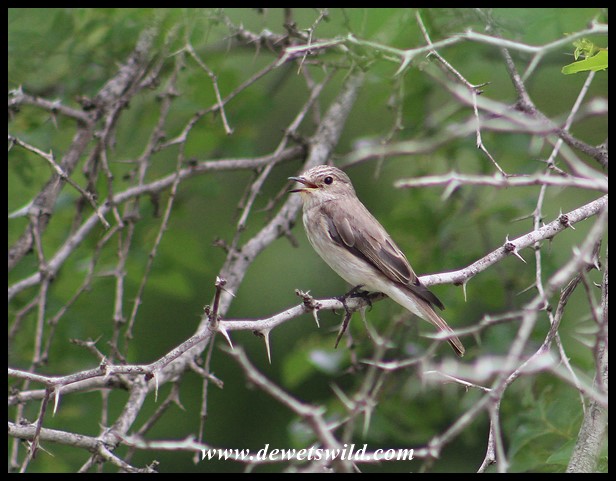
Muscicapa striata
The Spotted Flycatcher is a migrant to sub-Saharan Africa, travelling here to escape the winter in its Eurasian breeding grounds. The birds arrive in South Africa during October and November and leave again by early April, and is one of the most numerous summer visitors. While here, they can be seen in any part of the country, though the highest densities occur in our northern and eastern provinces. The IUCN considers the Spotted Flycatcher to be of Least Concern, estimating a total population of at least 54-million.
While they’re visiting our country during our summer months, the Spotted Flycatcher is not picky about its habitat – any open haunt that provides them a low perch from which to hunt the insects they subsist on seems to do. They are usually seen alone in these parts. Fully grown they measure about 14cm in length and weigh approximately 15g.


 DeWetsWild
A species that I too have overlooked! I will keep more of an eye out for them – thanks. I enjoyed your lovely photos.
Thanks, Carol. They’re quite easy to miss.
Great shots!
Thanks, Ben, and welcome here!
Your acute eye and dedication to the work really amazes me.
Thank you kindly, Beth
Nice photos! I would have missed it, thinking it was a sparrow.
Thank you, Susie. They do blend in very well with their surroundings.
Dis ‘n pragtige ou voeltjie Dries!
Ek dink ook so, dankie Aletta
Marvellous capture!
Thank you, Sue!
Beautiful bird with colors that allow it to blend in well with its surroundings. I am amazed that you were able to get such nice shots of it.
Thank you, Hien. I suppose the fact that I only now have a decent enough collection of them to showcase the species explains your point perfectly!
Flycatchers are delightful!
Such busy bodies they are!
Sadly the numbers breeding in the UK have crashed in the past decade or two and are now a rare sight.
Any ideas for the reasons behind that, Brian? So many other species have made such good recoveries in the UK (I know this thanks to your blog!) that it seems strange this species is going the other way!
It seems though they have a hard time avoiding the ‘hunters’ guns and lime sticks on the Med Islands during migration. Probably not the only reason if they have a hard time crossing the Sahara that will reduce numbers as well.
Sad that they have to endure challenges like that
This is a lovely bird to highlight.
I also thought so, Anne. They’re so easily overlooked while visiting here.
Soft beauty and anything that helps control pesty insects are lovely to me!
Same here, Janet!
These birds are other necessity to eliminate pests like the mosquitos and the little insects, or at least help balance the Natural scale. Interesting bird. Thanks, D. 🙂
And so every little piece of the tapestry is vital!
Lovely shots of this pretty bird! For some reason, I seem to have missed flycatchers of all kinds until just this past year. Just beginning to know a couple of them that inhabit our woods.
They’re a fascinating, if shy, family of birds, Carol
☺️Thanks…. I saw my first Vermillion Flycatcher last week!
Google helped me to see what a Vermillion Flycatcher looks like – quite a show-off compared to this species!