
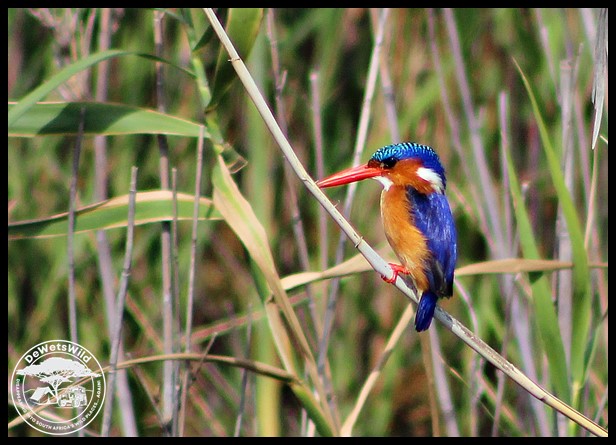
Corythornis cristatus
The beautiful Malachite Kingfisher is, true to its name, mainly a piscivore though it’ll also feed on frogs, tadpoles and aquatic insects. They hunt from preferred perches, diving into the water to snatch their prey. Its diet dictates that this species is always found near water, ranging from tiny streams and sewage ponds to large rivers, dams and estuaries, provided there is sufficient growth of plants in and along the water providing perches. They are usually seen alone or in pairs.
Nesting in burrows they dig themselves in the earthen banks of rivers and streams, monogamous pairs of Malachite Kingfishers may breed throughout the year but usually coinciding with the rainy season. Clutches of 3-6 eggs are incubated for 2 weeks by both parents, with the chicks fledging when they’re between 3 and 4 weeks old. They start fishing for themselves about a week after leaving the nest and become fully independent from the age of about 7 weeks.
Malachite Kingfishers are found almost all over sub-Saharan Africa, being absent only from the driest pockets, and is considered to be of least concern by the IUCN. In South Africa they’re found in every province, though restricted to the course of the Orange River in the Northern Cape.


 DeWetsWild
Beautiful coloration. They appear to be quite small, but it’s hard to tell scale without other references. Those small branches give me the impression the bird is smaller than a robin.
You are spot on, John. They’re very small birds.
Dis nou ‘n mooi kleurvolle voeltjie! Ek het hulle onlangs in Sodwana daar in die bome gewaar, maar kon nooit ‘n foto van hulle neem nie … en kyk nou net hoeveel mooies het jy hier in een post!
Baie dankie, Corna.
As jy daaraan dink dat ons 320 ander soorte voels voor hierdie een bespreek het sal jy verstaan dat ons ook maar lank moes wag om genoeg ordentlike fotos van hulle bymekaar te maak om darem iets aanmekaar te sit! 😉
What lovely photos of the exquisite malachite kingfishers!
Thank you very much, Carol!
What a handsome fellow! Thanks much for sharing, this made my day.
Hope all continues to be well for you and all your dear family.
I’m so happy to hear from you again, Takami. We’re well, thank you very much. And you?
Thank you Dries! Glad to know you are all doing well. We are also doing OK, thanks much for asking 🙂
That is wonderful news, Takami, and we hope it stays that way!
Wow! Such a stunner….the iridescence of that blue is unreal!
You really should see them in real life, Lori. The camera just can’t capture entirely how perfect they are.
A jewel. Heavenly.
O absoluut!
I still recall my first encounter with these birds – colourful jewels they are.
That’s a very apt description, Anne!
Hulle is darem maar ongelooflik mooi! Soveel kleure! Het hulle in Eshowe gesien!
Regtig van die mooiste voëltjies in ons land, Aletta.
😀
I was excited to see the title because these little guys are stunners, as is that very top shot. That one is frame-worthy in an artistic sense.
Thank you very much, Janet. These pictures hardly do them justice.
Pretty little bird! Thanks, D. 🙂
It certainly is, H.J!
Beautiful
Undeniably so!
A little beauty, indeed.
You should see them in real life, Lois. Breathtaking.