
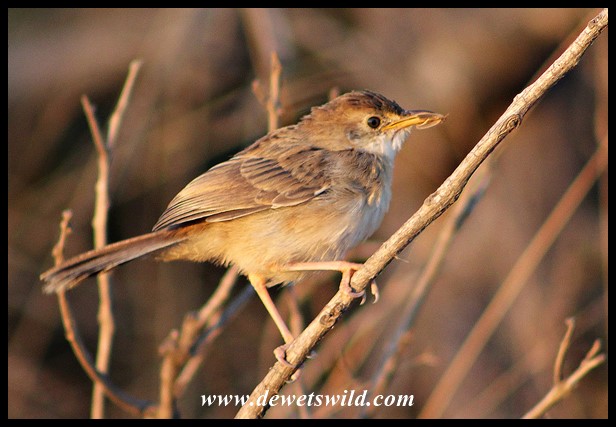
Cisticola fulvicapilla
The Neddicky is a common and conspicuous member of the Cisticola-family, usually being seen singly, in pairs or small family groups (the latter at the end of the breeding season), with the male especially often singing from a prominent perch. It is a bird of moist heathland, savanna and open woodland habitats, though they have adapted to exotic plantations and suburban gardens. It feeds on insects, searching on and close to the ground for its prey.
Neddickys nest in spring and summer. The female builds the ball-shaped nest all by herself, using dry grass, spider-web and down to complete the job. The nest is usually well-hidden low in a bush or grass tussock. Incubating the clutch of 2-5 eggs takes about two weeks, with the chicks leaving the nest about the same length of time after hatching. Like other members of the family, Neddickys are small birds, weighing only 9g and measuring around 11cm in length when fully grown.
The Neddicky occurs almost throughout South Africa, avoiding only the dry Karoo and Kalahari in the west of our country. Beyond our borders it is found as far north as Gabon in the west and Tanzania in the east. The IUCN considers the species to be of least concern.


 DeWetsWild
These are lovely photos of what I agree are endearing little birds!
Thank you very much, Carol. As cisticolas go these are certainly easier to recognise.
That is true!
Cute little birds!
Aren’t they just!?
Somehow, when you see a Neddicky you know that is is one – it stands out from other LBJs and has an endearing personality.
The further south you see them the more clearly those grey underparts are to see, making it easier to identify them. Up here in the North though, and especially in the Lowveld, I still have considerable difficulty!
Pretty little bird! Thanks, D. 🙂
Thanks, H.J!
So cute. 😊
Yep, we think so too Irene.
Dear little birds!
Very true, Anne. Thank you.
Sweet little one.
Agreed, thanks, Lois!
Interressant, wat is die outjie se afrikaanse naam.
Dankie, Ineke – In Afrikaans is dit ook n Neddikkie
Vreemd nog nie voorheen so gehoor nie.