
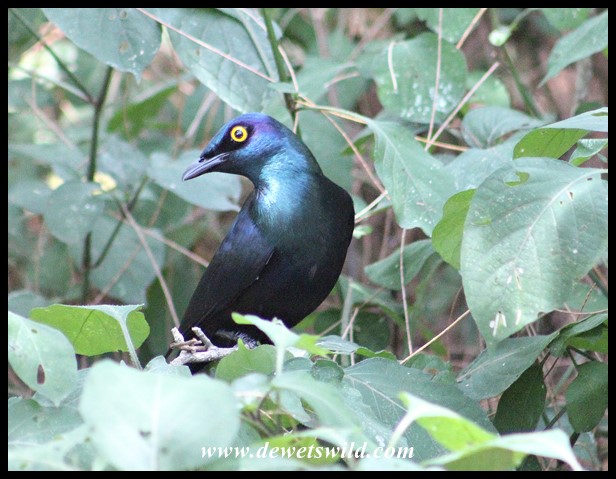
Notopholia corusca
(previously Lamprotornis corruscus)
The smallest of the five “glossy” starlings occurring in South Africa, with a weight of around 50g and a length of 18cm, the Black-bellied Starling is also the most melodious of the family and capable of mimicking the calls of quite a number of other bird species.
Black-bellied Starlings feed mainly on a wide variety of fruit, supplementing their diet with the occasional snail, insect or spider. They drink and bathe regularly and may congregate in large flocks, at times numbering more than a hundred, during the non-breeding season but are found in monogamous, solitary pairs during the breeding season. They nest in holes in trees during the summer months, with the female being solely responsible for incubating the clutch of 2-4 eggs, though the male does do his fair share when it comes to the feeding of the hatchlings.
Its distribution being reflective of its preference for dense, high-rainfall coastal and riverine forest habitats, the Black-bellied Starling occurs along our eastern coastline, from the Garden Route through to the border with Mozambique, extending marginally into the extreme south-east corner of Mpumalanga. Beyond our borders its distribution extends along Africa’s Indian Ocean coast as far north as Somalia. Throughout this range it is very rarely found more than 100km inland. The IUCN lists the Black-bellied Starling as being of least concern.


 DeWetsWild
They are very handsome as your photos show. Sometimes it can be quite difficult to distinguish between the different species of glossy starlings where they occur in overlapping regions, so its nice to see a selection of lovely photos of the black-bellied starling.
Thank you, Carol! Seeing (and hearing) them in abundance at Cape Vidal on our recent visit really helped to figure out what to look out for.
I love their iridescence and bright yellow eyes.
It does make them stand out in their forest abodes!
Light and agile, how beautiful it is! The size reminds me of cipret, a small bid found here in my village.
Do you have a photo of the cipret you could point me to, please Rudi?
Pragtige foto’s Dries!
Baie dankie, Aletta!
Interesting to see this starling. Here we have grackles that have similar shiny feathers and iridescent colors. They are bigger than your starling and have the same sort distinctive yellow eyes. But they do not have a melodious song!
Thank you very much for the interesting comparison, Anne! I’ve gone to read up about the grackles and seems, despite their strong resemblance that they’re not related to our starlings at all – making the similarity even more interesting!
Interesting! Different sides of.the world and similar but not the same.
You have gathered a delightful selection of photographs here. I particularly like the one next to the hole in a tree trunk.
Thank you very much, Anne. The Black-bellied Starlings were most co-operative when we visited Cape Vidal in January, as you can see.
Talk about being able to give someone the evil eye or the stink eye!! That eye can do it. 🙂
janet
The bright yellow and bright blue really make those eyes stand out!
This bird seems to be made of metal, really impressive! Great addition, D. 🙂
Thank you very much, H.J. There’s four other glossy starlings in South Africa that also boast this bright metallic blue.
Great photos for this Black-bellied Starling. It looks very handsome!
Thank you so much, Hien. I am glad to know the photos showed this beautiful bird adequately.