
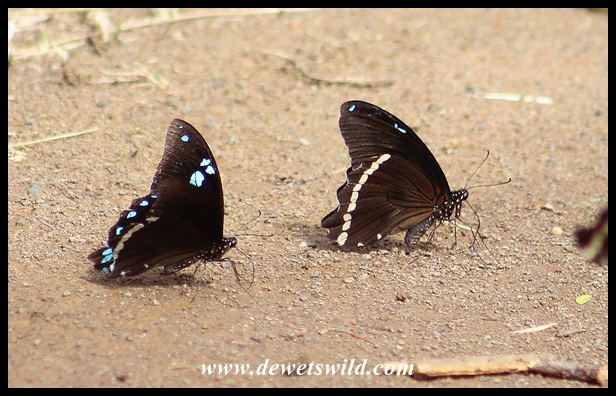
Papilio nireus
The Green-banded Swallowtail, also known as the Black Velvet, is a large and strikingly coloured butterfly with a wingspan of almost 10cm. Adults can be seen throughout the year, though much more commonly in the summer months. About equal in size, females can be distinguished by the greenish sheen to the bands on their wings while that boasted by males are bluer in colour. They fly fast and direct, and often hover over flowers, mud puddles and fresh droppings. The larvae feed on a wide variety of food plants, including citrus.
In South Africa the Green-banded Swallowtail occurs from the Garden Route through most of Kwazulu-Natal and into Mpumalanga, Limpopo and Gauteng, inhabiting forests, woodland, savannas and well planted suburban gardens and parks, with its distribution further extending over most of the rest of Sub-Saharan Africa.


 DeWetsWild
Indeed… I think some flowers powder or nuts was there and they found out it 😀
Pair butterflies 🦋 on Ground… different candid pic
Thank you, Siva. I got the idea that this group was congregating at some kind of “mating ground” but nothing in the literature mentions anything of the kind.
Lovely! I am looking forward to butterfly season!
Thankfully our autumns are warm so we have a few weeks of butterfly season left to enjoy! And thereafter I’ll rely on you to get us through our winter with beautiful American butterflies, please Kathy.
Deal! We shall pass the baton!
Pragtige skoenlappers!
Defnitief, Aletta. Defnitief.
Lovely photos and useful to see the females and males together and even in the same frame. And thanks the penny dropped with me (finally) that the name comes from the colour of the females’ bands rather than the more showy blue of the males.
Thank you very much, Carol!
Beautiful photographs all!
Thank you very much, Anne. I had beautiful models.
Another beauty.
janet
Indeed! The diversity of butterflies keeps me fascinated.
Pretty butterflies! They are a beautiful enhancement for any garden of flowers. Thanks, D. 🙂
Thanks, H.J. I’d love to have these beauties in our garden!
To me the band looks blue, and I am not supposed to be colorblind. Butterflies have always held my interest because they are soft and gentle insects. It bothers me greatly if I see children abusing them.
No, you’re not colourblind, Beth. The females have the green band that gives the species its name, while the males have that electric blue.