
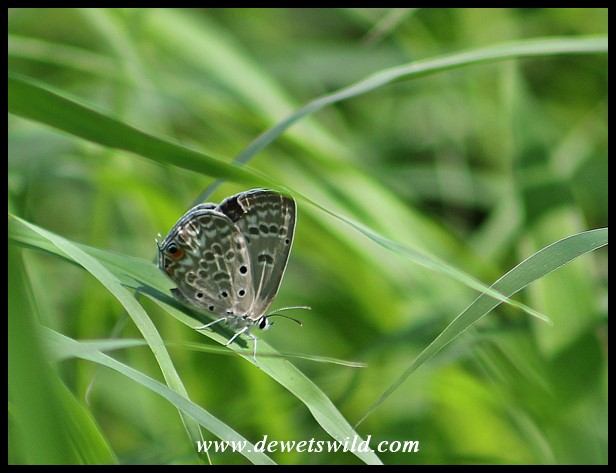
Lepidochrysops patricia
With a wingspan of 4.5cm, the Patrician Blue is one of the largest members of the family. Patrician Blues are rare in the Western Cape and occurs only in the eastern-most reaches of the Northern Cape, but otherwise occur commonly all over our seven other provinces. They have a wide habitat tolerance, occurring from mountain grasslands to the edges of forests but are most common in savannas. Adults are only seen between spring and autumn, reaching a peak in numbers in November and December.
Like other butterflies of the genus Lepidochrysops the Patrician Blue employs a most interesting breeding strategy. Their larvae feed on the immature seeds of Salvia– and Lantana plant species in their first two developmental stages and then exude a pheromone that prompts Carpenter Ants (Camponotus spp.) to carry the caterpillars into their nests, where they feed on the larvae of the ants until they pupate. After emerging from the chrysalis the adult butterfly then crawls out of the ants’ nest.


 DeWetsWild
How interesting – I had not heard of that butterfly – ant connection before. Amongst the blue butterflies visiting here I must look out for this larger species – we certainly have more than enough invasive alien lantanas in the margins of the neighbouring plantation!
You’ll definitely notice the Patrician Blue as it is noticeably larger than the “usual” blues that visit our gardens, Carol.
Such a lovely hue of blue! And what a complex lifecycle🤔
Welcome here!
Indeed, that something so seemingly delicate can employ such an elaborate and fraught strategy to ensure the survival of future generations is amazing!
So amazing!! And we think we’re complex!😉
Yep! “Go to the ant… (and butterfly)… and be wise”!
Pragtig
Ongetwyfeld, Toortsie!
An interesting adaptation of the need for ants in the life cycle. Nature has unique ways, for sure.
How’s that for thinking out-of-the-box!
Beauty! It is as big as our Large Blue (Phengaris arion) which also uses the ant method but with just one species of red ant (Myrmica sabuleti). The Large Blue became extinct in the UK in ’79 but when the relationship with the ant was fully understood and conditions perfected it was re-introduced and is now thriving in sw England.
That’s a very encouraging conservation story! I hope we’ll strive to undo more and more of the damage we’ve done as a species.
A beautiful little creature.
janet
I agree wholeheartedly, Janet!
What clever and beautiful creatures. They’re like the cuckoos of the butterfly world. Rey sneaky though. 😅
Just goes to show again how much we can still learn about the natural world!
What an intriguing breeding procedure!
I agree, Anne – I would’ve thought the ants would treat the caterpillar as food!
Fascinating about the relationship with carpenter ants. Amazing. Love your shots, Dries, the second to last image is especially striking.
Thanks very much, Jane. Their reliance on ants for survival seems so contrary to what we’d expect, doesn’t it!?