
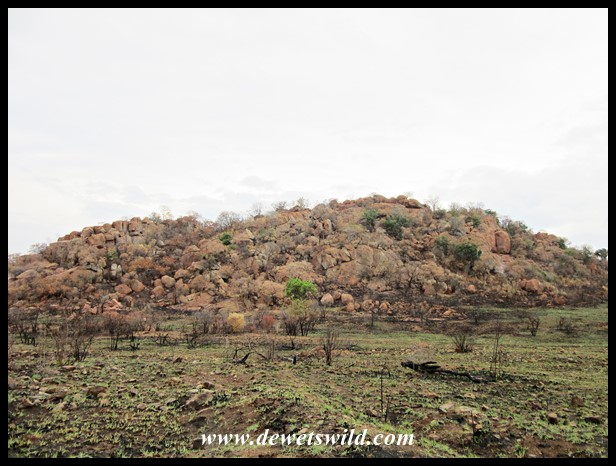
Sadly, our time for exploring the Pilanesberg National Park has very nearly run out by the point we make one final pit stop at the Mankwe Hide. From here it’s only a 12km drive to the exit at Bakubung Gate, and however we try to dawdle the last few miles along Letsha and Kubu Drives the gate still comes into view too soon for our liking…


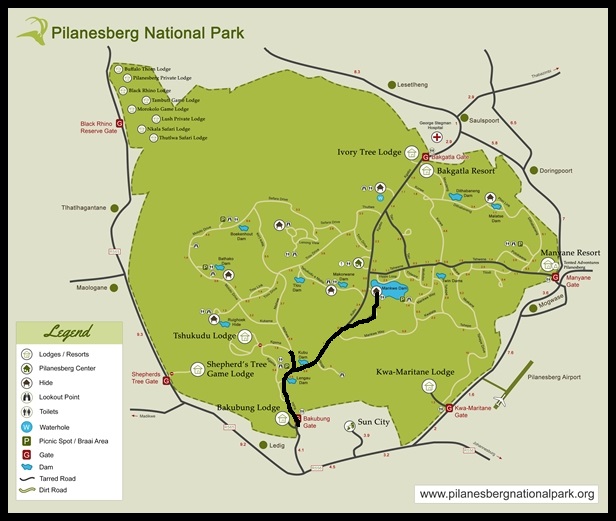
Mankwe Hide to Bakubung Gate
It is 18:02 as we drive out the Pilanesberg National Park at Bakubung Gate. We’ve spent exactly twelve amazing hours exploring the Park, most of it in drenching, cleansing rain. If you need to catch up on our drive through the Pilanesberg National Park, you can read all the previous posts here.
Now it’s just short of a two hour drive back to Pretoria and, as good a time as any, I think, to look back on how this Park came into existence. More than a billion years ago what is today the Pilanesberg National Park was an active volcano that, during its final eruption, collapsed in onto itself and the remains of which is visible from space as a range of concentric hills in South Africa’s North West Province.
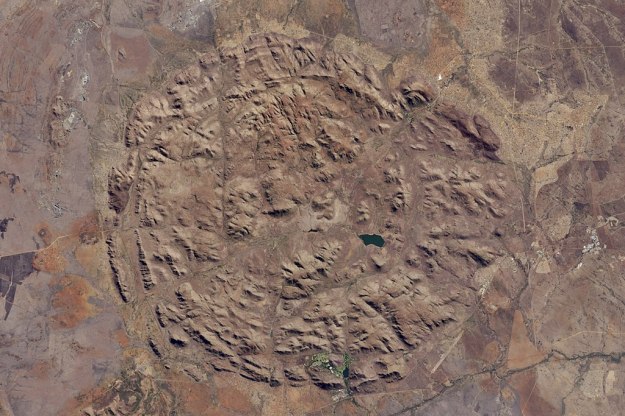
NASA image of the Pilanesberg
(https://en.wikipedia.org/wiki/Pilanesberg_Game_Reserve#/media/File:Pilanesberg_Ring_Dike_Complex_(19921993221).jpg)
Humans have been living in this area since the Stone Age. When the first European explorers, missionaries and eventually settlers arrived here it was ruled by Chief Pilane of the Bakgatla clan, hence the given name Pilanesberg (Pilane’s mountain). The Pilanesberg quickly became transformed into farmland. In 1961 South Africa’s apartheid government declared the homeland of Bophuthatswana for the Tswana-speaking people and Pilanesberg was one of the pockets of land incorporated into the new nominally independent “country”.
The Bophuthatswana Government started planning the Pilanesberg National Park in 1969 already. The 550km² reserve only opened on the 8th of December 1979 though, following the relocation of the farming communities that lived there originally, the removal of almost all human-made structures and exotic plants, fencing of the entire perimeter, provision of tourism infrastructure and the introduction of nearly 6,000 large wild animals from all over Southern Africa in the epic Operation Genesis.
With the dawn of a democratic South Africa in 1994 Bophuthatswana, and the Pilanesberg National Park, once again officially became part of the country.
 DeWetsWild
.jpg)
Somehow I missed all these before, but today they just popped up on my browser. What a joy to read even if they are old hat with everyone else!
I’m so glad these older posts of ours brought you some joy, Beth. Thanks for letting us know, we do appreciate it!
What a marvelous day you had and you came away with some wonderful photos. Thanks for sharing that amazing NASA shot of Pilansberg too. Your visit must have been made even sweeter after the long abstinence from the wild caused by the pandemic.
Thanks for coming along with us, if virtually, Carol, and you are so right; being able to be out in the wild again and just forget about the woes of the world, even if for only 12 hours, was magical.
I hate to see it end, but what a marvelous trip it’s been. It amuses me to see how close “sacred” and “scared” are, just as “friend” and “fiend.” 🙂 A complete aside, I know, but that’s how my mind works sometimes. Happy Tuesday/Wednesday.
janet
It was wonderful having you along on the trip, Janet! Come along next time again, won’t you?
Don’t worry. I have my bags packed and my virtual camera ready. 🙂 Where will we go next?
It’s a surprise at this stage, for us too! 🙂
Fascinating! Always good stories from your adventurous life down there.
Glad to know you enjoyed the Pilanesberg along with us, Ann-Christine!
♥ Always a joy being with you!
Wat ‘n dag! Met soveel wonderlike diere ! Dankie dat jy dit met ons gedeel het Dries! Veral ‘n kameelperd wat my gunsteling dier is!
Dit was regtig n baie besonderse dag, Aletta, en ons is regtig bevoorrreg om dit te kon ervaar en deel met mense wat dit waardeer!
👍
All good things come to an end – you have made wonderful memories.
Indeed we have, Anne, We were spoiled rotten!
It has been 11 hours of learning and seeing through your eyes for me. I sincerely thank you, D. for your great posts. 🙂
It was wonderful to have you join us on our drive through the Pilanesberg, H.J. and perhaps one day soon you’ll come experience it for yourself?
Quite a fascinating history, Dries!
Indeed, Lois. There’s lots of hope to find in the story of Pilanesberg. Hope that one day we’ll have more respect for nature.