
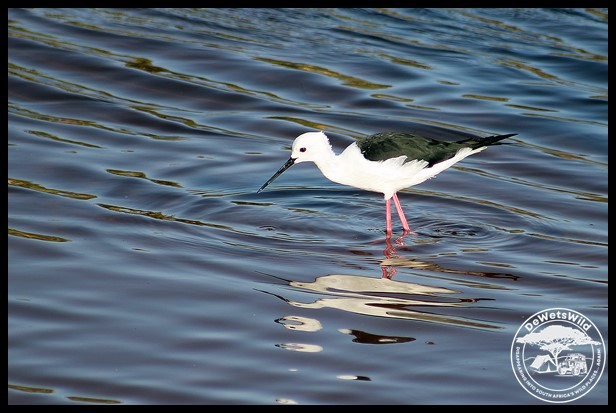
Himantopus himantopus
The very elegant Black-winged Stilt is one of the most widespread birds on the planet, occurring on every continent except Antarctica (though some authorities consider it to actually be as many as five different species). As a result it is listed as being of least concern by the IUCN. It is also widely distributed over all of South Africa, even occurring in the arid west of the country where its habitat requirements are met – basically any open wetland habitat, whether fresh or brackish, natural or man-made (even sewerage plants and salt works), is to their liking. They are nomadic birds, regularly moving from one body of water to the next. As is probably to be expected, Black-winged Stilts feed on aquatic invertebrates, tadpoles, frogs, small fish and fish- and frog-eggs.
Pairs of Black-winged Stilts are monogamous and usually nest alone, though occasionally up to 10 pairs may nest in close proximity. Their nests are mounds of mud and plantmaterial built by both partners at the edge of the water. They breed at anytime of year, but there’s a distinct peak in nesting behaviour in the spring months in our part of the world. The female is responsible for incubating the clutch of up to 5 eggs for almost 4 weeks. The chicks leave the nest within 24 hours of hatching to follow the parents around and feed themselves. By the age of a month they start flying and become fully independent by the time they are two months old. Black-winged Stilts are active both by day and during the night.
With probably the longest legs in relation to its body of any bird, adult Black-winged Stilts weigh in at about 165g and measure 38cm from tip-to-tip.


 DeWetsWild
Well it took ‘forever’ to view the images and find time to reply! This stilt is indeed much like our ‘Black-necked Stilt’ —- I sometimes think that a studio full of eccentric artists were given the tasks, “Paint these white bird forms any way you’d like.. It’s a competition, and there are thousands of species and thousands of variants…” And the artists have a blast – some keeping with black and white, some adding whimsical touches of color, and others, trying to test the vieweers to see ‘what’s different between the two images?’ (as in the tanagers)
Here’s an old image of the Black-necked stilt in coastal Ecuador:
https://playamart.files.wordpress.com/2014/06/p6030254-stilt-egret.jpg?w=700&h=
They’re such beautiful and graceful birds, Lisa, and the fanciful way you describe them really is so fitting!
Thanks for the link to your picture of Ecuador’s black-necked stilt – he certainly looks dressed to the nines for any formal affair!
They are such graceful birds. I liked the photo where one of its legs is drawn farther back and its bill is near the water. I did a drawing of our black-necked stilts many years ago.
Thank you, Siobhan. Did you share your drawing on your blog? I’d love to see it.
You’re welcome! I haven’t shared it yet. My new scanner/printer is coming soon.
Something wonderful to look forward to!
These are all such lovely photos of the stilts so busily yet so elegantly foraging. The header image is particularly striking – perfect timing!
Very kind of you, Carol – thank you!
Hello Dries!
The Black-winged stilt has a home here in Japan too! They look so elegant with their long legs, I always feel envious 🙂 Very happy to see them through your photos.
Thank you dear Takami!
Glo nie ej het hulle al hier by ons gesien nie!
Dit is verbasend, Aletta, gegewe hoe lief die verskillende waadvoels vir die Langebaan-strandmeer is. Ek hoop een of twee van hierdie langbeen-modelle maak gou n verskyning vir jou.
Ek sal moet gaan soek!
Klink na n goeie plan!
👍
All great shots but I love the reflection. 😊💙
Thank you very much, Irene!
My pleasure. 😊
A few pairs have started breeding in the UK in the past couple of years, an upside of global warming!
That is a welcome boon! The flipside of the coin though being that some other kinds of birds probably now find the UK too warm and move ever further northwards?
And those at the very north will have no place to go this will include insects and plants 😥
A sad reality indeed
I haven’t seen one of these birds in a while – they are beautiful and so elegant.
They’re always a treat to find, Anne.
Beautiful photos of a beautiful bird! In North America, as H.J. commented above, we have the Black-necked Stilt which looks very similar.
Thank you, Hien. They’re quite elegant birds, whether Black-winged or Black-necked.
Fabulous photo, never see this one here!
Thank you, Rudi. Perhaps another kind of Stilt is at home in your country?
I love these guys and we have lots of them at the Preserve. 🙂 Those legs are just amazing.
janet
Great to hear of them flourishing in your part of the world too, Janet!
We have the Black-necked Stilt that must be related to the Black-winged one. Lovely long legged bird, it yips like a little puppy dog. Great post, D. 🙂
Very interesting, thanks H.J, and I agree it is a most beautiful bird. It seems the Black-necked is one of the Stilts various authorities consider a subspecies of the Black-winged, while others raise it to full species status.