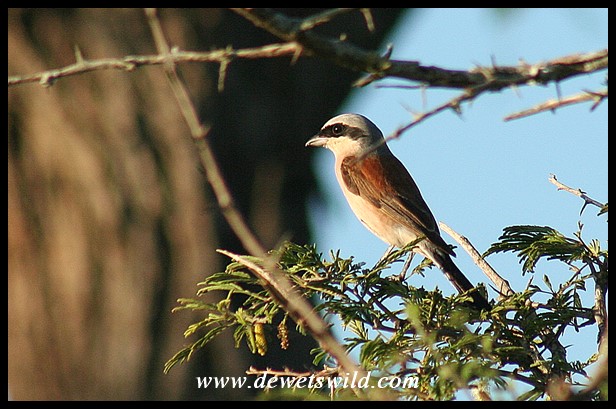
Lanius collurio
Red-backed Shrikes visit South Africa in our summer months, arriving from late October with the last individuals leaving again by April. While here, they can be seen in all our provinces, though they’re much more common on the eastern side of the country than the arid west. Apart from South Africa, they also spend their non-breeding season over much of the rest of southern, central and eastern Africa, departing back to their northern breeding grounds in Europe and Asia with the onset of warmer weather there. The IUCN considers this species to be of least concern, estimating a total population of at least 24-million.
In our southern climes the Red-backed Shrike inhabits more open habitats ranging from open scrublands and grassveld to a variety of savanna and woodland associations. They are mainly insectivorous in their diet, though they will also prey on smaller birds, rodents and lizards if the opportunity presents itself. Such larger prey is often impaled on a thorn or barbed wire, which is why the Red-backed Shrike (like several others of its family) are also known as “butcher birds”.
Males are more conspicuous than females thanks to their more colourful plumage and preference for more open areas. Adults measure about 18cm in length.


 DeWetsWild
They are very attractive birds. Lovely photos, Dries. ‘Butcher bird’ sounds like a gangster.
Thanks Sylvia. Their gangster name fits their dominating personalities perfectly!
Hello Dries,
These are a different type of Shrike from Japan, so what a treat to see them and learn something new! I love the “war paint” – very effective 🙂
Hope you and your family continue to take care and stay safe.
So glad we could introduce you to our Red-backed Shrike, Takami!
We’re fine thank you and I hope you can say the same?
I always look forward to learning more about the beautiful wildlife of your country through your posts 🙂 I am very happy to hear you are well, and we are too!
That is good news!
Another beautiful shrike! Lucky you. 🙂
We do have more than our fair share of shrikes here in South Africa it seems, Siobhan – must be our multitude of creepy-crawlies that keeps them fed!
In some nature reserves they are among the most conspicuous of birds as they perch alone prominent on shrubby bushes. (Even after many years, I remember how triumphant I felt after battling to first identify them and finally managing to figure it out!)
Indeed, Carol – especially the males like showing themselves off!
And I know that feeling of finally being able to tell one species apart from another – I still get it from time-to-time with the “lbj’s”
Such an attractive bird, Dries.
Agreed Tracy!
I am always fascinated by the patience you must have to gather these galleries of bird images. Thanks for taking the time to share them with us.
Thank you very much, John! Blogging provides an excellent opportunity to “catalogue” all the pictures we’ve collected over many years of visits to South Africa’s wild places.
Love to see these Shrikes. They used to breed in the UK when I was a kid now they are scarce spring & autumn vagrants.
That’s not a comforting thought at all, Brian. I’ve read about other birds that have been wiped out of the British Isles that are starting to make a comeback – I hope soon this one will be among those.
Meanwhile, one of the Common Fiscals in our garden is making friends with me – a future post in the making. I have enjoyed seeing these photographs – the heimwee for places of the wild is growing.
Hopefully not long before your turn to visit Mountain Zebra NP, Anne?
Looking forward to hearing more about your escapades with your new friend too!
It’s a good looking bird. We have the Loggerhead Shrike (lands ludovicianus) that resembles your shrike except the red colored back. This one has the same methods of impaling their preys in thorns. Great shots and post, D. 🙂
Thank you, H.J. The shrikes are fascinating birds, don’t you think?
The black around the eye is quite striking.
janet
Shrike war-paint!
😉