
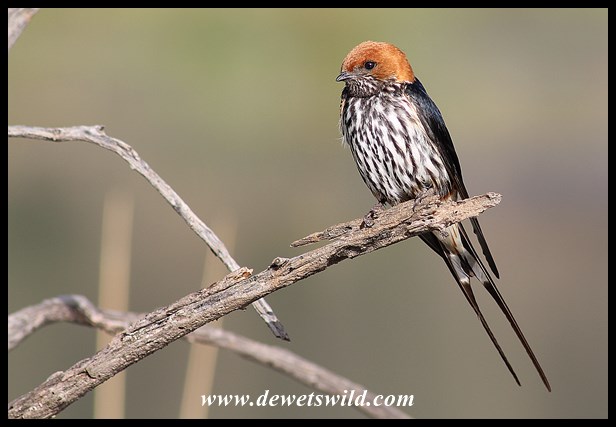
Cecropis abyssinica
One of the most abundant swallows in Africa, the Lesser Striped Swallow visits most of South Africa during our warmer months (though some birds remain year-round in the warmer Lowveld and northern reaches of Kwazulu-Natal). The majority of the local population arrives from July and August and head back northwards between February and May.
The Lesser Striped Swallow is a bird of mesic woodlands and savannas, often being seen close to open water, but have adapted to cultivated land and thrives in urbanised environments. Insects and other invertebrates, caught on the wing, make up the majority of their food intake though they will also settle on branches to feed on seeds and small berries on occasion.
Lesser Striped Swallows construct bowl-shaped nests of mud under rock overhangs, horizontal branches, culverts, bridges and the eaves of roofs. These nests are often used for several consecutive years, and not always by the same pair of birds. Pairs are monogamous. Their breeding season stretch over several months from early spring to autumn. Clutches of 2-4 eggs are incubated by the female for 3 weeks. While the hatchlings start flying when they’re less than 3 weeks old, they still remain dependent on their parents for the shelter of their nest and food for about a month after taking to the air for the first time.
Although it is only a summer visitor to most of South Africa, where it can be commonly seen in all provinces with the exception of the Free State, Western and Northern Cape, the Lesser Striped Swallow has a wide distribution over most of Sub-Saharan Africa and is considered to be of least concern by the IUCN, which also states that their populations are growing.
Lesser Striped Swallows often occur alongside the Greater Striped Swallow with which it can easily be confused.


 DeWetsWild
Thank you for this info. I’m deeply disappointed by a member of our local bird sanctuary who advised me to break down the nest each year because they are “territorial”. This year I see them, but they are not building a nest where it was. i wish I googled it instead of just trusting them.
I hope that your pair, or another, will eventually return to your home, Marise, when they feel their nest will be safe there again. It sounds as if they brought you real joy and it is a pity that you were given such destructive advise.
We have a pair of lesser stripped swallo it back ws nesting under our roof. We stay in Parys in the Free State. We have 1 of the babies that keeps jumping out of the nest. I put it back only to have one jumping out again. It has been extremely uhot here. They are still too small to fly. They are fully fledged.
Sounds like their first attempts at flight is giving you grey hair and nightmares, Michael. Pat yourself on the back for the fact that their parents thought your home is a good place to raise a family!
I have a pair of lesser striped swallow that visits me every September/ October from the year 2020. I reside in Kzn Queensburgh area. I have plenty pictures of them even videos of them interacting with me. Life’s precious moments IL always treasure
You are blessed to have such a positive experience with these birds, Bethel!
Lovely photos of this endearing (and hard to photograph) swallow. I particularly like the photo of the two gathering mud. They have such a cute and cheering call that I still associate with pairs nesting under the eaves of the huts at Mkhuze rest camp from holidays there when I was a child.
You are so right, Carol – uMkhuze’s Mantuma Camp is an excellent place to see Lesser Striped Swallows in summer! Now I am imaging munching on a burger bought at the little Rhino-Dine-O while a mixed herd of nyala and impala move through the camp. Bliss.
You conjure up great memories.
Recent news about Ezemvelo is not that encouraging, sadly.
I’m trusting that, despite the shenanigans in the boardroom at Ezemvelo, the dedication and hard work of the “foot soldiers” on the ground in the reserves will carry the organisation through.
I sincerely hope so too. The KZN reserves are absolute treasures.
i like swallows. It’s that interesting tail.
I also think the connotation between swallows and warmer weather endears them in our minds!
What a striking bird! The silhouette in flight looks like our barn swallow.
They do fit that typical swallow “mould”, don’t they Siobhan?
Dis die mooiste van al die swaeltjies. Pragtige foto’s weereens, Dries!
Baie gaaf van jou, danke Dina, en ek stem saam dat hulle pragtig is!
So cute! I’m wondering though – many birds have curious names. Is this bird lesser striped (as opposed to greater striped) smaller than its counterpart? Does it actually have fewer stripes? I clicked on the link you provided and could not see much difference between the two in terms of stripes, but the greater striped seem a lot fatter.
You are spot on! The “Greater” is buffer in appearance and slightly larger in all dimensions that the “Lesser”, though you’d really have to have both of them sit together to do the comparison. For me, the easiest ID feature is that the Lesser has a far bigger part of the head covered by the rufous colouration than does the Greater.
Very, very beautiful!
I’ll pass your words of adoration to the next Lesser Striped Swallow I see, Ann-Christine!
Please do!
Love the color combinations on these birds. They’re quite distinctive!
Indeed their plumage is something to be proud of, though easily confused with the related Greater Striped Swallow when not giving a clear view.
What an attractive fellow!
janet
Most definitely, Janet!
Lovely photos! One of the most handsome swallows in my opinion. They don’t come as far south as Mossel Bay where we have been since lockdown began, but I did see its Greater Striped Swallow cousin last week so summer is around the corner!
It really is wonderful news that the swallows have returned, Don, though they must’ve rued their return when that cold front hit earlier in the week!
Ours have not arrived yet – I keep a close watch out for them. Mind you, we have been experiencing icy temperatures lately.
We also had two terribly cold days yesterday and Wednesday, but thankfully it passed quickly. This really was the coldest winter I can remember for a long time and definitely the coldest I’ve experienced since moving to Pretoria at the end of 2006.
I have two nests om my veranda, and one by my bedroom window, sheer and utter joy every year when the families return. It was a celebration when we heard them last week.
Ag dis wonderlik! Now we can celebrate that spring is here!!!
That’s a very handsome swallow, probably very fast when flying.
Indeed, Hien – little fighter jets on the wing and no flying insect that crosses their path has any hope of evading capture.
Love all the photos of these lovely birds that you have in South Africa! Thanks for sharing them.
We love sharing them with appreciative nature lovers like yourself, Anne!
This is definitely the most beautiful swallow I’ve ever seen! I kid you not! Great shots too! Thank you, D. 🙂
Thank you, H.J. I absolutely agree that they’re beautiful birds.
Pretty little one!
Aren’t they just, Lois!?