
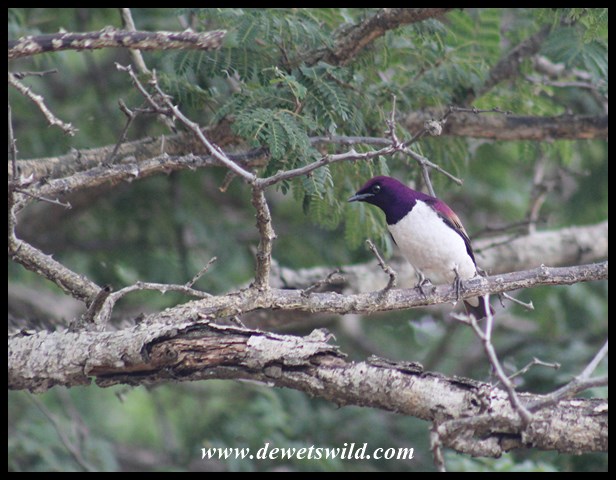
Cinnyricinclus leucogaster
Violet-backed Starlings occur throughout much of sub-Saharan Africa, migrating to South Africa to breed from October to April and they can then be found in Kwazulu Natal, Mpumalanga, Limpopo, Gauteng and North West Province. They inhabit savannas, various kinds of woodland habitats, and gardens, feeding on fruit and insects.
The Violet-backed Starling is one of the smaller members of its family, growing to about 18cm in length and weighing around 45g. The males and females are so dimorphic that they may easily be confused for two different species.
Usually seen in monogamous pairs, or small flocks (fewer than 20 birds) at the end of the breeding season before starting their migration back northwards, Violet-backed Starlings breed in holes in trees or fence posts. The female is singly responsible for the incubation of the clutch of 2-4 eggs over a 2 week period, though the male takes an active role in feeding the chicks until they fledge about 3 weeks after hatching.
The IUCN lists the Violet-backed Starling as being of least concern, though it does note that their populations may be declining due to habitat degradation.


 DeWetsWild
Such a fabulous colour the males have. I still refer to them as plum-coloured starlings, but I am learning 🙂 Surprisingly we have had these starlings visit our garden, only a few times over the years and only fleetingly.
I don’t blame you, Carol; despite the name changes having occurred 15 or so years ago a thick-knee still looks like a dikkop to me…
Given the vast numbers in which summer migrants appear here in our summer I always thought of this particular species as being rather under-represented numerically. Perhaps it is because the females are so easy to overlook or mistake for something else at first glance; but then the males stand out so beautifully and almost can’t be missed (though I also find them rather shy).
Its funny how we like to hold on to the old familiar names, especially those that are so descriptive.
You make an interesting point about it being easy to overlook or misidentify the females and so perhaps not have an accurate picture of these starlings being around or not.
The male’s violet feathers are just amazing and so unusual! Does Africa have more ‘purple’ birds than other parts of the world?!! Thinking of the beautiful Lilac-breasted Roller, too. 😉
We’re certainly blessed with lots of beautifully coloured birds at this end of the continent!
Pragtige kleur! Hulle kom nie hier by ons voor nie.
Sekerlik van ons kleurvolste akkedisse, Aletta
Beautiful color!
Very flashy in real life, Robert!
You have taken some lovely photographs of these very beautiful birds. I shall have to travel north again when time permits.
Thanks Anne!
It is my understanding that the males get the bright colors in order to look good and attract a female. The females are plainer so they will not be so noticeable when on the nest with their young. These males have a marvelous color.
You are spot on, Anne. The female’s drabber colouration is excellent camouflage and as she is responsible for the incubation of the eggs her survival is paramount.
So, why do the males get the fancy colours and not the females? What a gorgeous bird. 😍
He’s got to look good for his lady, otherwise she dumps him for someone else! 😀
What great colors!
janet
Oh definitely, Janet!