
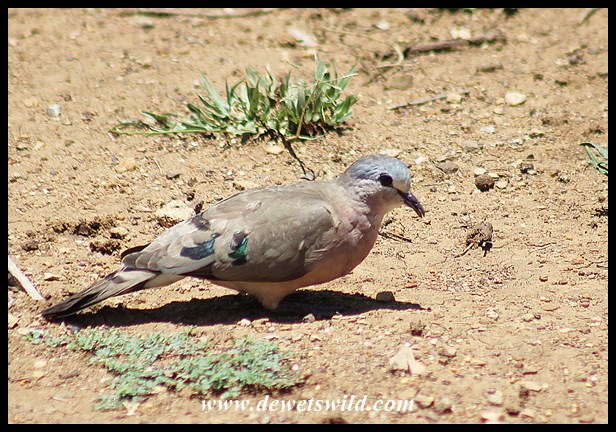
Turtur chalcospilos
The Emerald-spotted Wood Dove is a well-loved and common resident of many of South Africa’s better known nature reserves and national parks, where its melancholy call is often heard. They occur from the Eastern Cape to the North West Province, through Kwazulu-Natal, Mpumalanga, Limpopo and Gauteng, and widely through central and east Africa. The Emerald-spotted Wood Dove inhabits woodland, thickets and savannas. They feed mainly on grass- and other kinds of seeds, but will also peck at fallen fruit and invertebrates.
Emerald-spotted Wood Doves are usually encountered singly or in monogamous pairs, very rarely forming larger aggregations. Typically, clutches of 2 eggs are incubated by both parents over a 2 week period in a flimsy stick nest built in a tree or tall shrub. The chicks grow quickly and fledge about two weeks after hatching. They breed throughout the year, with a distinct peak in spring and summer. Adults are about 20cm long and weigh around 64g.
The IUCN lists the Emerald-spotted Wood Dove as being of least concern.


 DeWetsWild
thank you for the info of the emerald slotted wood dove. I love his soft cooing sound..so calming and they are really beautiful.
One of our favourite bushveld birds as well, Louise!
I also love the call – so haunting and penetrating. Lovely to see them too and the flashes of the auburn flight feathers as they spread their wings when flying. They always seem to be such busy little birds!
Our bushveld reserves would be so much poorer without these little doves.
Such lovely birds, Dries. I love the emerald green bars. Very fancy indeed. 😍
Always nice to see them, though it’s mostly a glimpse as they fly off!
They look so ordinary and then that pop of color!
janet
In real life you’d really appreciate those metallic green spots, Janet!
I would.
Love the emerald spots, very pretty dove.
So pretty and yet so shy to show off!
You have managed to capture the emerald spots so well. These are delightful birds: I hear them more than see them at Addo and have occasionally even heard them around Grahamstown.
Thank you very much, Anne.
This is another of those more commonly seen species (especially in the bushveld reserves further north) that I just didn’t seem to have many photos of – when I realised that and actively tried to photograph them I quickly learned that it’s not that easy; they might be often seen, but rarely wait around for a photo once they realise they have been spotted.
Lovely bird and delicately elegant.
Nodding in agreement this side, Anne
I love their muted colors. Such a pretty bird.
To me its their demure song that has me enchanted, Lois