
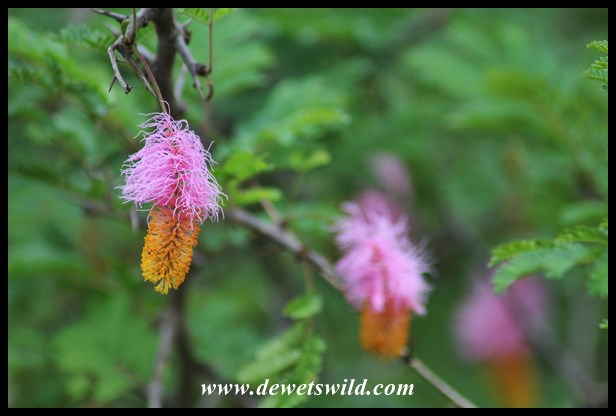
Dichrostachys cinerea
The Sickle Bush is a hardy, thorny shrub or small tree (maximum 7m high) occurring in the savanna habitats of South Africa’s Kwazulu-Natal, Mpumalanga, Limpopo, Gauteng and Northwest Provinces. In overgrazed areas the Sickle Bush quickly form dense thickets and as such can be problematic to farming communities, despite the leaves and pods being excellent fodder for game and small stock, and therefore regular clearing of such invasive thickets yield much sought-after firewood. It is considered to be of least concern by the IUCN. Apart from South Africa it occurs naturally over the rest of sub-Saharan Africa, the Middle East, the Indian subcontinent, South Asia and Australia, and has been introduced to the Caribbean and parts of North America.
The beautiful flowers are borne during summer, explaining where this plant gets its alternative local name of “Kalahari Christmas Tree” from. Apart from being used as fodder or firewood, or fashioned into small implements or fence posts, the roots, bark and leaves of the Sickle Bush is also used in traditional medicines. The species is also ideally suited to be made into attractive bonsai.


 DeWetsWild
Your photos capture the fragile prettiness of the flowers beautifully.
Thank you very much, Carol!
I love the colorful blooms!
Our very special Christmas decorations!
Ek ken die boom glad nie Dries! Dis regtig pragtig!
Kyk uit vir die Sekelbos wanneer julle weer Wildtuin toe gaan, Aletta!
Ek sal beslis!
Interessant dankie
Dankie Tina!
Pingback: THERE’S SOMETHING ABOUT TREES – Something Over Tea
What pretty flowers they have! Too bad they’re so invasive.
Sadly it’s incorrect veld management practices, such as overgrazing, that allows the sickle bush to proliferate out of control.
We have similar issues here. Some of our invasives take over and, unfortunately, help spread wildfires. 😦
We used to call the flowers Christmas Bells when I was very young.
Such a lovely and apt description, Anne!
You will see I have directed my readers to your photographs of the flowers. I do not have any, although my memory of them is very clear!
That is very kind of you, thank you Anne!
Those really are beautiful.
Always a cheerful sight for us
The flowers are attractive, Dries. Are the thickets dry enough to be firewood right away?
You have to wait quite a few weeks for the cleared wood to be dry enough for use as firewood Miriam, but it is worth the wait.
Die blommetjies is altyd mooi maar ai die bosse is maar moeilik om te beheer, alhoewel ek dink daar is nie meer baie oor weens die afkap en gebruik vir vuurmaak hout.
Nee wat, Ineke, jy hoef nie daaroor bekommerd te wees nie en die teendeel is waarskynlik waar – hoe meer en wyer die veld oorbenut word, hoe sneller verdig die sekelbosse.
Dis ook weer waar. Ek het gesien in die Bosveld is dit reeds n verpesting. Net gedink dis brandhout wat uitgekap kan word.
Love their twisted and knotted seed pods!
They’re very decorative!
Die blommetjies is so mooi…lyk soos bottelborsels.
Die Kalahari Kersboom verdien beslis sy naam!
So pretty, Dries. It would make a beautiful bonsai.
An attractive plant and obviously useful, if invasive.
janet
Absolutely, Janet, and proof again just how delicate the natural balance is.