
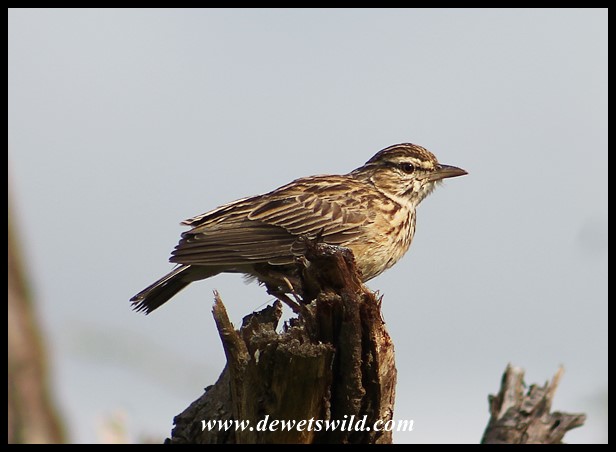
Calendulauda sabota
The Sabota Lark is a common inhabitant of dry, open grasslands, savannas and scrublands, one of our most numerous larks. They feed on seeds and insects, and is apparently not dependent on a regular water supply. They love calling from a high vantage point, such as a treetop or pole, and mimicking the songs of other birds. It occurs only in parts of South Africa, Swaziland, Namibia, Botswana, Zimbabwe, Mozambique and Angola. The IUCN lists it as being of Least Concern.
Normally seen singly, in monogamous pairs or small family groups, Sabota Larks breed during spring and summer. Their cup-shaped nests are usually built low to the ground, hidden amongs rocks or dense, thorny vegetation. Adult Sabota Larks weigh about 23g, attaining a total length of about 14cm.


 DeWetsWild
What an amazing songster. So non descriptive in looks but what a mimic. I listened to the recording in awe! That recordist knows his birds!
I know, right! I tried to identify some of the mimicked calls he lists, but got stumped most of the time. What the Sabota Lark lacks in colourful plumage it definitely makes up for in repertoire!
Cute and I bet the sound is very cheerful.
janet
Most definitely, Janet – they’re quite talented!
This is one of my favourite larks, just about always announcing their presence with cheerful song from the top of a bush or tree – nice photos!
Thanks, Don! If you don’t mind me asking, as a more experienced birder, do you also still find the Larks, Pipits etc a challenge to identify?
Dries, they never stop being a challenge! But I find I can ID most of the LBJ’s that I encounter after years of learning their characteristics, calls, habitat, behaviour, etc. Pipits remain a major challenge but I follow the rule “if in doubt, it’s probably an African Pipit”. Faansie Peacock’s excellent guide on LBJ’s is a must have reference book if you want to make progress on ID’ing these tricky birds
Thanks very much for the tip, Don! We already have two of Faansie’s books in our collection and it seems we need to add a third.
There are only two larks I can identify – this one and the rufus-naped (cos of its distinctive song)! Your photos are great – I love their subtle markings and attitude too.
Thanks very much, Carol – I am glad I’m not the only one finding these LBJ’s so tricky to identify!
Oh but I am always so impressed by your wide knowledge of such a variety of birds including the LBJs (not to mention insects too)!
Kind as always, thanks Carol!
🙂
Beautiful!
I agree, Shayleene – in their own subtle way.
This is a new one for me!
Glad we could introduce you to the Sabota Lark!
I have still not got the identification of larks under control. These photographs make me feel “How could you miss this one?” – until the next lark comes along!
The Larks, pipits, cisticolas and warblers have me thoroughly confused too, Anne. Thankfully the conspicuous white brow and streaking on the their chest makes the Sabota Lark easier to tick.