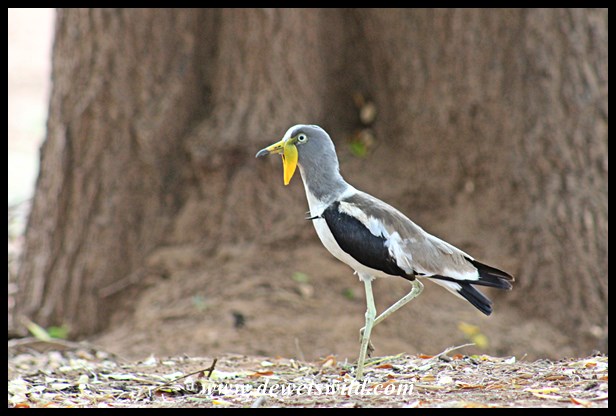
Vanellus albiceps
White-crowned Lapwings are usually seen on the sandy or muddy banks and islands of large rivers and other natural waterbodies, searching for invertebrates and occasionally small frogs and fish to feed on. Adults weigh approximately 190g and measure around 30cm in length.
Outside of the breeding season White-crowned Lapwings congregate in groups of up to 30, though more usually numbering 6-12, but during the dry-season breeding period they are to be found in highly territorial pairs. The nest is a scrape or the footprint of a large mammal in the sand, vigorously defended against any bird or animal that ventures too close. Clutches consist of 2 or 3 eggs.
In South Africa the White-crowned Lapwing occurs only in the Lowveld and Limpopo Valley and is considered rare and threatened by diminishing river flows – there’s only about 90 pairs in total along the Limpopo, Luvuvhu, Olifants and Sabie Rivers in the Kruger National Park. North of our borders they are found patchily in parts of southern and eastern Africa, with the majority of the population occurring in central and west Africa. It is listed as being of least concern by the IUCN.


 DeWetsWild
Beautiful photos. I love nature and have a pair of binoculars at the window, just in case!
Thanks, Susie! That sounds very familiar – my camera’s also somewhere close at hand most of the time.
Such remarkable birds and I enjoyed seeing them through your photos. We will look out for them on our visit to Kruger next year. Sad to learn about another species adversely affected by our fraught river systems.
Thanks, Carol!
We found the low-level bridge across the Olifants at Balule, and the whole of the S63-road along the Luvuvhu River, to be excellent spots to see White-crowned Lapwings.
Thanks for the info – will keep a note of that.
I am pleased you have had such good sightings of this lovely bird.
Thanks Anne – we’ve been really lucky with our sightings of them of late.
What a striking bird! As always, I love learning new things here, and even more happy to see how the citizens take care of their wildlife 🙂 Best wishes to you and your family.
We’re so glad to know that you find something of interest here, Takami – thank you and best wishes to you all too!
i’ve not seen this bird before.
Not one that gets much airtime on the documentaries I’m afraid Gavin – sadly they focus on the more “charismatic” species and basically ignore the rest.
That’s a good looking bird. Is that a yellow wattle? Good shots! 🙂
Thanks H.J! Indeed, those oversized wattles are one of their most striking characteristics.
What a striking bird! Good pictures of them. I bet they would look good in black and white too.
Thanks, Siobhan! Pity those yellow wattles would loose their lustre in black-and-white though.
They are a unique feature!
Ir looks like quite a delicate little bird, although its breeding strategy seems rather fraught. I wonder about some of these IUCN listings. If they are based on in-country surveys commissioned by the home government, then that could really skew the results. For example, our environment departments and parks and wildlife services are massively under-funded and survey data is often not current.
Thankfully South Africa has a very passionate and dedicated citizen scientist community, Tracy – the Southern African Bird Atlas Project (SABAP2) being an excellent case in point, providing fantastic insights into the distribution and population dynamics of our birdlife that no government or agency would be able to collect otherwise.
Kudos to all those wonderful citizen scientists out there.
Amen to that!
So jammer dat die voëls so verminder weens skaarste van veral nattigheid/water. Paar mooi fotos wat jy geneem het.
Dit is beslis so, Ineke, en in die meerderheid van gevalle is dit mense se skuld dat die water opdroog.
Beslis! hier is bv ook die besoedeling van water ook die oorbeweiding van velde langs riviere. Nou wil hul dit omkeer en weiding weg te hou maar probleem bly daar is te veel beeste op te klein stukkies veld. Ai die mens is ook maar ïnhalig”. Hoe kan dit ook anders, daar moet voorsien word in vleis en melk vir mense en natuur moet maar terugstaan.
Ons sal moet afskaal voor die hele sisteem in duie stort…
Eintlik is dit bietjie laat. Hier kap hul bome af eb plante weer aan. Dis egter seker 20 jaar se boomgroei wat verwyder word. Ek raak sommer benoud as ek net daaraan dink. Die veld word opgewei en bome word afgekap!