
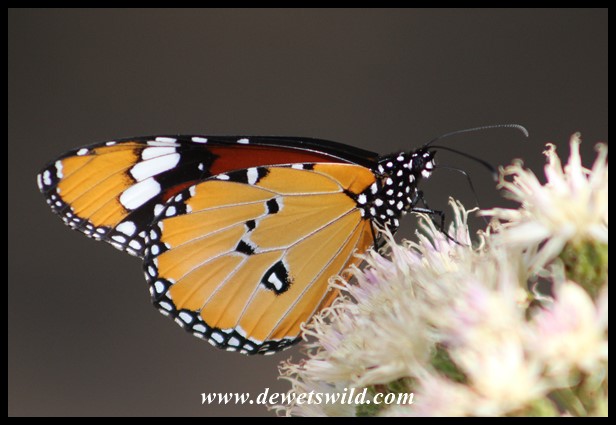
Danaus chrysippus orientis
The African Monarch is one of our most commonly seen butterflies, flying throughout the year and occurring in every corner of our country. Furthermore they’re widespread over the rest of Africa, the Indian Ocean islands, large tracts of Asia and Australia, where they are known as the “Plain Tiger”. These butterflies prefer more open habitats, are regularly seen in parks and gardens, and fly rather slowly, settling often on flowers or wilted plants.
Females lay eggs singly on their favourite larval food plants from the Milkweed family (especially the genuses Asclepias, Ceropegia, Stapelia and Huernia). Their metamorphosis from egg to butterfly takes from 4 to 6 weeks depending on the local climate. Adults are medium-sized butterflies, with a wingspan of between 5 and 8cm, and feed on nectar and alkaloids from damaged or dying plants. Their colouration serves as warning to predators that this butterfly is foul-tasting (likely resulting from their feeding on milkweeds as larvae), and as a result several other kinds of more palatable butterflies mimic the same colours and patterns. They live for up to two weeks in their adult form.


 DeWetsWild
Pingback: Wildlife Wednesday – Monarch Munching | Ouch!! My back hurts!!
WoW Dries, you’ve taught me something new, again!
I really didn’t know that Africa (and surrounds) had it’s own Monarch! So, maybe the monarchs we saw in New Your weren’t the first one we’ve seen! Maybe I’ve seen them back in SA!
I sometimes wonder just how unpalatable these brightly marked insects are. When we spotted our first Monarch in New your it landed on a buddleia butterfly bush… shared by a beauty of a praying mantis, who was munching on something. On later inspection of photos we realised the mantis was eating a monarch abdomen. We actually found a monarch wing close by… seemingly from the very butterfly the mantis was eating!! I think I will have to do another post about our finds in NYC, thanks to your share of the African Monarch!👍😃
You would definitely have seen our African Monarchs here in SA, AJ – they’re one of the most commonly seen butterflies we have.
Interesting observation about the mantis eating a monarch – perhaps the North American species is all show and no action!
It was really nice to study the differences between ‘your’ monarchs and ours here in Ecuador. It’s really interesting how so many species have close cousins in other areas of the world, and the monarch – and its food sources – are in that category.
I remain quite quiet while loading pages then reading off line at home. Perhaps next month there will be an option for internet at the apartment. There’s light at the end of the tunnel – great light!
I find the distribution of the different species and families so interesting, Lisa. Wondering how the patterns we see today were influenced by things like continental drift, etc.
You are always most welcome here, and it’s good news that we might see you around more often soon!
Lovely! http://robertsnapspot.com/2018/12/01/wing-it/
Thanks Robert!
Yep, I remember gawking at that beautiful Fritillary butterfly you showcased!
Such delicate beauties!
Delicate but no delicassy! 😉
Good one! 😄
I didn’t know how little I know about butterflies. We have monarchs here in North Dakota, obviously. I wonder how different they are from the variety you feature here.
Your Monarchs are actually a different but very closely related species to ours, John.
I have loved these little creatures for many years. Once upon a time there was a website called “Things that Fly” that featured these lovelies, but the website disappeared for seemingly no reason. I have spent years trying to find it again, but to no avail. I remember the migration of Monarchs from the USA to Mexico and how that cutting one type of tree they used as a resting place seemed to almost annihilate them for the western world. Sigh.
It’s scary just how easily we humans can destroy the natural environment around us.
Beautiful pictures all!
Thank you very much, Anne!
Pragtig!!!
Dartelende dames so tussen die blommetjies
🦋🥀🦋
Pragtig. Snaaks ek het nog nie veel gesien nie. Die swan plants waarop hul wurms/ruspes voed het almal nog blare. Ek dink dis seker die koue wat hul nog terughou. Nou as ek terugdink aan my hoërskool jare het ek nogal van hul gevang en skooltoe gevat om te ontleed vir biologie. Het hul nie n sterk reuk wat voëls afskrik nie. Ek verbeel my al dat ek onthou hul het nogal gestink as mens dit so kan noem.
Jy’s heeltemal reg, Ineke, en hulle proe net so aaklig as wat hul van naby ruik – dis juis om roofdiere af te sit.
Ha, het soiets vermoed.
Beautiful!
Undeniably!
In South Australia they’re called Monarchs or Brown Wanderers. Beautiful butterflies.
Amazing that an animal so dainty is so widely distributed over the globe!
The clusters of them on the trees when they winter in South America are mind blowing.
One of nature’s true marvels
Dankie weereens vir mooi foto’s en inligting, Dries!
Bly om te weet jy’t dit so geniet, dankie Dina!
They look very similar to the monarchs of the West. Pretty butterflies. 🙂
Indeed a very closely related cousin, H.J.
Such beautiful creature!
We agree wholeheartedly, Montucky!
majestic
They’re certainly deserving of their name!
Absolutely gorgeous shots, Dries. 😍
Thank you very much, Sylvia!
Very cool! Eats milkweed too! Whoah! Love it.. 🧡
People tend not too think of the smaller fry as being as remarkable as the bigger animals that Africa is home to. Welcome here, Jeanne.
Oh but the delicacy.. thanks for sharing the beautiful photos.
The pleasure is all ours! We love sharing South Africa’s beautiful natural heritage with everyone we can.