
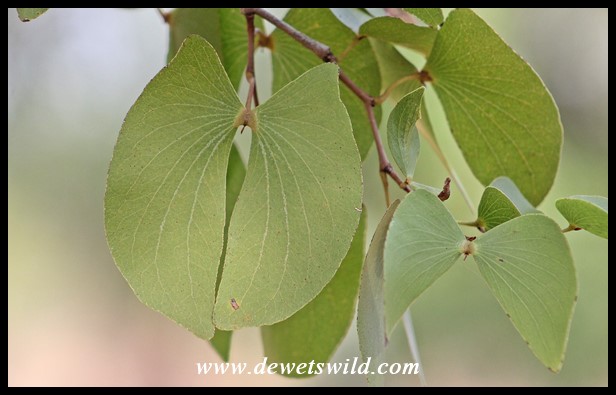
Colophospermum mopane
Anyone who has visited the northern Kruger National Park would be well acquainted with the Mopane, a tree that proliferates in hot, dry, low-lying areas. Apart from the Limpopo Valley and northern Lowveld in South Africa, the Mopane is mainly found south of the Kunene and Zambezi Rivers. In dry, shallow soils the Mopane grows as a short shrub, dominating the landscape, but in deep, damp alluvial soils they may grow to 30m tall, forming beautiful woodlands. The trees are a favourite for many browsing animals, with elephants especially being very fond of every part of the tree, including the rough bark.
Mopane wood is hard and termite resistant, making it sought-after as a building material, for fences and mining, railway sleepers and for making furniture. It is also one of the most widely used trees for fire-wood where it occurs. The Mopane is probably best known though as the food source for a uniquely African delicacy; the protein-rich Mopane Worm – more correctly the caterpillar of the Mopane Moth Gonimbrasia belina.


 DeWetsWild
What beautiful leaves!
Agreed!
I love the butterfly-shaped leaves. These photos are making me impatient for our trip to Kruger!
Thoughts of mopane has me longing for Kruger too, Carol! If all goes to plan we’ll be there again in a weeks time.
I am sure you will have a great time. I look forward to you sharing your photos.
A beautiful and useful tree indeed. I have eaten a Mopani worm and have the certificate to prove it. It was at The Boma, Lokotula Lodge, Victoria Falls in 2002😁
Good on you, Helen! I use the excuse that I don’t eat mopane worms for fear of upsetting the delicate mopane ecosystem… 😉
Good one 😁
Wonder hoe lyk die mot?
Dit is nogal n groot dog vaal mot, Tina. Self het ek nog nie n foto van een nie, maar hier is een op die wikipedia: mopane moth
Sal gaan kyk
Eerste keer Mopanie wurm geproe in Zimbabwe in 2010. Nie sleg nie en ook nie juis uitstaande nie!. Nooit gedink dat dit Mopanies het die blare wat jy hier wys nie. Nooit te oud om te leer nie!.
Het jy nog jou sertifikaat?
Natuurlik. Hy is ingeplak by al die fotos
Bly ek kon jou aan daardie spesiale ete se kos bekendstel, Ineke! 😀
Haha, dit was n belewenis. Sertifikaat is in my plakboek geplak.
I remember children at boarding school and some students at university delighting in receiving boxes of dried mopane worms in the mail. It is not a delicacy I am in a hurry to try 🙂
Neither me, Anne. Truth be told though I have a very “delicate” palate, and I think I would try mopane worms before I try shrimps, mussels, oysters, snails, octopus or sushi…
Baie interessante inligting! Iewers het ek ‘n ou, ou briefie wat op twee mopanieblare geskryf is…
Dit fassineer my, Tannie Frannie – weet jy dalk op welke manier die briefie-blare preserveer is dat hulle nie verbrokkel nie? Mopanie blare is gewoonlik so bros!
Het dit sommer net in ‘n album geplak en nou weet ek nie waar om te gaan soek om te sien of die blare verbrokkel het nie! In my hart is hulle nog vars en groen.
Ek hoop dit bly so!
GREAT BLOG AND LOVED THE PHOTOGRAPHS, CHINA
Thank you!
You show different view of South Africas nature then we in Europe is see in TV! You should have a international attention of your lovely work, Dries, and your family! I love people who care about the animal and nature!😊😊😊
So very kind of you, thank you John! Mopane trees are one of my favourite reminders of Kruger Park.
That’s quite a caterpillar. The front looks like some sort of machine.
janet
Your observation is spot-on, Janet; they’re little eating machines for sure!