
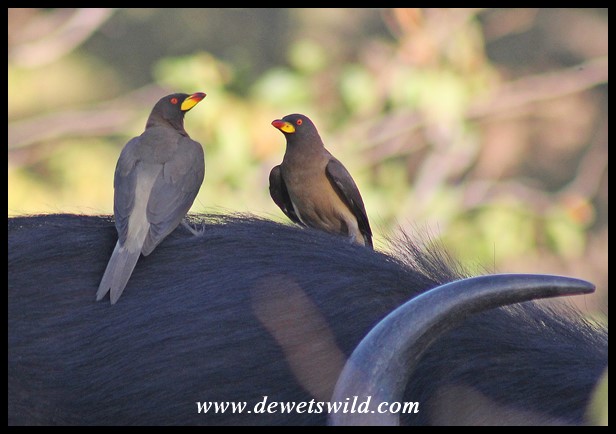
Buphagus africanus
Inhabiting savannas and open woodlands, most often near a reliable water source, Yellow-billed Oxpeckers are reliant on populations of large game (mainly buffalo, giraffe, black and white rhinos, hippos and large antelope) and untreated livestock from which they can glean the ticks and other ectoparasites on which they subsist. They will also feed on blood dripping from open wounds on their hosts, often hampering their healing and recovery.
Adult Yellow-billed Oxpeckers measure around 20cm in length, with a weight of about 60g. Pairs are monogamous and breed in holes in trees during spring and summer, raising clutches of 2-3 chicks, often with the help of immature birds from previous broods.
Exterminated from South Africa as a result of the rinderpest epidemic of the 1890’s, Yellow-billed Oxpeckers naturally recolonized the Kruger National Park from Zimbabwe only in the 1970’s. They were also introduced to Hluhluwe-Imfolozi Park in northern Kwazulu-Natal in the 1980’s but as they’re not being seen there any more this was probably not successful. Today they are still classified as Vulnerable in South Africa and the Lowveld remains the only reliable place to see the Yellow-billed Oxpecker in our country, though the IUCN lists the species as being of Least Concern overall, indicating a patchy distribution that spans much of southern, eastern, central and western Africa.


 DeWetsWild
We are always interested when we see the red-billed oxpeckers, but we have yet to see the yellow-billed. Lovely to see your photos, and it is amazing how well the birds are tolerated/appreciated by the buffaloes.
I will bet good money that you’ll be seeing them during your upcoming visit to northern Kruger, Carol – keep an eye out for them when you come across those big buffalo herds.
We definitely will – thanks.
I had not heard of rinderpest so followed your link and was stunned by the devastation it caused.
It must have been a time of horrible hardship for so much of this continent.
That header shot made me smile. Those two look as if they’re having a great conversation while sitting on their couch, which of course they are. 🙂
janet
And having a snack at the same time – makes me want to watch a movie! 😉
Fantastic photos, Dries. Just goes to prove that there’s a job for every living creature. 😅
Thanks, Sylvia! And that’s exactly the reason why we shouldn’t mess with ecosystems to the extent we do – we might wipe out something that’s essential to our own survival without us even knowing about it.
Lovely beak color on those birds. They fill an interesting niche – groomers of the great beasts.
I think the tolerance with which they’re accepted even into the most delicate nooks and crannies shows how much their service is appreciated
wow – those colourful bills are quite spectacular, however their tendency to drink the blood from dripping wounds gave me pause. It wouldn’t be so bad if it actually helped the poor animal heal. “Vampire” birds might have been a better description!
I suppose all of us have our dark side, don’t we? 😀
So skaars soos hoendertande! Ek onthou daar was ‘n jong man wat destyds dit sy missie gemaak het om hierdie voëls te bewaar. Hy is tragies oorlede in ‘n vliegongeluk. Ek kan nie meer sy naam onthou nie.
Pragtige foto’s, Dries!
Baie dankie, Dina. Gelukkig raak hulle ook volopper soos die buffeltroppe in die WIldtuin toeneem in getalle, en as mens geluk aan jou kant het kan jy hulle nou al regdeur die Laeveld te siene kry.
It is pleasing to note that the re-introduction of these birds in the Eastern Cape appears to have been successful. We have not only seen them in the Addo Elephant National Park but on the outskirts of our town too.
It’s good that they’re making a comeback, Anne, but I think the birds relocated to the Eastern Cape’s Addo and Mountain Zebra National Parks would be of the red-billed species.
You are quite correct: mea culpa.
It still is amazing that birds we wiped out of that area have made such a remarkable comeback!
I was so happy to see my first oficial Yellow-billed Oxpecker last year.
Always a special tick to add to your list!
These birds I have often seen in nature films, but not so close! Very beautiful birds!😊
They’re very interesting birds to watch, and would make a great documentary subject!
These birds are adorable–let me have a look inside your nostril!
Just shows you how much the animals appreciate their service – no way a buffalo would tolerate me poking around inside there! 😀